
Last updated: October 3, 2026
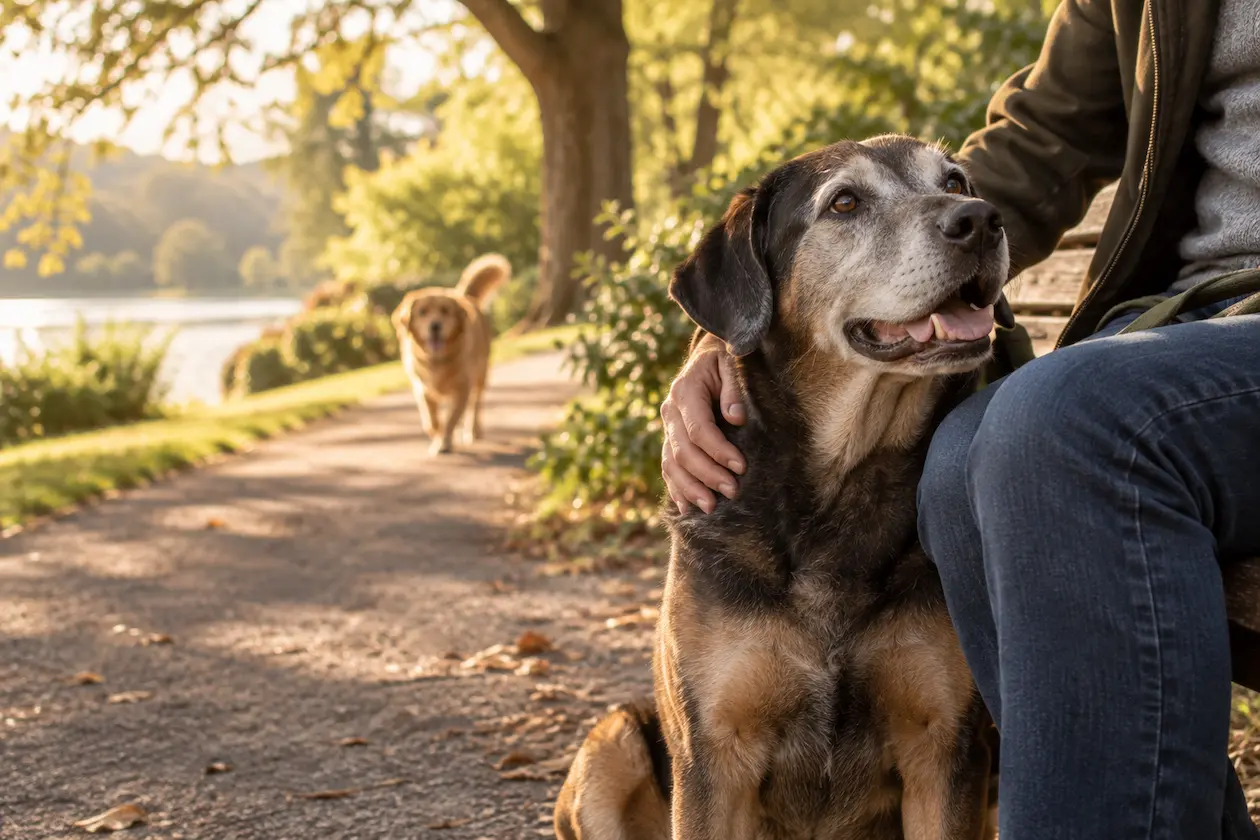
How To Use
This calculator converts your dog's age from dog years to human years using modern conversion formulas that account for size differences. The old "multiply by 7" rule is outdated and doesn't account for how different sized dogs age at different rates.
Quick Steps
- 1 Enter your Dog's Age in years.
- 2 Select your Dog's Size Category (small, medium, large, or giant).
- 3 Click the Calculate button to see the human age equivalent.
Dog Year Conversion
Fill Out The Fields Below
How to Use the Dog Year Conversion Calculator
This calculator converts your dog's age into human-equivalent years using size-adjusted formulas instead of the outdated "multiply by 7" shortcut. It only takes two inputs:
- Dog's age: Enter your dog's current age in years. If your dog is under a year old, you can use a decimal such as 0.5 for six months.
- Size category: Choose small, medium, large, or giant. Size is the single biggest factor in how quickly a dog ages after its first year, so this choice changes the result noticeably.
The result shows the human-age equivalent along with a short explanation of the formula used, so you can see exactly how the number was calculated rather than relying on a single blanket multiplier.
Dog Years to Human Years Conversion Chart
This chart shows approximate human-age equivalents by size category. Notice how the sizes start close together and then spread apart, because larger dogs age faster as they get older.
| Dog Age | Small | Medium | Large | Giant |
|---|---|---|---|---|
| 1 year | 15 | 15 | 14 | 12 |
| 2 years | 19 | 20 | 20 | 19 |
| 5 years | 31 | 35 | 38 | 40 |
| 8 years | 43 | 50 | 56 | 61 |
| 10 years | 51 | 60 | 68 | 75 |
| 13 years | 63 | 75 | 86 | 96 |
| 15 years | 71 | 85 | 98 | 110 |
Values are rounded estimates. Individual dogs vary with breed, genetics, and health, so treat these as a guide rather than an exact figure.
Why the "Multiply by 7" Rule Is Wrong
The idea that one dog year equals seven human years is a myth that has stuck around for decades. It is easy to remember, but it does not match how dogs actually develop:
- The first year is huge. A one-year-old dog is roughly a teenager, not a seven-year-old child. Dogs reach sexual and physical maturity far faster than the rule suggests.
- Aging is not linear. Dogs age quickly early in life and then slow down, so a flat multiplier over-ages young dogs and under-ages middle-aged ones.
- Size is ignored. A 6 lb toy breed and a 120 lb mastiff age at very different rates, yet the "times 7" rule treats them identically.
- Lifespan does not fit. Many small dogs live 15 to 16 years, which the old rule would translate to well over 100 human years, an unrealistic equivalence.
How Size Changes Dog Aging
After the first year, size becomes the dominant factor in aging. Larger dogs mature quickly but age faster overall and tend to have shorter lifespans, while smaller dogs age more gradually.
| Size Category | Typical Weight | First Year Equals | Each Year After |
|---|---|---|---|
| Small | Up to 20 lbs | 15 years | +4 years |
| Medium | 21–50 lbs | 15 years | +5 years |
| Large | 51–90 lbs | 14 years | +6 years |
| Giant | Over 90 lbs | 12 years | +7 years |
Worked Examples: Converting Dog Years
Seeing the math applied to real dogs makes the size effect clearer. Here are three examples worked step by step:
Example 1: A 5-year-old small dog
Start with 15 for the first year, then add 4 years for each of the next four years (4 × 4 = 16). Total: 15 + 16 = about 31 human years.
Example 2: An 8-year-old large dog
Start with 14 for the first year, then add 6 years for each of the next seven years (7 × 6 = 42). Total: 14 + 42 = about 56 human years.
Example 3: A 10-year-old giant dog
Start with 12 for the first year, then add 7 years for each of the next nine years (9 × 7 = 63). Total: 12 + 63 = about 75 human years, already firmly a senior.
Dog Life Stages by Human Age
Converting to human years is most useful when it tells you what life stage your dog is in, since that guides diet, exercise, and vet care.
- Puppy (0–1 year): Rapid growth and development, roughly a human infant through teenager. Focus on socialisation and puppy nutrition.
- Young adult (1–3 years): The human 20s. Full energy, physically mature, and settling into adult behaviour.
- Mature adult (3–6 years): The human 30s to 40s. A good time to watch weight and keep up preventive care.
- Senior (7+ years, sooner for large breeds): Roughly the human 50s and up. Consider senior diets, joint support, and more frequent checkups.
- Geriatric: The final stage, where comfort, mobility, and quality of life become the priority.
The Science Behind Dog Aging
Researchers have moved well beyond the "times 7" rule, and modern work shows aging is a more complex, non-linear process:
- Epigenetic clocks. A 2020 study proposed a formula based on DNA methylation, translating dog age to human age using a natural-logarithm curve rather than a flat multiplier.
- Front-loaded aging. That research and others confirm dogs age fastest in their early years, which is why the first year counts for so much.
- Size and lifespan link. Large and giant breeds consistently show shorter lifespans and earlier onset of age-related conditions than small breeds.
- Breed differences. Even within a size class, genetics can shift lifespan by years, so any conversion is an estimate for the average dog.
FAQs
Frequently Asked Questions
Why is the "multiply by 7" rule inaccurate?
The old rule doesn't account for size differences. Small dogs age more slowly after their first year (about 4 human years per dog year), while large dogs age faster (6-7 human years per dog year). Also, the first year of a dog's life represents much more development than 7 human years.
How does size affect dog aging?
Smaller dogs typically live longer and age more slowly after their first year. A 10-year-old small dog might be equivalent to 56 human years, while a 10-year-old large dog might be equivalent to 66 human years.
What is the conversion formula?
The formula varies by size. Small dogs: 15 human years in first year, then 4 per year. Medium: 15 in first year, then 5 per year. Large: 14 in first year, then 6 per year. Giant: 12 in first year, then 7 per year.
Other Calculators for Dogs
Dog Calorie Calculator by Breed — Free Daily Calorie & Feeding Tool
Free dog calorie calculator by breed. Find out exactly how many calories your dog needs per day by weight, breed, age, and activity level. Get instant kcal and feeding portions for Labradors, German Shepherds, Chihuahuas, and every breed in between. Try it now.
Puppy Calorie Calculator | Puppy Nutrition Calculator by Breed - Free Tool
Free puppy calorie calculator and nutrition tool. Calculate your puppy
Senior Dog Calorie Calculator - Free Daily Calorie Tool
Free senior dog calorie calculator. Calculate your older dog\
Other Pet Age Calculators
Cat Age Calculator: Cat Years to Human Years
Free cat age calculator. Convert your cat\

Cat Life Expectancy Calculator: How Long Do Cats Live?
Free cat life expectancy calculator. Estimate how long your cat will live by breed, indoor or outdoor living, spay or neuter status, and weight. See average cat lifespan, lifespan by breed, and vet-backed tips to add healthy years.
Dog Age Calculator | How Old Is My Dog Calculator - Free Tool
Free dog age calculator. Convert your dog\
Free dog printables
Keep these dog care guides handy
A rotating selection of practical dog guides chosen from our free printable library.Dog Body Condition Chart
A printable 1–9 body condition reference.
Dog Budget Checklist
Plan monthly, annual, and one-time dog costs.
Raw Feeding Reference Card
A printable BARF and 80/10/10 portion guide.