
Last updated: October 3, 2026
How To Use
Enter your Golden Retriever's sex, age, and current weight to check if they are within the healthy weight range for their stage of life.
Quick Steps
- 1 Select your Golden Retriever's Sex.
- 2 Select their Age.
- 3 Enter their Current Weight in pounds.
- 4 Click Calculate to see the weight assessment and full growth chart.
Golden Retriever Weight Calculator
Fill Out The Fields Below
About Golden Retriever Weight
Golden Retrievers are a large breed known for their friendly, tolerant attitude. They are highly food-motivated, which makes them prone to weight gain — portion control and regular exercise are essential throughout their lives.
Key Weight Characteristics
- • Highly food-motivated — prone to overeating
- • Full height by 12 months; fills out until 18–24 months
- • Males noticeably larger and heavier than females
- • Carry a genetic POMC variant that affects appetite signals
Body Condition Check
- ✓ You should be able to feel but not see the ribs with light pressure.
- ✓ Viewed from above, there should be a visible waist behind the ribs.
- ✓ From the side, the belly should tuck up noticeably.
- ✓ Check for fat deposits around the neck and base of the tail as early signs of weight gain.
Golden Retriever Weight: What Does a Healthy Golden Actually Look Like?
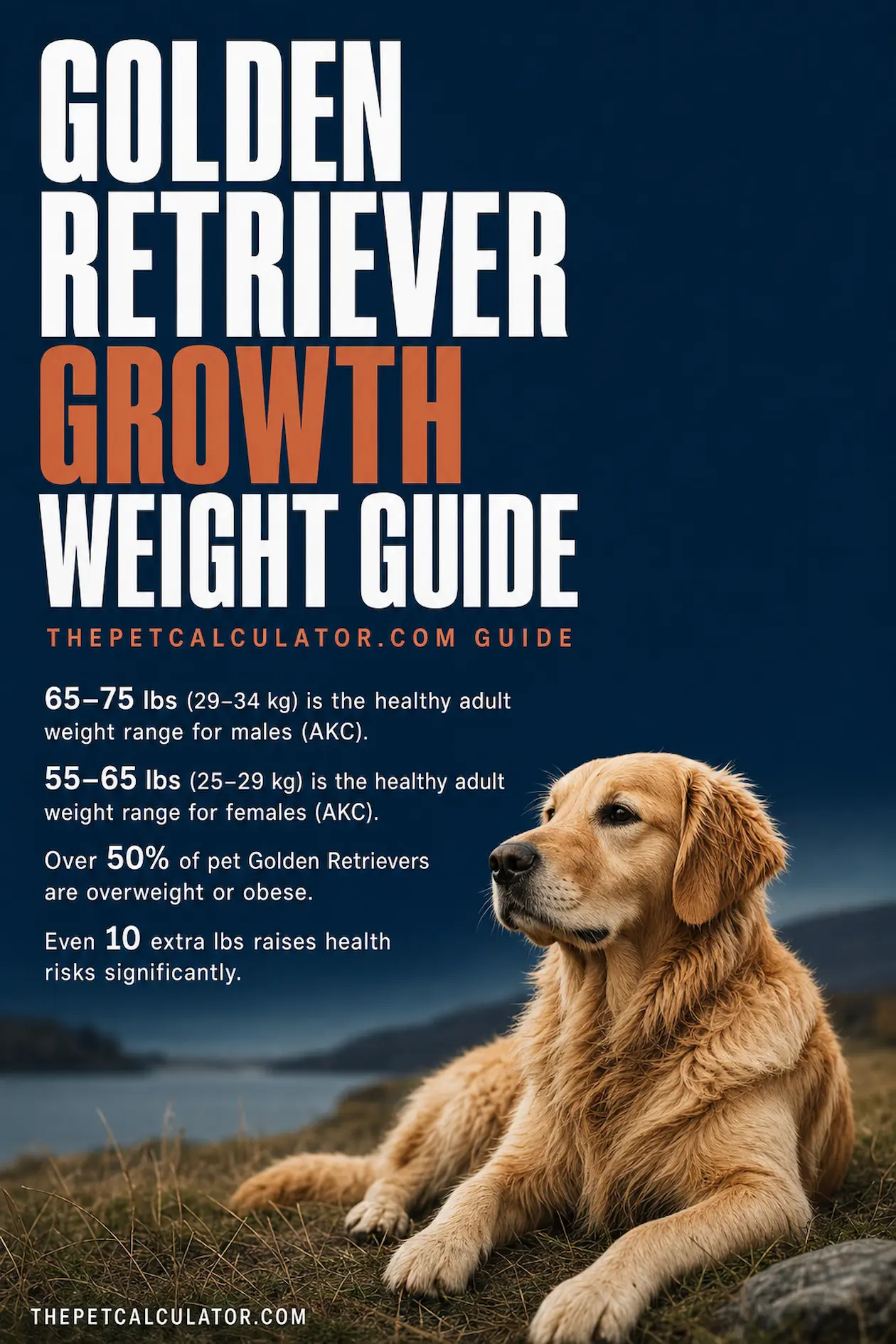
A healthy adult male Golden Retriever weighs 65–75 lbs (29–34 kg) and a healthy female weighs 55–65 lbs (25–29 kg) per AKC breed standards. But the number on the scale only tells part of the story. A 70 lb Golden Retriever with a visible waist and easily felt ribs is healthy. A 70 lb Golden with no waist and buried ribs is overweight — and many Goldens fit that second description.
Golden Retrievers carry a genetic variant affecting the POMC appetite pathway, which means they genuinely feel hungry more often than most breeds. This, combined with their famously eager-to-please nature, makes it easy for owners to overfeed without realising it. Studies suggest over 50% of pet Golden Retrievers are overweight or obese — making this breed one of the most at-risk for obesity-related health problems.
The visual comparison below shows the body shape difference between a healthy-weight Golden and an overweight one. Use it alongside the rib check (press gently along the ribcage — ribs should be easily felt) and the waist check (a clear indent should be visible from above) to assess your dog's body condition.
The rib test and waist check matter more than the scale alone. A lean Golden is a longer-lived, healthier Golden.
Golden Retriever Weight Chart by Age in kg and lbs: Puppy to Adult
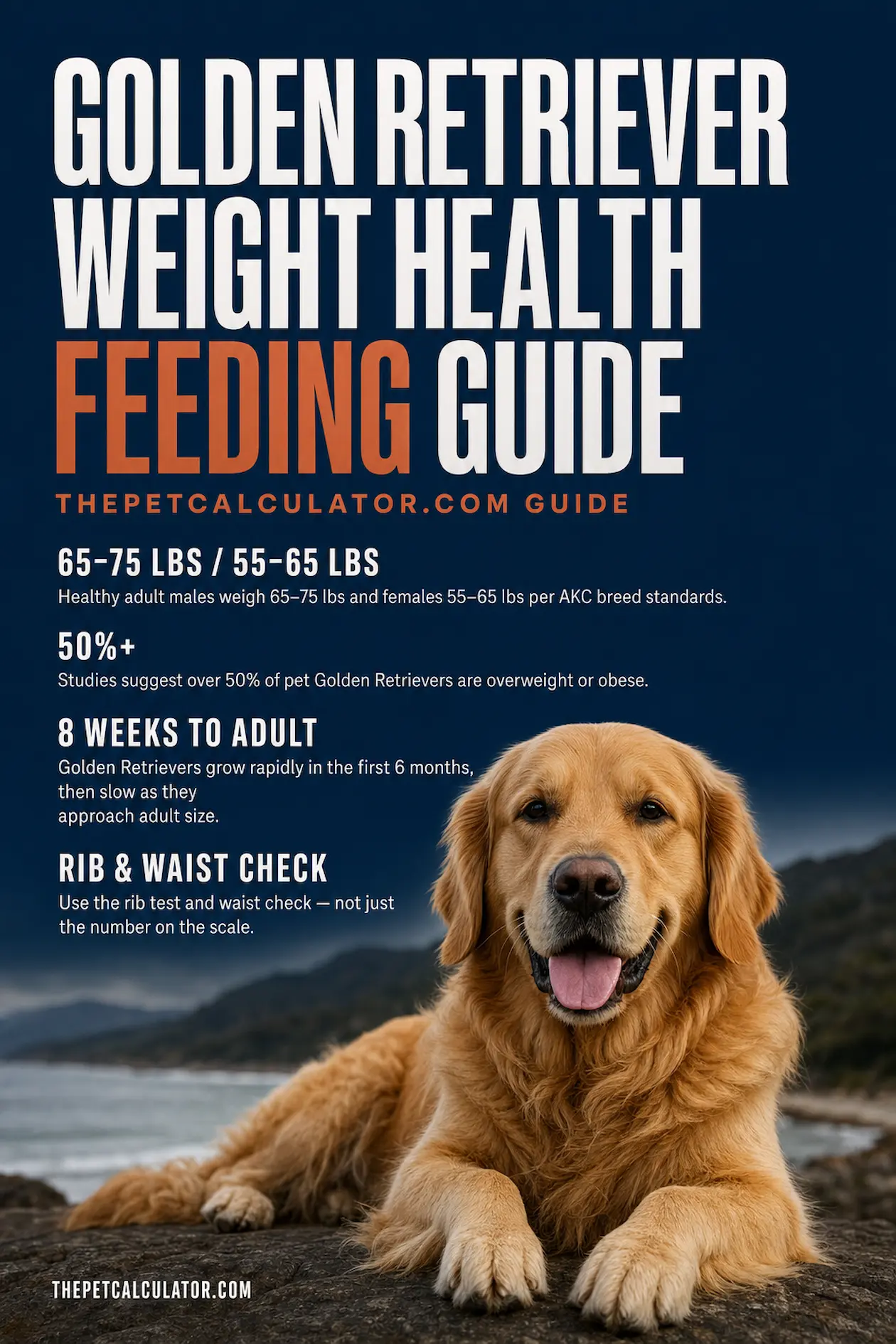
Golden Retrievers are a large breed that grows rapidly in the first 6 months, then slows as they approach adult size. The table below shows expected weight ranges from 8 weeks to adulthood. If your puppy is consistently above the high end of these ranges, consult your vet — overfeeding large-breed puppies forces bones to grow faster than joints can handle, which is a known risk factor for hip dysplasia.
| Age | Male (lbs) | Female (lbs) | Male (kg) | Female (kg) |
|---|---|---|---|---|
| 8 weeks | 9–14 lbs | 8–12 lbs | 4–6.5 kg | 3.5–5.5 kg |
| 3 months | 18–24 lbs | 16–22 lbs | 8–11 kg | 7–10 kg |
| 4 months | 25–33 lbs | 22–30 lbs | 11–15 kg | 10–14 kg |
| 5 months | 33–42 lbs | 28–37 lbs | 15–19 kg | 13–17 kg |
| 6 months | 40–50 lbs | 34–44 lbs | 18–23 kg | 15–20 kg |
| 8 months | 50–62 lbs | 43–54 lbs | 23–28 kg | 19–24 kg |
| 10 months | 58–70 lbs | 50–61 lbs | 26–32 kg | 23–28 kg |
| 12 months | 62–73 lbs | 54–64 lbs | 28–33 kg | 24–29 kg |
| 18 months | 64–74 lbs | 55–65 lbs | 29–34 kg | 25–29 kg |
| Adult (2+ years) | 65–75 lbs | 55–65 lbs | 29–34 kg | 25–29 kg |
Data based on AKC breed standards and published growth references. Individual dogs vary — consult your vet if your puppy is consistently above or below these ranges.
Average growth curves for male (blue) and female (pink) Golden Retrievers. Shaded bands show the healthy weight range for each sex.
Golden Retriever Growth Chart: When Is a Golden Fully Grown?
0–4 months: The fastest growth phase. Golden Retriever puppies grow rapidly and reach approximately 40–50% of their adult weight by 4 months. Feed a high-quality large-breed puppy food — avoid overfeeding during this period.
4–8 months: Growth continues steadily but begins to slow. The distinctive Golden Retriever body shape becomes defined. Skeletal structure is still developing — avoid high-impact exercise like long runs or jumping until growth plates close.
8–12 months: Growth tapers off significantly. Golden Retrievers typically reach their adult height by 12 months. Males average 23–24 inches at the shoulder; females 21.5–22.5 inches.
12–24 months: Height is set, but Golden Retrievers continue to fill out in muscle mass and chest depth until 18–24 months. Any weight gain after 24 months is almost always fat. If your Golden is getting heavier after their second birthday, revisit their daily calorie intake with our Dog Nutrition Calculator or check their weight loss plan with our Dog Weight Loss Calculator.
Is My Golden Retriever Overweight? Body Condition Score Guide
Body condition scoring (BCS) is the same method vets use to assess a dog's weight. It does not require a scale — it uses what you can see and feel. Use the silhouettes below alongside the rib test and waist check for the most accurate self-assessment of your Golden Retriever's body condition.
Underweight
- • Ribs, spine, hip bones clearly visible
- • Very pronounced waist from above
- • Belly tuck exaggerated from side
- • Minimal body fat or muscle mass
Ideal Weight
- • Ribs easily felt, not visible
- • Clear waist visible from above
- • Belly tucks up from side
- • Good muscle tone, no fat pads
Overweight
- • Ribs hard to feel under fat
- • No visible waist — barrel shape
- • Belly sags, no tuck
- • Fat deposits at neck and tail
For a full body condition assessment, use our Dog BMI Calculator or ask your vet to score your Golden on the 1–9 Purina Body Condition Scale.
A healthy-weight Golden Retriever — note the visible waist behind the ribs when viewed from above.
Mini Golden Retriever Weight: Is There a Small Golden Retriever?
"Mini Golden Retriever" is not a breed recognised by the AKC. What is marketed as a miniature or small Golden Retriever is typically one of the following: a Golden Retriever × Cocker Spaniel cross, a Golden Retriever × Miniature Poodle cross (often called a "Petite Goldendoodle"), or in some cases a smaller purebred Golden from a small-framed line.
These crossbreeds typically weigh 20–45 lbs as adults, depending on which breeds were crossed and the generation of the cross. They are not purebred Golden Retrievers and will not match the weight ranges in our calculator above. If you have a mini Golden crossbreed, use our general Dog Weight Calculator as a starting point and ask your vet to establish your individual dog's ideal weight.
If you have a purebred Golden Retriever who is on the smaller side (55–60 lbs male, 48–55 lbs female), that is within the lower end of the breed range and not a separate variety. There is no officially recognised miniature purebred Golden Retriever.
Goldendoodle Weight: Mini, Medium and Standard
The Goldendoodle (Golden Retriever × Poodle) is one of the most popular golden crosses, and its adult weight depends almost entirely on the size of the poodle parent and the generation of the cross. Because the Goldendoodle is not an AKC breed, there is no official standard, so the weight ranges below are wide. Use the poodle-parent size to find the row that matches your dog.
| Goldendoodle Size | Poodle Parent | Typical Adult Weight | Height |
|---|---|---|---|
| Petite/Toy | Toy Poodle | 10–25 lbs | 10–14 in |
| Miniature | Miniature Poodle | 25–35 lbs | 14–17 in |
| Medium | Small Standard | 40–50 lbs | 17–21 in |
| Standard | Standard Poodle | 50–90 lbs | 20–24 in |
F1, F1b and multigenerational crosses shift weight toward whichever parent dominates the litter, so two dogs from the same size category can still differ by several pounds. The most reliable predictor remains the size of the poodle parent. For an individual estimate, use our general Dog Weight Calculator and confirm your dog's ideal weight with your vet.
English Cream vs American Golden Retriever Weight
The "English Cream" Golden Retriever (sometimes marketed as a "white golden") differs from the American Golden Retriever mainly in coat colour, and slightly in build, not in a separate weight class. Both types are the same breed, and both sexes fall within the standard ranges: males weigh 65–75 lbs and females 55–65 lbs. English-line Goldens are sometimes described as slightly stockier or blockier, but they weigh within the same healthy range as American Goldens.
Do not assume "English Cream" means a bigger or smaller dog. The label refers to coat colour and lineage, not size, so a cream-coated Golden and a darker American Golden of the same sex should target the same weight. Use the breed ranges above regardless of coat colour, and let body condition, not colour or marketing terms, guide what a healthy weight looks like for your dog.
Golden Retriever Health Problems: How Weight Makes Them Worse
Golden Retrievers are genetically predisposed to several serious health conditions. Excess body weight significantly worsens every one of them. Understanding the connection between weight and these specific conditions is what makes weight management for this breed genuinely life-or-death.
Cancer: Approximately 60% of Golden Retrievers die from cancer — the highest rate of any breed. The Morris Animal Foundation's Golden Retriever Lifetime Study, the largest of its kind, is actively investigating the relationship between lifestyle factors (including obesity) and cancer incidence. Chronic obesity drives systemic inflammation, which is a known cancer risk factor. While weight cannot eliminate genetic cancer risk, lean Golden Retrievers have meaningfully better health outcomes.
Hip dysplasia: OFA data places Golden Retrievers among the top breeds affected by hip dysplasia, with 19–24% of evaluated dogs showing signs. Excess weight does not cause hip dysplasia, but it dramatically accelerates joint deterioration and pain — often by years.
Heart disease: Subvalvular aortic stenosis (SAS) is a heart condition found in Golden Retrievers. Overweight dogs have increased cardiac workload, which worsens outcomes for dogs with existing heart conditions.
Skin and coat problems: Obesity is associated with increased skin fold infections, hot spots, and poor coat condition in Golden Retrievers. A healthy weight supports better skin health and coat quality.
Golden Retriever Hip Dysplasia: How Weight Wrecks the Joints
Hip dysplasia affects approximately 19–24% of Golden Retrievers according to Orthopedic Foundation for Animals (OFA) data, making it one of the most impactful health conditions in the breed. The condition begins when the hip joint — a ball-and-socket joint — develops abnormally: the ball (femoral head) does not sit properly in the socket (acetabulum), causing laxity, painful grinding, and progressive arthritis.
Hip dysplasia has a significant genetic component, but weight is the single most controllable risk factor for how severely it progresses. Every extra pound adds approximately 3–4 lbs of force on the hip joints with each step. For a 75 lb Golden who should weigh 65 lbs, that extra 10 lbs adds 30–40 lbs of excess joint force with every step — thousands of times per day.
Overfeeding puppies is particularly damaging. Excess calorie intake during the growth phase causes bones to grow faster than the supporting soft tissue can develop, increasing the probability of abnormal joint formation. Large-breed puppy foods are specifically formulated to slow growth rate and protect joint development.
For Golden Retrievers already diagnosed with hip dysplasia, even modest weight loss of 5–10% of body weight has been shown to significantly reduce pain scores and improve mobility. It is often more effective than non-steroidal anti-inflammatory medications alone.
Golden Retriever Lifespan: How Weight Determines How Long They Live
Golden Retrievers typically live 10–12 years. The breed's lifespan has actually shortened over the past several decades — Goldens commonly lived 16–17 years in the 1970s, compared to 10–12 years today. While genetics and the breed's high cancer rate play a significant role, obesity is a major controllable factor.
Landmark research on dog longevity consistently shows that lean dogs live measurably longer than overweight dogs. A study tracking paired Labrador Retrievers found the lean group lived a median of 1.8 years longer than their heavier counterparts. For Golden Retrievers — who already carry a heavy cancer burden — the compounding effect of obesity-driven inflammation, joint disease, and metabolic stress is especially significant. Veterinary consensus estimates the lifespan cost of chronic obesity at up to 2 years in large breeds.
Female Golden Retrievers tend to live slightly longer than males on average (11–12 years vs 10–11 years). English Cream Golden Retrievers — a colour variant, not a separate breed — are sometimes marketed as having a longer lifespan, but there is no scientifically validated evidence that coat colour affects lifespan in Golden Retrievers.
A lean Golden Retriever is likely to live 1–2 years longer than an overweight one. Combined with dramatically lower cancer inflammation risk, weight management is the most impactful health decision you can make.
Why Golden Retrievers Are Always Hungry: The POMC Gene Explained
If you've ever owned a Golden Retriever, you know they seem to be perpetually hungry — begging at the table, inhaling food, acting starved immediately after a meal. This is not a behaviour problem. It is genetic. Golden Retrievers (along with Labrador Retrievers) carry a variant in the POMC (pro-opiomelanocortin) gene that disrupts the brain's normal appetite and satiety signalling.
In dogs without this variant, the POMC pathway produces hormones that signal "I'm full" after eating. In Goldens with the variant, this signal is weakened — so they genuinely feel hungry more often and more intensely than other breeds. This is not a personality trait you can train away; it is hardwired into their neurology.
The practical implication: your Golden Retriever's begging does not mean they are underfed. It means their brain is not registering satiety the way it should. The correct response is strict portion control, scheduled meals, and no free-feeding. Use measured portions and account for every treat. Our Dog Feeding Calculator can help you find the right daily calorie target for your specific Golden.
How Much to Feed a Golden Retriever: Feeding Chart by Age and Life Stage
Golden Retrievers need carefully measured meals at every life stage. Because of their POMC variant, free-feeding is not an option — a Golden left with unlimited access to food will overeat to the point of obesity. The calorie ranges below are starting estimates for moderately active dogs; adjust up or down based on your individual dog's body condition score.
Key rules: always measure meals with a kitchen scale or measuring cup, never estimate. Account for treats and chews in the daily calorie total — treats should make up no more than 10% of daily intake. Split the daily ration into at least two meals to reduce hunger-driven begging. For personalised daily calorie targets, use our Dog Feeding Calculator or our Dog Nutrition Calculator.
Puppy calories vary significantly with age — a 3-month-old needs far less than a 9-month-old. Use our Dog Feeding Calculator for a personalised target at your puppy's current weight and age.
When to See a Vet About Your Golden Retriever's Weight
Consult your veterinarian promptly if you notice any of the following:
- ⚠Sudden unexplained weight gain or loss — changes of more than 5–10% of body weight over a few weeks can indicate thyroid disease, diabetes, Cushing's disease, or other conditions.
- ⚠Stiffness, limping, or reluctance to exercise — early signs of hip dysplasia or joint disease, especially in Goldens over 5 years old.
- ⚠Difficulty rising or climbing stairs — this often indicates painful joint disease worsened by excess weight.
- ⚠Laboured breathing during moderate exercise — can indicate cardiac or respiratory issues compounded by obesity.
- ⚠Lumps, bumps, or swellings — given Golden Retrievers' high cancer rate, any new mass should be evaluated promptly, not watched and waited.
- ⚠Your Golden is significantly above healthy weight ranges — your vet can rule out medical causes of weight gain and create a safe, supervised weight loss plan.
Golden Retriever Weight Quick Reference
| Category | Male | Female | Notes |
|---|---|---|---|
| Adult healthy weight | 65–75 lbs | 55–65 lbs | AKC breed standard |
| Adult weight (kg) | 29–34 kg | 25–29 kg | ×0.4536 to convert lbs |
| Fully grown by | 18–24 months | 16–18 months | Height set by 12 months |
| Daily calories (adult) | 1,300–1,700 kcal | 1,100–1,400 kcal | Moderately active |
| Daily calories (senior 8+) | 900–1,200 kcal | ~15% less than adult | |
| Typical lifespan | 10–11 yrs | 11–12 yrs | Weight is key factor |
| Hip dysplasia prevalence | 19–24% of breed | OFA data — weight worsens it | |
For personalised calorie and feeding recommendations, use our Dog Nutrition Calculator or Dog Feeding Calculator. To check body condition, use our Dog BMI Calculator.
FAQs
Frequently Asked Questions
What is the ideal weight for a Golden Retriever?
Adult male Golden Retrievers should weigh 65–75 lbs (29–34 kg) and females 55–65 lbs (25–29 kg) per AKC breed standards. These ranges assume a healthy, moderately active adult dog. Individual variation is normal — a large-framed male may healthily sit at 75 lbs. Use the rib check and waist check alongside the scale to confirm body condition.
How much should a male Golden Retriever weigh?
Adult male Golden Retrievers typically weigh 65–75 lbs (29–34 kg). Males are noticeably larger and heavier than females throughout their lives. A male at 70 lbs with a visible waist and easily felt ribs is at an ideal weight. Males may continue to fill out with muscle until 18–24 months even after reaching their adult height at around 12 months.
How much should a female Golden Retriever weigh?
Adult female Golden Retrievers typically weigh 55–65 lbs (25–29 kg). Females reach their adult weight slightly earlier than males. A female at 60 lbs with a clearly defined waist from above and easily palpable ribs is at an ideal weight. If your female is approaching or exceeding 70 lbs, consult your vet to assess body condition.
What is the average weight of a Golden Retriever?
The average adult Golden Retriever weighs around 65–70 lbs for males and 58–62 lbs for females per breed standards. However, many pet Goldens weigh significantly more due to overfeeding. An above-standard average does not mean it is healthy. Use the AKC ranges (65–75 lbs male, 55–65 lbs female) as your benchmark rather than what you see at the dog park.
At what age is a Golden Retriever fully grown?
Golden Retrievers reach their adult height by around 12 months but continue to fill out and develop muscle mass until 18–24 months. Males take slightly longer to mature than females. If your Golden Retriever is still gaining weight after 24 months, it is almost certainly fat rather than muscle — reassess their diet and exercise routine.
How much should a Golden Retriever puppy weigh at 6 months?
At 6 months, a male Golden Retriever typically weighs 40–50 lbs and a female 34–44 lbs — roughly 60–65% of adult weight. If your puppy is significantly above these ranges, consult your vet. Overfeeding large-breed puppies causes bones to grow too rapidly, increasing the risk of joint problems including hip dysplasia.
Is my Golden Retriever overweight?
To check: place both hands on their ribcage and press gently — you should feel individual ribs without pressing hard. Look from above — there should be a clear waist behind the ribs. From the side, the belly should tuck up noticeably. If you cannot feel the ribs or see a waist, your Golden is likely overweight. Use the calculator above to compare their weight to healthy ranges for their age and sex.
Why is my Golden Retriever always hungry?
Golden Retrievers carry a genetic variant in the POMC (pro-opiomelanocortin) gene that affects appetite and satiety signals in the brain. This means they genuinely feel hungry more often than other breeds — it is not just greed. This genetic trait makes portion control essential. A Golden Retriever left to free-feed will almost always become overweight.
How much should I feed my Golden Retriever per day?
A moderately active adult male Golden Retriever (65–75 lbs) needs approximately 1,300–1,700 calories per day in two meals. A female (55–65 lbs) needs around 1,100–1,400 calories per day. Senior dogs (8+ years) need 15–20% fewer calories. These are starting estimates — adjust based on body condition. Use our Dog Feeding Calculator for a personalised daily calorie target.
How much should I feed a Golden Retriever puppy?
Golden Retriever puppies need calorie-dense puppy food split into 3–4 meals per day until 6 months, then 2 meals per day. A 3-month-old puppy needs roughly 700–900 calories per day; a 6-month-old needs around 1,200–1,500 calories. Avoid overfeeding puppies — excess growth speed in large breeds increases hip dysplasia risk.
How long do Golden Retrievers live?
Golden Retrievers typically live 10–12 years. Maintaining a healthy weight is one of the most impactful ways to extend lifespan — research shows overweight dogs live 1.5–2 years less than lean dogs. Golden Retrievers also have an exceptionally high cancer rate (approximately 60% die from cancer), making overall health management throughout their lives especially important.
Do Golden Retrievers die of cancer?
Cancer is the leading cause of death in Golden Retrievers. Studies suggest approximately 60% of Golden Retrievers die from cancer — a rate significantly higher than most other breeds with a likely genetic component. Maintaining a healthy weight reduces chronic inflammation associated with higher cancer risk. While weight management cannot eliminate cancer risk, it is one of the controllable factors that supports long-term health.
What is hip dysplasia in Golden Retrievers?
Hip dysplasia is a developmental condition where the hip joint does not form properly — the ball and socket do not fit correctly, leading to painful grinding, joint deterioration, and eventually arthritis. It is one of the most common orthopaedic conditions in Golden Retrievers, affecting approximately 19–24% of the breed (OFA data). Hip dysplasia has a genetic component, but excess body weight dramatically worsens its progression and pain.
How does weight affect a Golden Retriever's hip dysplasia?
Every extra pound adds approximately 3–4 lbs of force on hip joints with each step. For a dog already predisposed to hip dysplasia, this extra load accelerates joint deterioration, increases pain, and hastens the onset of arthritis. Overweight Golden Retrievers with hip dysplasia typically show symptoms earlier and more severely than lean dogs with the same condition. Weight management is the single most impactful non-surgical intervention for hip dysplasia.
How can I help my Golden Retriever lose weight?
To safely help your Golden lose weight: measure every meal with a kitchen scale. Reduce portions by 10–15% or switch to a lower-calorie food. Account for all treats in the daily calorie total. Increase low-impact exercise like walking and swimming. Aim for a loss rate of 1–2% of body weight per week. Use our Dog Weight Loss Calculator to create a personalised safe plan.
What is a mini Golden Retriever and how much does it weigh?
"Mini Golden Retriever" is not an AKC-recognised breed. The term typically refers to a crossbreed — most commonly a Golden Retriever × Cocker Spaniel or Golden Retriever × Poodle mix. Adult minis typically weigh 20–45 lbs depending on the mix and parents. They are not purebred Golden Retrievers and will not match the weight ranges in this calculator. Use our general Dog Weight Calculator as a starting point.
What does a full-grown miniature Golden Retriever weigh?
A full-grown miniature Golden Retriever (typically a Golden Retriever × Cocker Spaniel or × Poodle mix) usually weighs 20–45 lbs as an adult. Weight varies significantly based on breeds crossed and generation of the cross. Our breed-specific weight ranges apply to purebred Golden Retrievers only.
How much does a Golden Retriever weigh in kg?
Male Golden Retrievers weigh 29–34 kg as adults; females weigh 25–29 kg. To convert pounds to kilograms, multiply by 0.4536. To convert kg to pounds, multiply by 2.2046. Our calculator shows results in both lbs and kg.
What are signs that my Golden Retriever is overweight?
Key signs of an overweight Golden Retriever include: ribs difficult to feel without pressing firmly, no visible waist from above, a belly that hangs down rather than tucking up, fat pads on the neck and at the base of the tail, reduced energy, reluctance to exercise, and laboured breathing during moderate activity. Even 5–10 extra pounds significantly increases joint disease, cancer risk, and shortens lifespan.
How much exercise does a Golden Retriever need?
Adult Golden Retrievers need at least 1–2 hours of moderate to vigorous exercise daily. They were bred as working gun dogs with high endurance. Regular walking, swimming, fetch, and hiking are essential for maintaining healthy weight and joint health. Puppies under 18 months should have limited high-impact exercise to protect developing joints. Use our Dog Exercise Calculator for a personalised daily recommendation.
Is it normal for a Golden Retriever to always seem hungry?
Yes — it is normal and expected. Golden Retrievers carry a genetic variant affecting the POMC appetite pathway that makes them feel hungry more persistently than most breeds. It means your Golden is not being greedy — they genuinely experience stronger hunger signals. The correct response is strict portion control and scheduled feeding times, not free-feeding or responding to every begging session.
Other Calculators for Dogs

Dog Calorie Calculator by Breed — Free Daily Calorie & Feeding Tool
Free dog calorie calculator by breed. Find out exactly how many calories your dog needs per day by weight, breed, age, and activity level. Get instant kcal and feeding portions for Labradors, German Shepherds, Chihuahuas, and every breed in between. Try it now.

Puppy Calorie Calculator | Puppy Nutrition Calculator by Breed - Free Tool
Free puppy calorie calculator and nutrition tool. Calculate your puppy

Senior Dog Calorie Calculator - Free Daily Calorie Tool
Free senior dog calorie calculator. Calculate your older dog\
Other Pet Weight Calculators
Australian Shepherd Weight Calculator | Is Your Aussie a Healthy Weight? | The Pet Calculator
Check your Australian Shepherd\
Beagle Weight Calculator | Healthy Weight for 13-Inch & 15-Inch Beagles
Free Beagle weight calculator — check your Beagle\
Bearded Dragon Weight Chart by Age | Free Weight Calculator
Free bearded dragon weight calculator plus a bearded dragon weight chart by age. Check if your bearded dragon is a healthy weight, from hatchling to adult, with growth milestones and care tips.
Free dog printables
Keep these dog care guides handy
A rotating selection of practical dog guides chosen from our free printable library.Dog Feeding Guide
Portion guidance by weight, age, and life stage.
Puppy Calorie Guide
Calorie targets by breed size and age.
Dog Quality of Life Checklist
Track the HHHHHMM quality-of-life measures.