
Last updated: October 3, 2026
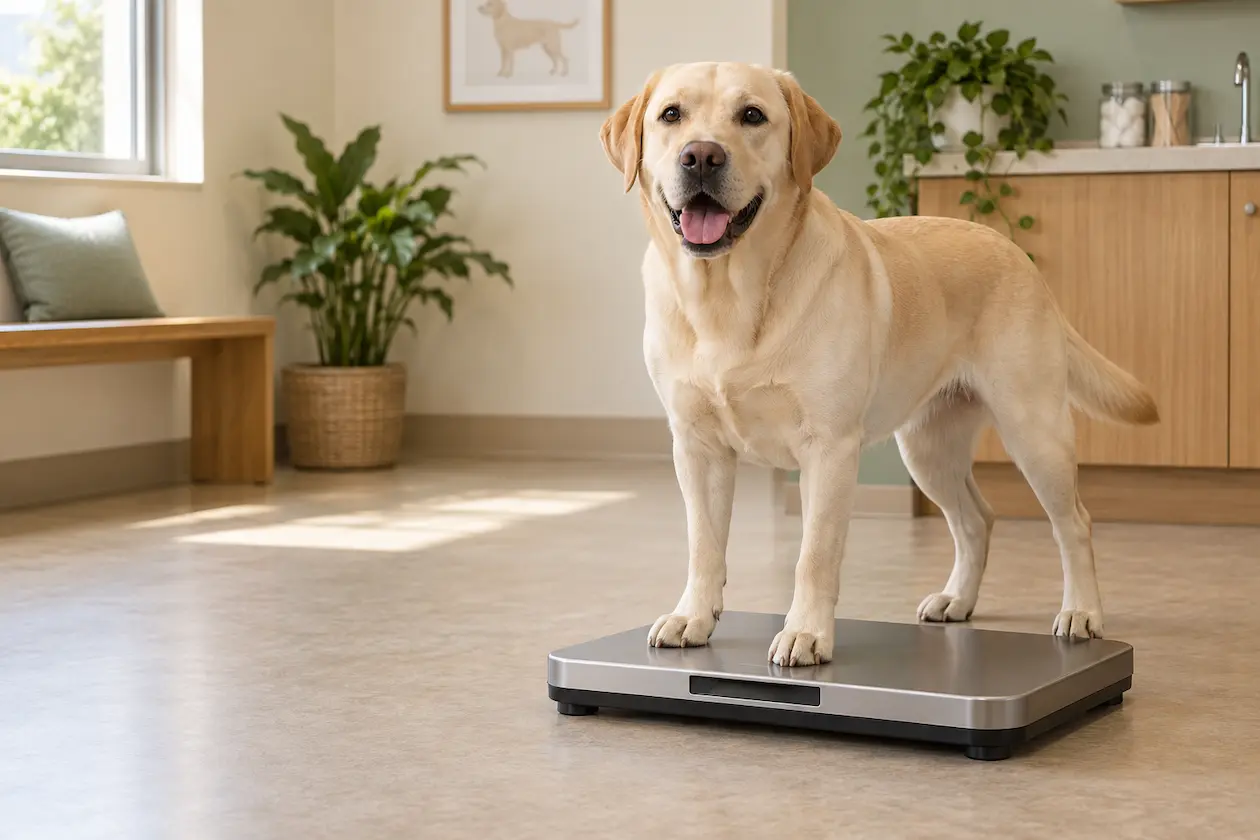
How To Use
Enter your Labrador's sex, age, and current weight to check if they are within the healthy weight range for their stage of life.
Quick Steps
- 1 Select your Labrador's Sex.
- 2 Select their Age.
- 3 Enter their Current Weight in pounds.
- 4 Click Calculate to see the weight assessment and full growth chart.
Labrador Weight Calculator
Fill Out The Fields Below
About Labrador Weight
Labradors are one of the most popular dog breeds worldwide, beloved for their gentle nature and intelligence. They carry a genetic mutation in the POMC gene that makes them feel hungry almost constantly — making them the breed most statistically prone to obesity.
Key Weight Characteristics
- • POMC gene mutation makes them perpetually hungry
- • Full height by 12 months; muscle mass develops until 18–24 months
- • American-type Labs tend to be leaner; English show-type Labs stockier
- • Need 1–2 hours of vigorous exercise daily to stay at a healthy weight
Body Condition Check
- ✓ Feel along the ribcage — ribs should be easily felt without deep pressure.
- ✓ Looking from above, a clear waist should be visible behind the ribs.
- ✓ Fat deposits around the neck and tail base are early warning signs.
- ✓ A broad, square head and stocky build does not mean an overweight belly is acceptable.
Last updated: March 21, 2026
AKC Labrador Retriever Weight: Male vs Female (in Pounds)
By the AKC Labrador Retriever breed standard, an adult male Labrador should weigh 65 to 80 pounds and an adult female 55 to 70 pounds. Males also stand a little taller, at 22.5 to 24.5 inches at the shoulder, compared with 21.5 to 23.5 inches for females. Use this as the quick answer, then check your own Lab against the full growth chart by age further down the page.
| Adult Labrador (AKC standard) | Weight (pounds) | Weight (kg) | Height at shoulder |
|---|---|---|---|
| Male Labrador | 65–80 lb | 29–36 kg | 22.5–24.5 in |
| Female Labrador | 55–70 lb | 25–32 kg | 21.5–23.5 in |
These are the AKC standard adult ranges. Show or bench (English-type) Labs sit toward the top of each range and field or working (American-type) Labs toward the bottom. Puppies are still growing, so use the by-age chart below for dogs under two years.
Labrador Normal Weight: What Should Your Lab Weigh?
How much do Labs weigh? The normal weight for a Labrador depends on sex, age, and type. Labrador Retrievers are a large breed with a notable weight difference between males and females. Understanding the correct range for your dog's sex is essential — comparing a female Lab to male weight standards will give a misleading picture. This Labrador Retriever weight chart breaks down healthy ranges by sex and age.
Male Labrador Retrievers should weigh 65–80 lbs (29–36 kg) as adults. The AKC Labrador breed standard specifies this range. The average Lab weight for adult males is around 70–75 lbs. Males have a broader chest, thicker neck, and more muscular build than females, which accounts for their heavier weight.
How much should a female Lab weigh? Adult female Labrador Retrievers should weigh 55–70 lbs (25–32 kg). Most healthy adult female Labs settle around 58–65 lbs. Females have a lighter, slightly more refined build and typically reach their adult weight somewhat earlier than males.
Within these ranges, the type of Labrador matters too. English-type Labs (show or bench Labs) tend to be stockier and heavier, sitting toward the upper end of each range. American-type Labs (field or working Labs) are leaner and more athletic, typically sitting toward the lower end. Both types are healthy and correct within the standard ranges.
For more on assessing your Lab's condition beyond the scale, see our dog weight guides, including the body condition score method and healthy weight resources.
Labrador Growth Chart: Weight by Age (Puppy to Adult)
This chart shows the expected weight range for Labrador Retrievers from 8 weeks to adulthood. Labs grow rapidly through the first 6 months, slow through 12 months, and continue filling out with muscle mass until 18–24 months.
| Age | Male (lbs) | Female (lbs) | Male (kg) | Female (kg) |
|---|---|---|---|---|
| 8 weeks | 10–15 | 8–12 | 4.5–6.8 | 3.6–5.4 |
| 3 months | 20–28 | 18–24 | 9.1–12.7 | 8.2–10.9 |
| 4 months | 28–38 | 24–32 | 12.7–17.2 | 10.9–14.5 |
| 5 months | 36–48 | 30–40 | 16.3–21.8 | 13.6–18.1 |
| 6 months | 44–57 | 37–48 | 20.0–25.9 | 16.8–21.8 |
| 8 months | 54–68 | 45–57 | 24.5–30.8 | 20.4–25.9 |
| 10 months | 60–74 | 50–63 | 27.2–33.6 | 22.7–28.6 |
| 12 months | 64–78 | 54–67 | 29.0–35.4 | 24.5–30.4 |
| 18 months | 65–79 | 55–69 | 29.5–35.8 | 24.9–31.3 |
| Adult (2+ years) | 65–80 | 55–70 | 29.5–36.3 | 24.9–31.8 |
English-type Labs typically sit at the upper end; American-type Labs at the lower end. Consult your vet if your Lab is consistently outside these ranges.
Male vs Female Labrador Weight Comparison Chart
Male Labradors are noticeably heavier than females at every age. The chart below overlays both growth curves from puppyhood to adulthood. Shaded bands represent the healthy weight range for each sex.
Average growth curves for Male (blue) and Female (pink) Labrador Retrievers. Shaded bands show the healthy weight range for each sex.
How Big Do Labs Get? Labrador Growth Timeline
How big do Labs get? Adult male Labradors reach 65–80 lbs and stand 22.5–24.5 inches at the shoulder; females reach 55–70 lbs and 21.5–23.5 inches. Labs are a large breed, and like most large dogs they take longer to fully mature than smaller breeds. Understanding the growth timeline helps you distinguish healthy growth from weight gain.
0–4 months: Rapid skeletal growth. Lab puppies grow explosively — a male puppy goes from about 12 lbs at 8 weeks to over 30 lbs by 4 months. How much should a 4 month old Lab weigh? Males typically weigh 28–38 lbs at 4 months; females 24–32 lbs. This is a critical period for nutrition: feed a quality large-breed puppy food and avoid overfeeding. Overweight Lab puppies are at higher risk for joint problems, particularly hip dysplasia, later in life.
4–8 months: Growth continues fast but begins to slow. The Lab's characteristic athletic build — broad chest, strong neck, powerful hindquarters — becomes apparent. At 6 months, many male Labs are already 44–57 lbs.
8–12 months: Growth tapers. Most Labs reach full adult height by 12 months. Weight at 12 months is close to adult weight — males 64–78 lbs, females 54–67 lbs — but they are not yet at full muscular maturity.
12–24 months: Labs continue adding muscle mass and body bulk until 18–24 months. Males may not reach their full physical maturity until 2 years. Any weight gain after 24 months is almost certainly fat. Use our Dog Nutrition Calculator to review their calorie target, or our Dog Weight Loss Calculator if weight loss is needed.
Why Labradors Are Always Hungry: The POMC Gene Mutation
If you have a Labrador, you have probably noticed that they seem perpetually hungry — begging at meals, counter-surfing, eating things that aren't food. This is not a training failure. It is genetics.
Researchers at the University of Cambridge discovered that a significant proportion of Labradors carry a mutation in the POMC (pro-opiomelanocortin) gene. The POMC gene plays a key role in regulating appetite and the feeling of satiety (fullness). Dogs with this mutation produce less of the signalling molecules that tell the brain "I am full." The result: they feel hungry almost all the time, regardless of how much they have eaten.
The mutation is present in approximately 25% of pet Labradors — and up to 76% of Labradors selected as assistance or guide dogs, suggesting the mutation may also affect food motivation useful for training. The mutation is also found in Flat-Coated Retrievers.
What this means for your Lab: Never rely on your Lab to self-regulate their food intake. Free-feeding is not an option. Measure every meal. Account for every treat. Your Lab will always act hungry — but that doesn't mean they need more food. Use our Dog Feeding Calculator to determine the right portion for your dog's weight and activity level.
Labrador Body Condition Score: Visual Guide
Use these top-down and side-view silhouettes to visually assess your Labrador's body condition. This is the same method used by vets — adapted for the Labrador's athletic, muscular build.
Underweight
- • Ribs, spine, hip bones visible
- • Exaggerated waist indent
- • Pronounced belly tuck
- • Minimal muscle mass
Ideal Weight
- • Ribs felt easily, not seen
- • Clear waist visible from above
- • Moderate belly tuck from side
- • Good muscle tone, athletic build
Overweight
- • Ribs hard to feel under fat
- • No visible waist — barrel shape
- • No belly tuck, may sag
- • Fat pads at neck and tail base
Simplified visual guides. For a full body condition assessment, use our Dog BMI Calculator or consult your veterinarian.
How Much Should a Lab Weigh? The Complete Healthy Weight Guide
Understanding the healthy weight for a Labrador — and the ideal weight for a Labrador Retriever specifically — is more complex than simply being within the weight range. A healthy Labrador is one who is at the right weight for their frame, has good muscle tone, moves freely, and has energy levels appropriate for their age.

A healthy Labrador at ideal weight has a visible waist, good muscle tone, and ribs that are easily felt but not seen.
Studies consistently show that 34–59% of pet Labradors are overweight or obese — making them one of the breeds with the highest obesity prevalence. Because of the POMC gene mutation and their food-motivated nature, Labradors are particularly vulnerable. Here is what it actually takes to maintain a genuinely healthy Labrador:
Measure every meal. Use a kitchen scale or proper measuring cup — not a handful or estimation. Even 10% more food per day can add 5–8 lbs per year to a Lab's frame. Most owners overfill their dog's bowl without realising it.
Exercise is non-negotiable. An adult Lab needs 60–120 minutes of vigorous activity daily. Walking alone is rarely enough; swimming, off-leash running, fetch, and agility are all effective. Labs who don't get adequate exercise gain weight rapidly, especially combined with their POMC-driven appetite.
Weigh your Lab monthly. Use a large veterinary scale, or weigh yourself on a bathroom scale then weigh yourself holding your Lab and subtract. Monthly tracking catches weight creep before it becomes a major problem.
Annual vet checks are essential. Hypothyroidism can cause weight gain despite a normal diet and exercise routine. If your Lab is gaining weight despite strict portion control, ask your vet to run a thyroid panel. Use our Dog Weight Loss Calculator if your Lab needs to shed pounds, and our Dog Nutrition Calculator for a full calorie review.
Labrador Hip Dysplasia and Weight: Why Every Pound Counts
Hip dysplasia is one of the most significant health concerns for Labrador Retrievers — a hereditary condition where the hip socket does not properly cover the ball of the upper thigh bone, causing the joint to degrade over time. Labradors are among the breeds most commonly diagnosed with hip dysplasia, and excess weight dramatically worsens outcomes.
Every pound of extra body weight increases the load on already-compromised hip joints. Research in veterinary orthopaedic journals has found that overweight dogs with hip dysplasia have significantly more pain, worse mobility scores, and require surgical intervention at higher rates.
The most impactful data comes from a landmark Purina lifetime study showing that Labradors kept at a lean body weight lived an average of 1.8 years longer than their heavier littermates — and had a significantly later onset of hip dysplasia symptoms. This is the most compelling evidence available for the importance of weight management in Labs.
Elbow dysplasia is similarly affected. A common companion condition to hip dysplasia in Labs, it causes front leg lameness worsened by every extra pound the foreleg must carry. If your Lab has been diagnosed with hip or elbow dysplasia, create a safe weight reduction plan to ease joint load.
Labrador Health Issues: How Weight Worsens Every Condition
Labradors are generally robust dogs with a lifespan of 10–12 years, but they carry several hereditary health risks. Many are either directly caused by excess weight or significantly worsened by it:
Hip and elbow dysplasia: The most weight-sensitive conditions in Labs. Keeping a lean body weight is the single most impactful preventive measure available.
Diabetes: Obese dogs are 3 times more likely to develop type 2 diabetes. Labs are already at elevated risk as they age. Managing weight from puppyhood is the most effective preventive strategy.
Cruciate ligament tears (CCL/ACL): Overweight Labs face significantly higher risk. Every extra pound increases lateral force on the stifle joint. CCL surgery costs $3,000–$7,000 per leg.
Exercise-induced collapse (EIC): A genetic condition unique to Labs where dogs collapse after intense exercise. Caused by a DNM1 gene mutation. Not caused by weight, but harder to manage safely in overweight Labs. DNA testing confirms EIC status.
Black Lab vs Chocolate Lab health issues: Studies suggest chocolate Labs have shorter average lifespans (10.7 years vs 12.1 for black/yellow Labs) and higher rates of certain conditions — possibly related to smaller founding gene pools in some breeding lines. Weight management is equally important for all colours.
Progressive retinal atrophy (PRA): A genetic eye condition leading to gradual blindness. Not weight-related, but worth mentioning as a significant inherited condition. Annual eye exams are recommended for breeding dogs.
Labrador Life Expectancy: How Weight Affects Your Lab's Lifespan
Labrador Retrievers have an average life expectancy of 10–12 years. But a landmark study by Purina found that Labradors kept at a lean body weight lived an average of 1.8 years longer than their heavier littermates — and experienced a significantly later onset of hip dysplasia, joint disease, and other age-related conditions. Over the course of a dog's life, that is an enormous difference.
The mechanism is well understood: chronic excess weight creates a state of low-grade systemic inflammation. This accelerates joint degeneration, strains the cardiovascular system, increases insulin resistance, and puts continuous mechanical load on organs and skeletal structures. For Labradors — already genetically predisposed to hip dysplasia, elbow dysplasia, and obesity via the POMC gene — excess weight doesn't just shorten the number of years; it degrades their quality in every one of those years. The data on Labrador lifespan is unambiguous: lean Labs live longer and suffer less. If your Lab is overweight, start a safe weight loss plan here.
Lean Labs outlive overweight Labs by up to 2 years — and live those extra years with significantly less pain and better mobility.
Labrador Feeding Guide: How Much to Feed Your Lab by Age
Because of the POMC gene mutation and their highly food-motivated nature, Labradors require strict portion control at every life stage. Here is a general guide — always check your specific food's guidelines and your vet's advice:
Labrador puppies (8–16 weeks): 3–4 meals per day. Feed a quality large-breed puppy food — the "large breed" formulation controls the calcium-to-phosphorus ratio critical for healthy joint development. Typical calorie needs: 400–600 kcal/day.
Labrador puppies (4–6 months): 3 meals per day. Calorie needs increase significantly. A 4-month Lab (~30 lbs) needs approximately 800–1,100 kcal/day. Do not overfeed — rapid growth increases dysplasia risk.
Labrador puppies (6–12 months): 2 meals per day. Continue large-breed puppy food until 12 months. Calorie needs: approximately 1,200–1,600 kcal/day.
Adult Labs (1–7 years): 2 meals per day. An average adult male Lab (70 lbs, moderately active) needs approximately 1,400–1,600 kcal/day. An average adult female (62 lbs) needs approximately 1,200–1,400 kcal/day. Spayed/neutered Labs need approximately 10–15% fewer calories. Use our Dog Feeding Calculator for a precise recommendation.
Senior Labs (7+ years): 2 meals per day. Calorie needs typically decrease 10–20% as activity reduces. Switch to a senior or weight-management formula. Monitor weight monthly — older Labs are prone to both muscle loss and fat gain.
Universal Lab feeding rules: Never free-feed. Measure every meal precisely. Treats must not exceed 10% of daily calories — low-calorie options like carrot sticks, green beans, or blueberries are excellent. Split daily rations into at least 2 meals to reduce bloat risk.
Labrador Feeding Chart by Age: Quick Reference
| Age | Meals/Day | Est. Daily Calories | Food Type |
|---|---|---|---|
| 8–16 weeks | 3–4 | 400–600 kcal | Large-breed puppy food |
| 4–6 months | 3 | 800–1,100 kcal | Large-breed puppy food |
| 6–12 months | 2–3 | 1,200–1,600 kcal | Large-breed puppy food |
| Adult male (65–80 lbs) | 2 | 1,400–1,700 kcal | Adult large-breed food |
| Adult female (55–70 lbs) | 2 | 1,200–1,500 kcal | Adult large-breed food |
| Senior (7+ years) | 2 | 1,100–1,400 kcal | Senior or weight-management |
Estimates for moderately active Labs. Spayed/neutered Labs need ~10–15% fewer calories. Get personalised feeding portions or check calorie needs for your Lab.
Labrador Daily Calorie Guide: Puppy, Adult, and Senior
The golden rule: Measure every meal — Labs will always act hungry, but that's the POMC mutation, not real hunger. Calculate your Lab's exact portion size • thepetcalculator.com
Labrador Exercise Needs: How Much Activity to Keep Your Lab Fit
Labradors were bred as working gun dogs — retrieving game from water and land for hours at a time. They have significantly higher exercise needs than many people expect, and insufficient exercise is one of the primary causes of weight gain in the breed.
Adult Labs need 60–120 minutes of vigorous exercise daily. A 20-minute walk twice a day is insufficient for most healthy adult Labs. They need sustained aerobic activity: fetch, swimming, off-leash running, hiking, or agility. Labs who don't get adequate exercise gain weight rapidly.
Swimming is especially recommended. Not only do most Labs love water, but swimming is highly effective for calorie burning and completely joint-friendly — making it ideal for Labs with hip or elbow dysplasia. Many Labs will swim for 30+ minutes at a time, burning far more calories than an equivalent walk.
Puppies need different exercise. Until growth plates close (around 12–18 months), avoid high-impact exercise like long runs on hard surfaces or excessive jumping. A common guideline: 5 minutes of exercise per month of age, twice a day — so a 4-month Lab puppy gets two 20-minute sessions. This protects developing joints.
Senior Labs still need daily activity. Reduce intensity but maintain duration. Gentle swimming, slow leash walks on varied terrain, and enrichment activities help maintain muscle mass and healthy weight in older Labs. Use our Dog Exercise Calculator for a personalised daily activity recommendation.
English Lab vs American Lab Weight: Size Comparison
The English Lab vs American Lab weight difference is one of the most common sources of confusion for Lab owners. Labrador Retrievers come in two widely recognised types: the English Labrador (show-type or bench Lab) and the American Labrador (field-type or working Lab). Both are the same AKC breed but have distinctive physical differences that affect what a healthy weight for a Labrador actually looks like.
English Labs are stockier, heavier-boned, broader in the chest and head, with a shorter, thicker neck. Adult English males typically weigh 70–80 lbs and females 62–70 lbs. They naturally sit toward the upper end of the AKC weight range and are popular as show dogs and companion animals.
American Labs are taller, leaner, and more athletic. Their head is more refined, their neck longer, and their body more narrowly built. Adult American males typically weigh 65–74 lbs and females 55–64 lbs. They are popular as working dogs, field trial dogs, and service dogs.
When using the weight calculator above, both types fall within the same healthy range — but always use the body condition score (rib check, waist check, belly tuck) alongside the weight number. An English Lab at 78 lbs may be perfectly healthy; an American Lab at 78 lbs may be overweight. The number must be interpreted with the body condition score.
Labrador Weight in Kg: Metric Conversion Chart
For Lab owners outside the United States who use kilograms, here is the complete Labrador weight reference in kg by age:
| Age | Male (lbs) | Male (kg) | Female (lbs) | Female (kg) |
|---|---|---|---|---|
| 8 weeks | 10–15 | 4.5–6.8 | 8–12 | 3.6–5.4 |
| 3 months | 20–28 | 9.1–12.7 | 18–24 | 8.2–10.9 |
| 6 months | 44–57 | 20.0–25.9 | 37–48 | 16.8–21.8 |
| 12 months | 64–78 | 29.0–35.4 | 54–67 | 24.5–30.4 |
| Adult (2+ years) | 65–80 | 29.5–36.3 | 55–70 | 24.9–31.8 |
To convert lbs to kg: multiply by 0.4536. To convert kg to lbs: multiply by 2.2046. A healthy male Lab at 72 lbs ≈ 32.7 kg.
How Much Should a Black Lab Weigh? Weight by Coat Colour
How much should a black Lab weigh? The same as any other Labrador of the same sex. All three coat colours — black, chocolate (brown), and yellow — share identical healthy weight ranges. Coat colour has no effect on the ideal weight for a Labrador Retriever.
Black Lab ideal weight: Adult male black Labs should weigh 65–80 lbs (29–36 kg); adult females 55–70 lbs (25–32 kg). The average weight for a black Lab is around 70–75 lbs for males and 58–65 lbs for females. Black Labs are the most common colour — making up the majority of the breed population — and the same weight standards apply to them as to chocolate and yellow Labs.
Chocolate Lab average weight: Adult male chocolate Labs should also weigh 65–80 lbs; females 55–70 lbs. However, a 2018 study in Canine Genetics and Epidemiology found that chocolate Labs have shorter average lifespans (10.7 years) compared to black and yellow Labs (12.1 years), and higher rates of ear and skin conditions. This is thought to be related to a smaller founding gene pool in some chocolate breeding lines — not the colour itself. An overweight chocolate Lab faces the same health risks as any overweight Lab, but these pre-existing vulnerabilities make weight management even more important.
Yellow Lab weight: Identical ranges — 65–80 lbs for males, 55–70 lbs for females. Yellow Labs include shades from fox-red to cream, and none of these shade variations affect healthy weight.
For any Labrador — black, chocolate, or yellow — the principles are identical: maintain the healthy weight range, do regular body condition checks, and ensure 60+ minutes of vigorous exercise daily. Assess your Lab's body condition score to see where they stand.
Fat Lab? How to Tell If Your Labrador Is Overweight
Search for "fat black Lab" or "overweight chocolate Lab" and you will find thousands of images of barrel-shaped Labs with no visible waist, rounded bellies, and thick fat pads. Sadly, this body shape has become so normalised that many owners no longer recognise it as overweight. Studies show that 34–59% of pet Labradors are overweight or obese — making the fat Lab one of the most common sights at any dog park.
A truly healthy Lab does not look like this. The correct body condition for a Labrador — regardless of colour — shows a clearly visible waist when viewed from above, a noticeable belly tuck from the side, and ribs that can be easily felt with light pressure. If your Lab has lost their waist, if their belly hangs level or sags, or if you cannot feel individual ribs without pressing hard — they are carrying too much weight.
Why this matters: An overweight black Lab, chocolate Lab, or yellow Lab faces the same serious consequences — increased hip and elbow dysplasia pain, 3× higher diabetes risk, higher rates of cruciate ligament tears, and up to 1.8 years off their lifespan. The breed's POMC gene mutation means most Labs will always act hungry, but acting hungry is not the same as needing food.
If your Lab is overweight, the fix is straightforward: reduce daily calories by 10–15%, eliminate table scraps and high-calorie treats, increase exercise gradually, and weigh monthly to track progress. A safe rate of weight loss for a Labrador is 1–2% of body weight per week. Use our Dog Weight Loss Calculator for a personalised safe calorie target, or our Dog Nutrition Calculator to review their full calorie needs.
When to See a Vet About Your Labrador's Weight
Consult your veterinarian promptly if you notice any of the following:
- ⚠Sudden unexplained weight gain or loss — changes of more than 5–10% of body weight over a few weeks can indicate thyroid disease, diabetes, or heart conditions.
- ⚠Reluctance to exercise or difficulty rising — early sign of hip or elbow dysplasia, especially in a previously active dog. Weight gain combined with reluctance to move accelerates joint damage.
- ⚠Panting heavily at rest — overweight Labs may pant excessively even at rest as excess fat compresses the chest and strains the cardiovascular system.
- ⚠Collapse after exercise — if your Lab collapses, loses coordination, or becomes extremely weak after intense activity, this is a potential sign of exercise-induced collapse (EIC) and requires immediate veterinary assessment.
- ⚠Excessive thirst and urination — early signs of diabetes, which overweight Labs are at elevated risk for. Early intervention dramatically improves outcomes.
- ⚠Your Lab is significantly above the weight ranges shown in the calculator — your vet can help rule out medical causes and create a safe, structured weight loss plan.
Labrador Weight Quick Reference
| Type | Male Weight | Female Weight | Fully Grown By | Daily Calories (adult) |
|---|---|---|---|---|
| English-type (show) | 70–80 lbs / 32–36 kg | 62–70 lbs / 28–32 kg | 18–24 months | 1,400–1,700 kcal |
| American-type (field) | 65–74 lbs / 29–34 kg | 55–64 lbs / 25–29 kg | 12–18 months | 1,300–1,600 kcal |
| AKC Standard (all types) | 65–80 lbs / 29–36 kg | 55–70 lbs / 25–32 kg | 18–24 months | 1,200–1,700 kcal |
For personalised recommendations, review your Lab's calorie needs, get a feeding plan, or check your Lab's body condition score.
Newborn Labrador Puppy Weight and Early Growth Milestones
Newborn Labrador Retriever puppies typically weigh 12–16 oz (340–450 g) at birth. Steady daily weight gain is the single best indicator that a puppy is healthy and well-fed. Any puppy that loses weight or fails to gain in the first week needs immediate veterinary attention.
Week 1–2: Puppies should roughly double their birth weight. They are entirely dependent on the mother's milk. By day 10–14, a healthy puppy should weigh 1.5–2.5 lbs.
Week 3–6: Eyes and ears open; puppies become active. By 4 weeks, a Lab puppy typically weighs 4–8 lbs. Weaning begins during this stage.
8 weeks (going home weight): A healthy male Lab puppy weighs 10–15 lbs; a female weighs 8–12 lbs. This is the typical age for puppies to go to new homes. If a breeder's puppies are significantly below these ranges at 8 weeks, ask about health and feeding history.
10–12 weeks: A 12-week-old male Lab typically weighs 20–27 lbs; a female 18–22 lbs. Growth continues at roughly 2–3 lbs per week. Feed a large-breed puppy food and avoid over-supplementing calcium, which can disrupt bone development.
FAQs
Frequently Asked Questions
What is the ideal weight for a male Labrador Retriever?
Adult male Labrador Retrievers should weigh between 65–80 lbs (29–36 kg). The AKC breed standard describes males as 65–80 lbs. Most healthy adult male Labs settle in the 68–75 lb range. English-type (show) Labs tend to be stockier and may reach the upper end; American-type (field) Labs are leaner and usually fall in the 65–72 lb range.
What is the ideal weight for a female Labrador Retriever?
Adult female Labrador Retrievers should weigh between 55–70 lbs (25–32 kg). The AKC breed standard sets the female range at 55–70 lbs. Most healthy adult female Labs settle around 58–65 lbs. Like males, English-type females tend toward the higher end and field-type females toward the lower end of this range.
What is a healthy Lab weight?
A healthy Lab weight — also called the ideal weight for a Labrador Retriever — depends on sex and type. Male Labs: 65–80 lbs (29–36 kg). Female Labs: 55–70 lbs (25–32 kg). The ideal Labrador weight is one where ribs can be felt easily but not seen, a visible waist is present from above, and the belly tucks up slightly from the side. Because Labs carry a POMC gene mutation that makes them feel constantly hungry, maintaining a healthy weight for a Labrador requires active management — measured meals, no free-feeding, and 1–2 hours of daily exercise.
What is the average Labrador weight?
The average Labrador weight for adult males is approximately 70–75 lbs (32–34 kg), and for adult females approximately 60–65 lbs (27–29 kg). However, surveys consistently show that a large proportion of pet Labs are overweight — the average pet Lab may actually weigh 80–90 lbs, which is above the healthy range. Use the calculator above to compare your Lab's weight against the healthy range for their age and sex.
What is the average weight for a Labrador Retriever at 6 months?
A male Labrador at 6 months typically weighs 44–57 lbs, with an average around 50 lbs. A female Labrador at 6 months typically weighs 37–48 lbs, averaging around 42 lbs. At 6 months, Labs are approaching but have not yet reached their full adult size — they'll continue to fill out until 18–24 months. If your 6-month-old Lab weighs significantly more than these ranges, consult your vet.
When is a Labrador fully grown?
Labrador Retrievers typically reach their full height by 12 months. However, they continue to fill out — adding muscle mass and body width — until 18–24 months. Males develop more slowly and may not reach their full bulk until 2 years. If your Lab is still gaining weight after 24 months, it is likely fat gain rather than growth. Use our Dog Weight Loss Calculator if weight management is needed.
Why is my Labrador always hungry?
Labradors carry a genetic mutation in the POMC (pro-opiomelanocortin) gene that disrupts their brain's normal hunger and satiety signalling. Studies from the University of Cambridge found that this mutation — present in approximately 25% of pet Labs and up to 76% of assistance dog Labs — means affected dogs never truly feel full. This is why Labradors are statistically the breed most prone to obesity. It is not a character flaw — it is a genetic reality. You must measure every meal and resist the begging, because your Lab genuinely cannot regulate their own intake.
Is my Labrador overweight?
To check if your Labrador is overweight, use the rib test: place your hands on their ribcage and press with light finger pressure — you should easily feel each individual rib. From above, a distinct waist should be visible between the ribs and hips. From the side, the abdomen should tuck up slightly. If your Lab's belly is level or rounded, if you cannot feel ribs without pressing hard, or if there's a thick roll of fat at the neck or base of the tail — they are likely overweight. Use our calculator above to check against healthy ranges for their age and sex.
What are the health problems for Labrador Retrievers?
The most significant health issues for Labrador Retrievers are hip dysplasia, elbow dysplasia, obesity (and related conditions like diabetes, joint disease, and heart disease), exercise-induced collapse (EIC), progressive retinal atrophy (PRA), and centronuclear myopathy. Of these, obesity is the most preventable and arguably the most impactful — excess weight worsens hip and elbow dysplasia, increases the risk of diabetes, puts strain on the heart, and shortens life expectancy by up to 2.5 years.
How does weight affect hip dysplasia in Labradors?
Hip dysplasia — a malformation of the hip joint — is one of the most common health concerns in Labradors. Every extra pound a dog carries increases the load on their hip joints. Research consistently shows that overweight dogs with hip dysplasia suffer significantly more pain, have greater mobility limitations, and require surgery at higher rates than dogs at a healthy weight. Labradors are already genetically predisposed to hip dysplasia — keeping them lean is one of the most effective ways to delay onset and reduce severity. Even modest weight reduction (5–10% of body weight) can measurably improve mobility in dogs with hip dysplasia.
How much should I feed my Labrador?
A typical adult Labrador (65–80 lbs) needs approximately 1,100–1,700 calories per day, depending on their size, age, and activity level. Always measure meals with a proper measuring cup or kitchen scale — never free-feed a Labrador. Treats should be no more than 10% of daily calories. Use our Dog Feeding Calculator for a personalised portion recommendation.
What is a Labrador growth chart?
A Labrador growth chart shows the expected weight range at each age milestone from puppy to adult. Male Labs typically weigh 10–15 lbs at 8 weeks, 44–57 lbs at 6 months, and 65–80 lbs as adults. Female Labs weigh 8–12 lbs at 8 weeks, 37–48 lbs at 6 months, and 55–70 lbs as adults. Labs grow rapidly in the first 6 months, then more slowly until 18–24 months when they reach full maturity. The growth chart in the calculator above shows the full range by age and sex.
What is the difference between English and American Labrador weight?
English Labradors (show-type) are stockier, broader, and heavier — adult males typically 70–80 lbs, females 62–70 lbs. American Labradors (field-type) are leaner and more athletic — adult males typically 65–74 lbs, females 55–64 lbs. Both are within the AKC standard of 65–80 lbs (male) and 55–70 lbs (female). Use the body condition score alongside the weight number to assess each type correctly.
What is the Labrador weight in kg?
Adult male Labradors weigh 29–36 kg (65–80 lbs). Adult female Labradors weigh 25–32 kg (55–70 lbs). To convert your Lab's weight from lbs to kg, multiply by 0.4536. To convert from kg to lbs, multiply by 2.2046. A healthy male Lab at 72 lbs weighs approximately 32.7 kg. A healthy female at 62 lbs weighs approximately 28.1 kg.
Does coat colour (black, chocolate, yellow) affect Labrador weight?
No — coat colour does not affect healthy weight ranges. A black Lab, chocolate Lab, and yellow Lab of the same sex should all fall within the same 65–80 lbs (male) or 55–70 lbs (female) range. However, studies have suggested that chocolate Labradors may have slightly higher health risks. Weight management principles are the same for all colours.
How much exercise does a Labrador need to stay at a healthy weight?
Adult Labradors need at least 60–120 minutes of vigorous exercise daily to maintain a healthy weight. A 20-minute walk twice a day is not enough — Labs need off-leash running, swimming, fetch, or similar vigorous activity. Swimming is especially recommended as it is joint-friendly and highly effective for calorie burning. Use our Dog Exercise Calculator for a personalised activity target.
What is a Lab puppy weight chart?
Key Lab puppy weight milestones: 8 weeks (males 10–15 lbs, females 8–12 lbs), 3 months (males 20–28 lbs, females 18–24 lbs), 6 months (males 44–57 lbs, females 37–48 lbs), 12 months (males 64–78 lbs, females 54–67 lbs). If your puppy is consistently above or below these ranges, discuss with your vet. Rapid weight gain in puppies can contribute to joint problems later.
How can I help my overweight Labrador lose weight safely?
To safely help an overweight Lab lose weight: (1) Get a vet check to rule out thyroid issues. (2) Reduce portions by 10–15% and monitor weekly. (3) Switch to a weight-management dog food if needed. (4) Cut all table scraps and high-calorie treats. (5) Increase exercise gradually. A healthy rate of loss for a Lab is 1–2% of body weight per week (about 0.7–1.5 lbs/week). Use our Dog Weight Loss Calculator for a personalised safe calorie target.
What is exercise-induced collapse (EIC) in Labradors?
Exercise-induced collapse (EIC) is a genetic condition in Labradors where dogs appear completely normal at rest but collapse after 5–15 minutes of intense exercise — losing coordination and hind leg strength. Episodes usually resolve with rest but can be fatal in severe cases. EIC is caused by a recessive mutation in the DNM1 gene. DNA testing can confirm EIC status. Maintaining a healthy weight doesn't prevent EIC but helps manage overall fitness.
What is the average Labrador Retriever size and dimensions?
Adult male Labradors stand 22.5–24.5 inches (57–62 cm) tall at the shoulder and weigh 65–80 lbs. Adult females stand 21.5–23.5 inches (55–60 cm) and weigh 55–70 lbs. Labs have a medium-length, athletic build with a broad head, otter tail, and dense double coat. Their muscular, powerful build means they can look healthy at weights that might seem high — always use body condition scoring alongside weight.
How much should a newborn Labrador puppy weigh?
Newborn Labrador Retriever puppies typically weigh 12–16 oz (340–450 g) at birth. Puppies should double their birth weight within 1–2 weeks. Any puppy that loses weight or fails to gain should be seen by a vet immediately. By 8 weeks, healthy Lab puppies weigh 10–15 lbs (males) or 8–12 lbs (females). Lab litters typically have 6–10 puppies, and litter size can affect individual birth weights.
Is 75 lbs normal for a 6 month old Labrador?
A 6-month-old Labrador at 75 lbs is significantly above the normal range. Male Labs at 6 months typically weigh 44–57 lbs; females 37–48 lbs. A 75 lb Lab at 6 months is 18–31 lbs above the expected male range. This could indicate an exceptionally large-framed dog (often English-type), but more commonly it suggests overfeeding during the critical growth phase. Rapid weight gain in Lab puppies is a serious concern — excess weight during skeletal development increases the risk of hip and elbow dysplasia. Consult your vet to assess body condition and adjust feeding immediately. Use the calculator above to track against the expected growth curve.
What is the normal weight for a Labrador?
The normal weight for a Labrador depends on sex and age. Adult males: 65–80 lbs (29–36 kg). Adult females: 55–70 lbs (25–32 kg). At 4 months, males typically weigh 28–38 lbs and females 24–32 lbs. At 6 months, males weigh 44–57 lbs and females 37–48 lbs. English-type (show) Labs tend to sit at the upper end of these ranges; American-type (field) Labs toward the lower end. The ideal weight for a Labrador is one where ribs are easily felt, a waist is visible from above, and the belly tucks up from the side.
How much should a black Lab weigh?
A black Lab should weigh the same as any other Labrador of the same sex. Adult male black Labs: 65–80 lbs (29–36 kg). Adult female black Labs: 55–70 lbs (25–32 kg). Coat colour does not affect healthy weight ranges — a black Lab, chocolate Lab, and yellow Lab of the same sex should all fall within the same range. However, black Labs are the most common colour, so statistically more overweight Labs happen to be black. The healthy weight for a black Lab is determined by sex and body condition, not colour.
Other Calculators for Dogs
Dog Calorie Calculator by Breed — Free Daily Calorie & Feeding Tool
Free dog calorie calculator by breed. Find out exactly how many calories your dog needs per day by weight, breed, age, and activity level. Get instant kcal and feeding portions for Labradors, German Shepherds, Chihuahuas, and every breed in between. Try it now.

Puppy Calorie Calculator | Puppy Nutrition Calculator by Breed - Free Tool
Free puppy calorie calculator and nutrition tool. Calculate your puppy

Senior Dog Calorie Calculator - Free Daily Calorie Tool
Free senior dog calorie calculator. Calculate your older dog\
Other Pet Weight Calculators
Australian Shepherd Weight Calculator | Is Your Aussie a Healthy Weight? | The Pet Calculator
Check your Australian Shepherd\
Beagle Weight Calculator | Healthy Weight for 13-Inch & 15-Inch Beagles
Free Beagle weight calculator — check your Beagle\
Bearded Dragon Weight Chart by Age | Free Weight Calculator
Free bearded dragon weight calculator plus a bearded dragon weight chart by age. Check if your bearded dragon is a healthy weight, from hatchling to adult, with growth milestones and care tips.
Free dog printables
Keep these dog care guides handy
A rotating selection of practical dog guides chosen from our free printable library.Dog Quality of Life Checklist
Track the HHHHHMM quality-of-life measures.
Puppy Calorie Guide
Calorie targets by breed size and age.
Dog Body Condition Chart
A printable 1–9 body condition reference.