
Last updated: October 3, 2026
Breed-Specific Weight Standards
Average Cat Weight by Breed: Weight Chart and Healthy Ranges
The average cat weight depends heavily on breed. Use the cat weight chart below to compare Siamese, Persian, Maine Coon, and other breeds, with healthy ranges in both pounds and kilograms plus male vs. female differences.
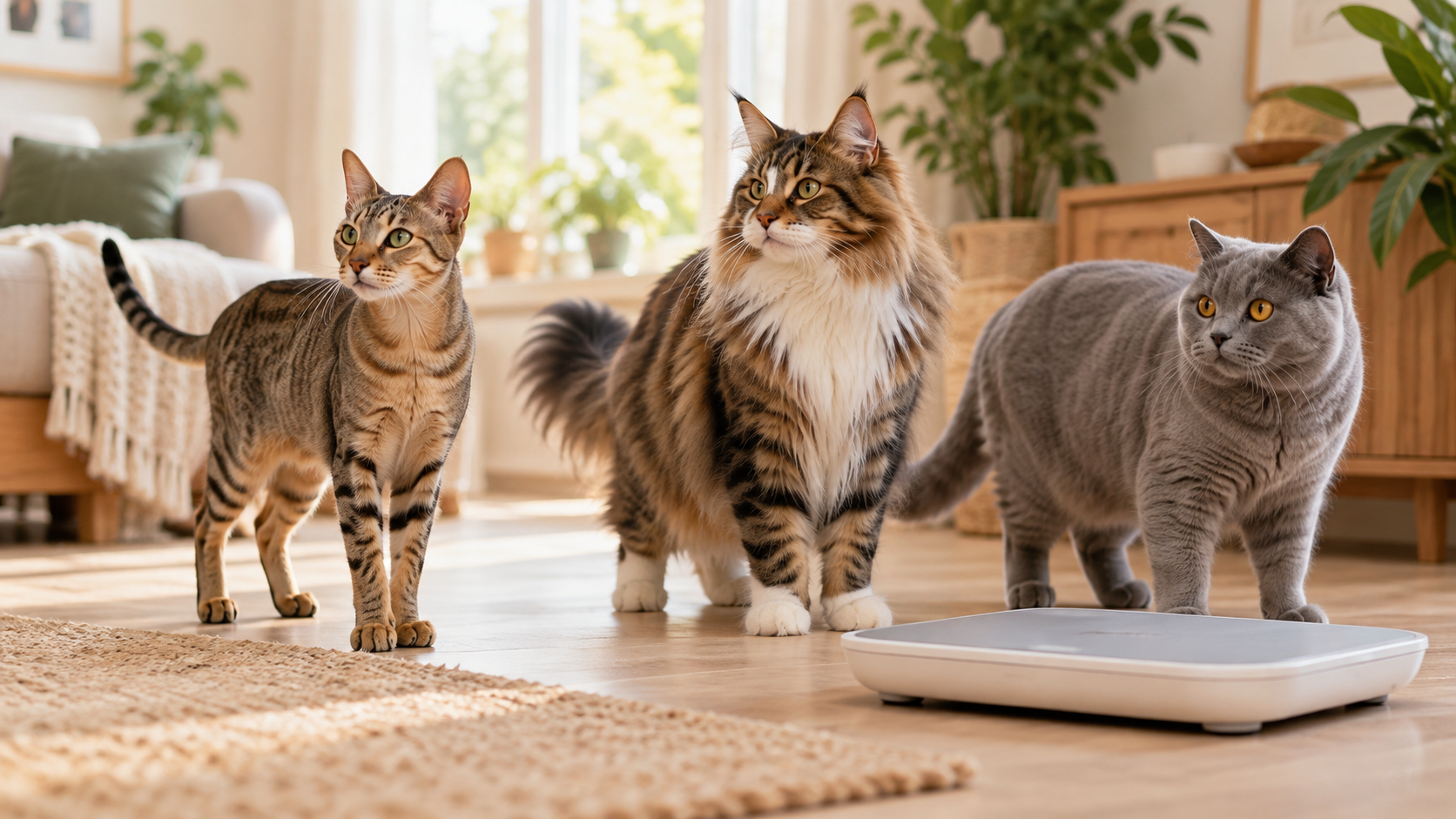
Cat Weight Chart by Breed
Healthy weight ranges for popular cat breeds, shown in both pounds and kilograms and organized by size category
Small Breeds
| Breed | Weight Range (lbs) | Average (lbs) | Weight Range (kg) | Average (kg) |
|---|---|---|---|---|
| Singapura | 4-8 | 6 | 1.8-3.6 | 2.7 |
| Munchkin | 5-9 | 7 | 2.3-4.1 | 3.2 |
| Cornish Rex | 6-10 | 8 | 2.7-4.5 | 3.6 |
| Devon Rex | 6-9 | 7.5 | 2.7-4.1 | 3.4 |
Medium Breeds
| Breed | Weight Range (lbs) | Average (lbs) | Weight Range (kg) | Average (kg) |
|---|---|---|---|---|
| Domestic Shorthair | 8-12 | 10 | 3.6-5.4 | 4.5 |
| American Shorthair | 10-15 | 12.5 | 4.5-6.8 | 5.7 |
| British Shorthair | 9-18 | 13 | 4.1-8.2 | 5.9 |
| Persian | 7-14 | 10.5 | 3.2-6.4 | 4.8 |
| Ragdoll | 10-20 | 15 | 4.5-9.1 | 6.8 |
| Siamese | 5-10 | 7.5 | 2.3-4.5 | 3.4 |
| Bengal | 8-15 | 11 | 3.6-6.8 | 5.0 |
| Abyssinian | 6-8 | 7 | 2.7-3.6 | 3.2 |
| Birman | 8-12 | 10 | 3.6-5.4 | 4.5 |
| Russian Blue | 7-15 | 10 | 3.2-6.8 | 4.5 |
| Scottish Fold | 6-13 | 9 | 2.7-5.9 | 4.1 |
| Sphynx | 6-12 | 9 | 2.7-5.4 | 4.1 |
Large Breeds
| Breed | Weight Range (lbs) | Average (lbs) | Weight Range (kg) | Average (kg) |
|---|---|---|---|---|
| Maine Coon | 12-20 | 16 | 5.4-9.1 | 7.3 |
| Norwegian Forest Cat | 8-16 | 12 | 3.6-7.3 | 5.4 |
| Siberian | 8-17 | 12.5 | 3.6-7.7 | 5.7 |
| Turkish Van | 7-20 | 13 | 3.2-9.1 | 5.9 |
Note About Tabby and Domestic Shorthair
"Tabby" refers to a coat pattern, not a breed. Most tabby cats are domestic shorthairs or American Shorthairs.
"Domestic Shorthair" refers to mixed breed cats with short coats. These cats typically weigh 8-12 pounds, with an average of 10 pounds.
For mixed breed cats, compare to the breed that most closely matches your cat's size and build, or use the general domestic cat range of 8-12 pounds.
Male vs. Female Weight Differences
Understanding gender-based size variation
Typical Weight Difference
Male cats typically weigh 1-2 pounds more than females of the same breed. This difference is most noticeable in larger breeds. For example, male Maine Coons may weigh 15-20 pounds, while females typically weigh 12-15 pounds. Breed weight ranges account for this variation.
Why Males Are Heavier
Male cats are generally larger due to hormonal differences and genetics. They tend to have more muscle mass and larger bone structure. This size difference is natural and should be considered when assessing weight. Both males and females can be healthy within their breed-specific ranges.
Assessing Weight by Gender
When using breed weight ranges, remember that males typically fall in the upper portion of the range, while females typically fall in the lower to middle portion. However, individual variation exists, and Body Condition Score (BCS) is often more reliable than weight alone for assessing health.
Neutered vs. Intact Cats
Neutered cats may have slightly different weight requirements due to metabolic changes. Neutered cats typically need 20-30% fewer calories than intact cats. However, breed weight ranges apply to both neutered and intact cats. Use our Cat Nutrition Calculator to determine appropriate calorie intake.
Popular Breed Weight Details
Detailed information about commonly asked breeds
Siamese Cat Weight
Siamese cats typically weigh 5-10 pounds, with an average of 7.5 pounds. They are a medium-sized breed known for their sleek, muscular build and distinctive color points. Siamese cats are active and may require more calories than sedentary cats.
Persian Cat Weight
Persian cats typically weigh 7-14 pounds, with an average of 10.5 pounds. Their long, thick coat can make them appear heavier than they actually are. When assessing weight, feel for body condition rather than relying solely on appearance.
Maine Coon Weight
Maine Coons are one of the largest domestic cat breeds, typically weighing 12-20 pounds with an average of 16 pounds. Males are often larger, sometimes reaching 20+ pounds. Maine Coons may continue growing until 18-24 months old. Use our Maine Coon Food Calculator for breed-specific nutrition guidance.
Domestic Shorthair Weight
Domestic shorthair cats (mixed breed cats) typically weigh 8-12 pounds, with an average of 10 pounds. However, weight varies significantly based on genetics, body frame, and individual variation. Use our Cat Weight Calculator or Cat BMI Calculator to assess your cat's health.
How Breed Weight Ranges Are Determined
The average weights listed in this guide come from published breed standards, veterinary references, and observed weight distributions across healthy adult cats. Each breed has a natural range rather than a single "correct" number, because genetics, bone structure, and body frame vary from cat to cat.
A breed's average is the midpoint most healthy adults of that breed cluster around, while the range captures the smaller and larger individuals who are still perfectly healthy. A large-framed Siamese near 10 pounds and a petite Siamese near 5 pounds can both be at an ideal weight for their build.
For this reason, weight is best used alongside Body Condition Score. Two cats of the same breed and weight can have very different amounts of muscle versus fat, so a hands-on assessment matters as much as the number on the scale.
Factors That Affect a Cat's Weight
Why individual cats vary from breed averages
Age and Growth Stage
Kittens gain weight rapidly during their first year, and large breeds like the Maine Coon may keep growing until 18-24 months. Senior cats often lose muscle mass and may weigh less than they did in their prime, even when healthy.
Body Frame and Bone Structure
A cat with a large, sturdy frame can healthily carry more weight than a fine-boned cat of the same breed. This is why breed weight ranges span several pounds rather than fixing a single target.
Neuter Status and Metabolism
Neutered and spayed cats need roughly 20-30% fewer calories than intact cats and are more prone to gradual weight gain. Adjusting portions after surgery helps keep them within a healthy range.
Activity Level and Lifestyle
Indoor cats with limited exercise burn fewer calories than active or outdoor cats. Enrichment, play sessions, and portion control all influence where a cat lands within its breed range.
Smallest to Largest Cat Breeds by Weight
Cat breeds span a surprisingly wide weight spectrum. At the small end, the Singapura averages around 6 pounds, making it one of the lightest domestic breeds. In the middle sit familiar breeds like the Siamese and Abyssinian at roughly 7 to 7.5 pounds, and the American Shorthair and British Shorthair at 12 to 13 pounds.
At the large end, the Ragdoll averages about 15 pounds and the Maine Coon tops the list near 16 pounds, with some males reaching 20 pounds or more. That means the largest breeds can weigh nearly three times as much as the smallest, which is why a single "average cat weight" figure is misleading without knowing the breed.
When comparing your own cat, always start with its breed or the breed it most closely resembles rather than a generic average. A 14-pound Maine Coon may be perfectly lean, while a 14-pound Siamese would likely be significantly overweight.
How to Weigh Your Cat at Home
Accurate weight tracking makes it far easier to spot small changes before they become health problems. The simplest reliable method uses a standard bathroom scale: weigh yourself alone, then weigh yourself while holding your cat, and subtract the difference. A digital scale gives cleaner readings than an analog one.
For small cats and kittens, a kitchen or baby scale is more precise because it can measure to the ounce. Place a towel or carrier on the scale, zero it out, and then set your cat on top. Weigh at the same time of day and roughly the same point in the feeding cycle so your readings are consistent.
Aim to weigh your cat monthly and record the results. A change of more than about half a pound in either direction over a few weeks is worth discussing with your veterinarian, since sudden weight loss or gain can signal an underlying issue.
Signs Your Cat Is Overweight or Underweight
Reading body condition beyond the number on the scale
Signs of a Healthy Weight
At an ideal weight you can feel your cat's ribs with a light touch but not see them, there is a visible waist when viewed from above, and a slight abdominal tuck when viewed from the side. This corresponds to a Body Condition Score of 4-5 out of 9.
Signs of an Overweight Cat
Ribs that are hard to feel under a layer of fat, no visible waist, a rounded or sagging belly, and a broad back are common signs of excess weight. Even a couple of extra pounds is significant on a small cat and raises the risk of diabetes and joint strain.
Signs of an Underweight Cat
Prominent ribs, spine, or hip bones, a severe abdominal tuck, and loss of muscle over the shoulders suggest a cat is underweight. This warrants a veterinary visit to rule out dental disease, hyperthyroidism, or other causes.
When to See a Vet
Any unexplained weight change, a persistent appetite change, or a Body Condition Score outside the healthy range is worth a professional check. Your veterinarian can set a safe target weight and a gradual plan to reach it.
Related Calculators and Guides
Once you know your cat's breed weight range, these free tools help you turn that number into an action plan. The Cat Weight Calculator compares your cat's current weight to its breed standard, while the Cat BMI Calculator helps you read body condition rather than weight alone.
For feeding and nutrition, the Maine Coon Food Calculator offers breed-specific portion guidance for large cats, and our broader nutrition tools help you match calorie intake to your cat's age, activity, and neuter status. Using weight standards and feeding tools together gives you the clearest picture of your cat's health.
Frequently Asked Questions About Cat Breed Weights
Common questions about breed-specific weight ranges and comparisons
What is the average cat weight?
The average cat weight for a healthy adult domestic cat is about 8-12 pounds (3.6-5.4 kg), with 10 pounds being typical. However, average cat weight varies widely by breed, from around 6 pounds for a Singapura to 16 pounds or more for a Maine Coon. Use the cat weight chart above to find the healthy range for your cat's breed.
How do I use a cat weight chart?
Find your cat's breed (or the breed it most closely resembles) in the cat weight chart, then compare its current weight to the listed healthy range in pounds or kilograms. If your cat falls above the range, it may be overweight; below the range, it may be underweight. Pair the chart with a Body Condition Score for the most accurate picture.
What is the average weight for a Siamese cat?
Siamese cats typically weigh 5-10 pounds, with an average of 7.5 pounds. Males are usually slightly heavier than females, typically weighing 1-2 pounds more. Siamese cats are a medium-sized breed known for their sleek, muscular build.
How much should a Persian cat weigh?
Persian cats typically weigh 7-14 pounds, with an average of 10.5 pounds. Their long, thick coat can make them appear heavier than they actually are. Use our Cat Weight Calculator to compare your Persian cat's weight to breed standards.
What is the average weight for a Maine Coon?
Maine Coons are one of the largest domestic cat breeds, typically weighing 12-20 pounds with an average of 16 pounds. Males are often larger, sometimes reaching 20+ pounds. Maine Coons may continue growing until 18-24 months old. Use our Maine Coon Food Calculator for breed-specific nutrition guidance.
How much should a tabby cat weigh?
"Tabby" refers to a coat pattern, not a breed. Most tabby cats are domestic shorthairs or American Shorthairs, which typically weigh 8-12 pounds (domestic shorthair) or 10-15 pounds (American Shorthair). Use our Cat Weight Calculator to assess your tabby cat's weight based on their actual breed or body frame.
What is the average weight for a domestic shorthair cat?
Domestic shorthair cats (mixed breed cats) typically weigh 8-12 pounds, with an average of 10 pounds. However, weight varies significantly based on genetics, body frame, and individual variation. Use our Cat Weight Calculator to compare your cat's weight to ideal ranges, or our Cat BMI Calculator to assess body condition.
Do male and female cats weigh the same?
No, male cats typically weigh 1-2 pounds more than females of the same breed. This difference is most noticeable in larger breeds. For example, male Maine Coons may weigh 15-20 pounds, while females typically weigh 12-15 pounds. Breed weight ranges account for this variation.
How do I know if my mixed breed cat is at a healthy weight?
For mixed breed cats, compare to the breed that most closely matches your cat's size and build, or use the general domestic cat range of 8-12 pounds. Body Condition Score (BCS) is often more reliable than weight alone for mixed breeds. Use our Cat BMI Calculator to assess body condition visually and tactually.
What if my cat's weight doesn't match breed standards?
If your cat's weight is outside breed standards, consider their body frame and Body Condition Score. A small-framed cat may be healthy at 7 pounds, while a large-framed cat may be healthy at 15 pounds. Use our Cat Weight Calculator and Cat BMI Calculator together for a complete assessment. Consult your veterinarian if concerned.
Compare Your Cat's Weight to Breed Standards
Use our free Cat Weight Calculator to see how your cat compares to breed-specific weight ranges.
Free cat printables
Keep these cat care guides handy
A rotating selection of practical cat guides chosen from our free printable library.Cat Body Condition Chart
A printable body condition reference for cats.
Cat Feeding Guide
Portions by weight, age, and life stage.
Kitten Calorie Guide
Calorie targets by kitten age and weight.