
Last updated: October 3, 2026
How To Use
This tool helps assess your cat's body condition and calculate an estimated BMI based on their Body Condition Score (BCS).
Note: BMI is calculated from your BCS assessment, not from weight. BCS is the primary and more accurate assessment tool for pets. Weight is collected for reference and validation purposes only.
The Body Condition Score uses a 1-5 scale where 3 is ideal. Simply fill out the fields and click Calculate to get started.
Quick Steps
- 1 Enter your Cat's Weight in pounds.
- 2 Select your Cat's Body Condition Score based on the descriptions below.
- 3 Click the Calculate button to see the BMI assessment and recommendations.
Cat BMI Calculator
Fill Out The Fields Below
Cat Body Condition Score Guide
| BCS | Description |
|---|---|
| 1 - Emaciated | Ribs, spine, and hip bones are highly visible. No body fat. Severe abdominal tuck. |
| 2 - Thin | Ribs, spine, and hip bones are easily visible. Minimal body fat. Obvious abdominal tuck. |
| 3 - Ideal | Ribs are easily felt but not visible. Waist is visible behind ribs. Minimal abdominal fat. |
| 4 - Overweight | Ribs are difficult to feel under fat. Waist is barely visible or absent. Abdominal fat pad present. |
| 5 - Obese | Ribs cannot be felt under heavy fat layer. No waist. Large abdominal fat pad. Fat deposits on back and base of tail. |
Is My Cat Overweight? A Quick Checklist
"Is my cat overweight?" is one of the most common questions cat owners ask, and this calculator is built to answer it. Not sure if your cat is at a healthy weight? Use this quick at-home checklist alongside our calculator. If you answer "yes" to 2 or more of these, your cat may be overweight. For a deeper walkthrough, see our full Is My Cat Overweight? guide.
Physical Signs
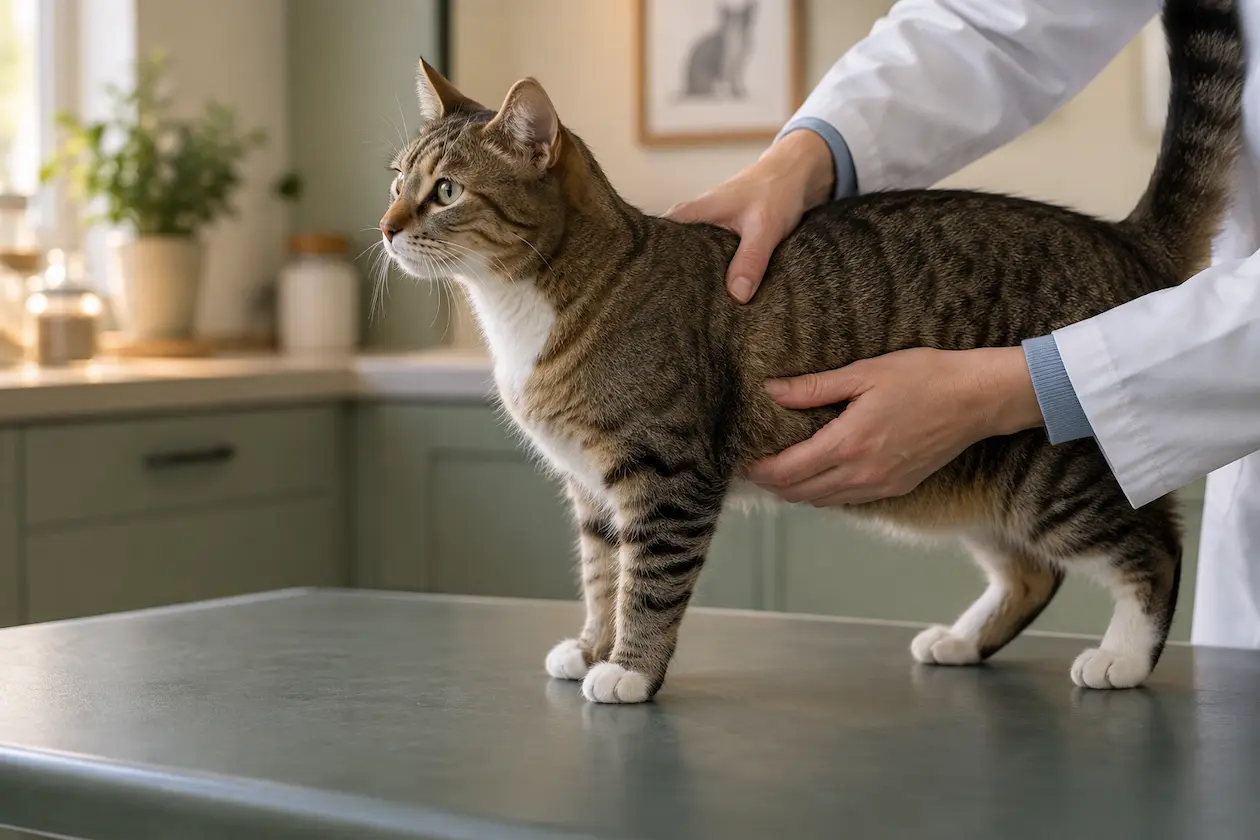
- Rib test: Can you feel your cat's ribs without pressing hard? If not, there's excess fat.
- Waist check: Look down from above, does your cat have a visible waistline behind the ribs? No waist = overweight.
- Belly tuck: View from the side, does the belly hang lower than the ribcage? A hanging belly (primordial pouch aside) indicates excess weight.
- Fat pads: Can you feel fat deposits at the base of the tail or between the shoulders?
Behavioral Signs
- Grooming: Does your cat struggle to groom their back or hindquarters?
- Jumping: Has your cat stopped jumping on counters or furniture they used to reach easily?
- Activity: Does your cat sleep significantly more than usual and resist play?
- Breathing: Does your cat pant or breathe heavily after minimal activity?
Cat Body Condition Score (BCS) Guide
The Body Condition Score is a 1–5 scale used by veterinarians to assess body fat. Here's what each score looks like and means:
Emaciated
Ribs, spine, and hip bones clearly visible. No body fat. Severe muscle loss. Action: Veterinary visit urgently needed.
Underweight
Ribs easily felt with minimal fat. Visible waist and abdominal tuck. Spine may be visible. Action: Gradually increase calories. Consult vet to rule out illness.
Ideal
Ribs felt through thin fat layer. Clear waist visible from above. Slight belly tuck from the side. Action: Maintain current diet and exercise routine.
Overweight
Ribs difficult to feel under fat layer. Waist barely visible. Belly rounds outward. Fat deposits on back and base of tail. Action: Reduce calories by 15–20%. Use our Cat Weight Loss Calculator.
Obese
Ribs cannot be felt. No waist. Large belly, heavy fat pads. Difficulty grooming or moving. Action: Veterinary weight management plan needed. Do not crash-diet, risk of hepatic lipidosis.
Ideal Cat Weight by Breed
"Is my cat overweight?" depends on breed. A 12 lb Maine Coon is perfectly healthy, while a 12 lb Siamese is likely obese. Here are ideal weight ranges for common breeds:
| Breed | Ideal Weight (lbs) | Ideal Weight (kg) | Notes |
|---|---|---|---|
| Domestic Shorthair | 8–11 lbs | 3.5–5 kg | Most common cat type. Wide variation. |
| Siamese | 6–10 lbs | 2.7–4.5 kg | Naturally lean and slender build. |
| Persian | 7–12 lbs | 3–5.5 kg | Stocky build can mask excess weight. |
| Maine Coon | 10–18 lbs | 4.5–8 kg | Largest breed. Males can reach 20+ lbs. |
| Ragdoll | 10–15 lbs | 4.5–7 kg | Large breed. Slow to mature (3–4 years). |
| British Shorthair | 9–17 lbs | 4–7.5 kg | Dense, muscular build. Prone to weight gain. |
| Bengal | 8–15 lbs | 3.5–7 kg | Athletic build. Very active breed. |
| Sphynx | 6–12 lbs | 2.7–5.5 kg | Higher metabolism due to no fur. Needs more calories. |
| Abyssinian | 6–10 lbs | 2.7–4.5 kg | Lean, active breed. Rarely overweight. |
For a detailed breed-specific weight assessment, use our Cat Weight Calculator. To calculate your cat's daily calorie needs, try our Cat Calorie Calculator. For normal weight ranges by age and breed, see our Cat Weight Chart by Age & Growth Guide.
Cat BMI vs. Body Condition Score: Which Should You Use?
Cat owners often ask whether they should rely on BMI or Body Condition Score (BCS). The two measures answer slightly different questions, and using them together gives the clearest picture of your cat's health.
| Feature | Cat BMI | Body Condition Score (BCS) |
|---|---|---|
| What it measures | A number derived from weight and body measurements | A hands-on visual and tactile fat assessment |
| Scale | Roughly 18–25 is considered healthy | 1–5 scale (3 is ideal) |
| Accounts for breed | No, a single number for all cats | Yes, judged against the individual cat's frame |
| Best for | A quick at-home screening number | The most reliable everyday assessment |
Bottom line: BCS is the gold standard veterinarians use because it adjusts for breed and frame. BMI is a useful supporting number, especially for tracking trends over time. Our calculator combines both so you get a complete picture rather than a single misleading figure.
How the Feline Body Mass Index (FBMI) Works
The Feline Body Mass Index (FBMI) adapts the human BMI idea for cats. Because cats do not stand upright, the method uses two body measurements instead of height: the rib cage circumference and the leg length from knee to ankle (the LIM, or lower-leg index measurement). Those measurements are combined into a single index number that estimates body fat percentage, which then maps onto a weight-status band. In practice, most owners find the Body Condition Score faster to use day to day, but the FBMI is a helpful cross-check because it turns a hands-on impression into a repeatable number you can track over time.
Our calculator estimates your cat's index from weight and Body Condition Score rather than asking for tape-measure readings, so you get an at-home number in seconds. Here is how a result maps to a weight-status band:
| BMI Range | Weight Status | Matching BCS | What It Means |
|---|---|---|---|
| Below 15 | Underweight | BCS 1-2 | Ribs and spine easily seen or felt with little fat. Check with your vet for underlying illness. |
| 15 to 25 | Ideal | BCS 3 | Ribs felt under a thin fat layer, clear waist, slight belly tuck. Maintain current routine. |
| 25 to 30 | Overweight | BCS 4 | Ribs hard to feel, waist fading, belly rounding out. Reduce calories by 15 to 20 percent. |
| Above 30 | Obese | BCS 5 | Ribs cannot be felt, no waist, heavy fat pads. A vet-guided weight plan is needed. |
Treat these bands as a guide, not a diagnosis. Breed frame, muscle, and age all shift where a healthy number falls, which is why pairing the index with a hands-on Body Condition Score gives the most reliable read.
Interpreting Your Cat's Results
Once the calculator returns a BMI figure and weight-status band, here is how to act on each outcome:
- Underweight result: Do not simply add food. Book a vet visit first, since sudden or unexplained weight loss can signal hyperthyroidism, dental pain, kidney disease, or parasites.
- Ideal result: Keep doing what you are doing. Re-check monthly and weigh your cat on the same scale so you catch small changes early.
- Overweight result: Switch from free-feeding to measured meals and trim daily calories by 15 to 20 percent. Build a safe target with our Cat Weight Loss Calculator.
- Obese result: Work with your veterinarian on a structured plan. Never crash-diet a cat, because rapid loss can trigger hepatic lipidosis (fatty liver).
To confirm your reading with a proper hands-on assessment, walk through our step-by-step Cat Body Condition Score guide. It shows exactly where to feel and what each score looks like so your BMI band and BCS agree.
Worked Examples: Reading Your Cat's Results
Numbers are easier to understand with real scenarios. Here are three common examples showing how weight, breed, and Body Condition Score come together:
Example 1: A 15 lb Maine Coon
A 15 lb Maine Coon sits squarely inside the healthy 10–18 lb breed range. If you can feel the ribs under a thin fat layer and see a slight waist, this cat is a BCS of 3, ideal. The high weight alone is not a concern for this large breed.
Example 2: A 14 lb Siamese
The same 14 lb weight tells a very different story for a Siamese, whose healthy range is 6–10 lbs. At 14 lbs the ribs are hard to feel and there is no waist, putting this cat at a BCS of 5 (obese). This cat needs a vet-guided weight loss plan.
Example 3: A 6 lb Domestic Shorthair
A 6 lb adult Domestic Shorthair falls below the typical 8–11 lb range. If the spine and ribs are highly visible with little fat, this is a BCS of 2 (underweight). Schedule a vet visit to rule out illness before increasing calories.
Why Cat Weight Matters: The Research
Feline obesity is one of the most common preventable health problems in pet cats, and the data shows why staying on top of body condition is worth the effort:
- It is widespread. An estimated 50–60% of domestic cats in the US are overweight or obese, making it the single most common nutritional disorder in cats.
- Diabetes risk climbs sharply. Overweight cats are roughly 4× more likely to develop type 2 diabetes than cats at a healthy weight.
- Joints suffer. Excess weight increases the risk of arthritis and lameness, and obese cats are about 3× more likely to develop joint problems.
- Lifespan shortens. Carrying extra weight is linked to a shorter life expectancy and higher rates of urinary tract disease and hepatic lipidosis (fatty liver).
- Small losses help. Even a modest 10–15% reduction in body weight can meaningfully improve mobility, insulin sensitivity, and overall quality of life.
The encouraging news: weight gain is gradual and reversible. Regular body condition checks, measured meals, and daily play are the most effective tools for keeping your cat in the healthy range.
FAQs
Frequently Asked Questions
What is a Body Condition Score for cats?
Body Condition Score (BCS) is a visual and tactile assessment tool that evaluates your cat's body fat using a 1-5 scale. A score of 1 indicates emaciated, 3 is ideal, and 5 is obese.
How do I determine my cat's Body Condition Score?
You can assess your cat's BCS by feeling their ribs, spine, and hip bones, and observing their waist and abdominal area. Use our detailed BCS guide in the calculator to match your cat's condition.
What is a healthy BMI for a cat?
A healthy BMI for cats typically ranges from 18-25, though this can vary by breed and body type. The Body Condition Score is often more reliable than BMI alone for assessing cat health.
What should I do if my cat is overweight?
If your cat is overweight (BCS 4-5), consult your veterinarian for a weight loss plan. They may recommend a calorie-restricted diet and increased exercise. Use our Cat Nutrition Calculator to determine appropriate calorie intake.
What should I do if my cat is underweight?
If your cat is underweight (BCS 1-2), consult your veterinarian immediately. Underweight cats may have underlying health issues that need to be addressed. A veterinarian can help create a safe weight gain plan.
Is my cat overweight?
You can determine if your cat is overweight by using our Cat BMI Calculator, which assesses Body Condition Score (BCS). Cats with a BCS of 4-5 are considered overweight to obese. Signs include difficulty feeling ribs, no visible waist, and excessive abdominal fat. Consult your veterinarian for a professional assessment.
How do I tell if my cat is overweight?
To tell if your cat is overweight, run three quick hands-on checks. Feel along the ribs: you should feel them easily under a thin fat layer, not have to press. Look down from above: a healthy cat has a visible waist that narrows behind the ribs. View from the side: the belly should tuck up slightly rather than hang low. If the ribs are hard to find, the waist is gone, and the belly rounds outward, your cat is likely overweight (BCS 4-5). Enter the weight and Body Condition Score into our Cat BMI Calculator for a clearer reading, then confirm with your veterinarian.
How do I know if my cat is obese?
Cats with a Body Condition Score (BCS) of 5 are considered obese. Obese cats have ribs that cannot be felt under heavy fat, no visible waist, large abdominal fat pads, and fat deposits on the back and base of tail. Use our Cat BMI Calculator to assess your cat's condition and consult your veterinarian for a weight management plan.
How much should my cat weigh?
Most domestic cats should weigh between 8–11 lbs (3.5–5 kg), but healthy weight varies significantly by breed. Siamese cats may be healthy at 6–10 lbs, while Maine Coons can be healthy at 12–18 lbs. Our Cat Weight Calculator can give you breed-specific weight ranges.
Can I calculate BMI for my cat at home?
Cat BMI is calculated using body weight and body measurements. Our calculator estimates BMI from your cat's weight and Body Condition Score. For the most accurate assessment, combine our calculator with a hands-on rib check, you should be able to easily feel (but not see) your cat's ribs through a thin layer of fat.
What percentage of cats are overweight?
Studies estimate that 50–60% of domestic cats in the US are overweight or obese. Indoor cats, neutered cats, and cats fed free-choice dry food are at higher risk. Regular body condition assessments can help catch weight gain early before it becomes a health problem.
What health problems does cat obesity cause?
Overweight cats face increased risk of diabetes, arthritis, urinary tract disease, hepatic lipidosis (fatty liver), and shortened lifespan. Obese cats are 4× more likely to develop diabetes and 3× more likely to develop lameness. Even modest weight loss (10–15%) can significantly improve health outcomes.
How do I help my overweight cat lose weight safely?
Reduce your cat's daily calories by 15–20% and increase play time to 15–20 minutes daily. Use puzzle feeders to slow eating, switch from free-feeding to measured meals, and weigh your cat weekly. Never crash-diet a cat, rapid weight loss can cause hepatic lipidosis. Use our Cat Weight Loss Calculator for a safe plan.
Other Calculators for Cats
Cat Food Carb Calculator | Free Carbohydrate Calculator for Cat Food
Free cat food carb calculator. Calculate carbohydrate content in wet and dry cat food from the guaranteed analysis label. Compare carbs on a dry matter basis. Essential for low-carb and diabetic cat diets.
Cat Calorie Calculator - Daily Calories & Feeding Amounts for Cats
Free cat calorie calculator. Enter your cat
Kitten Calorie Calculator - Free Daily Calorie Needs Tool
Free kitten calorie calculator. Enter your kitten
Other Pet Health Calculators
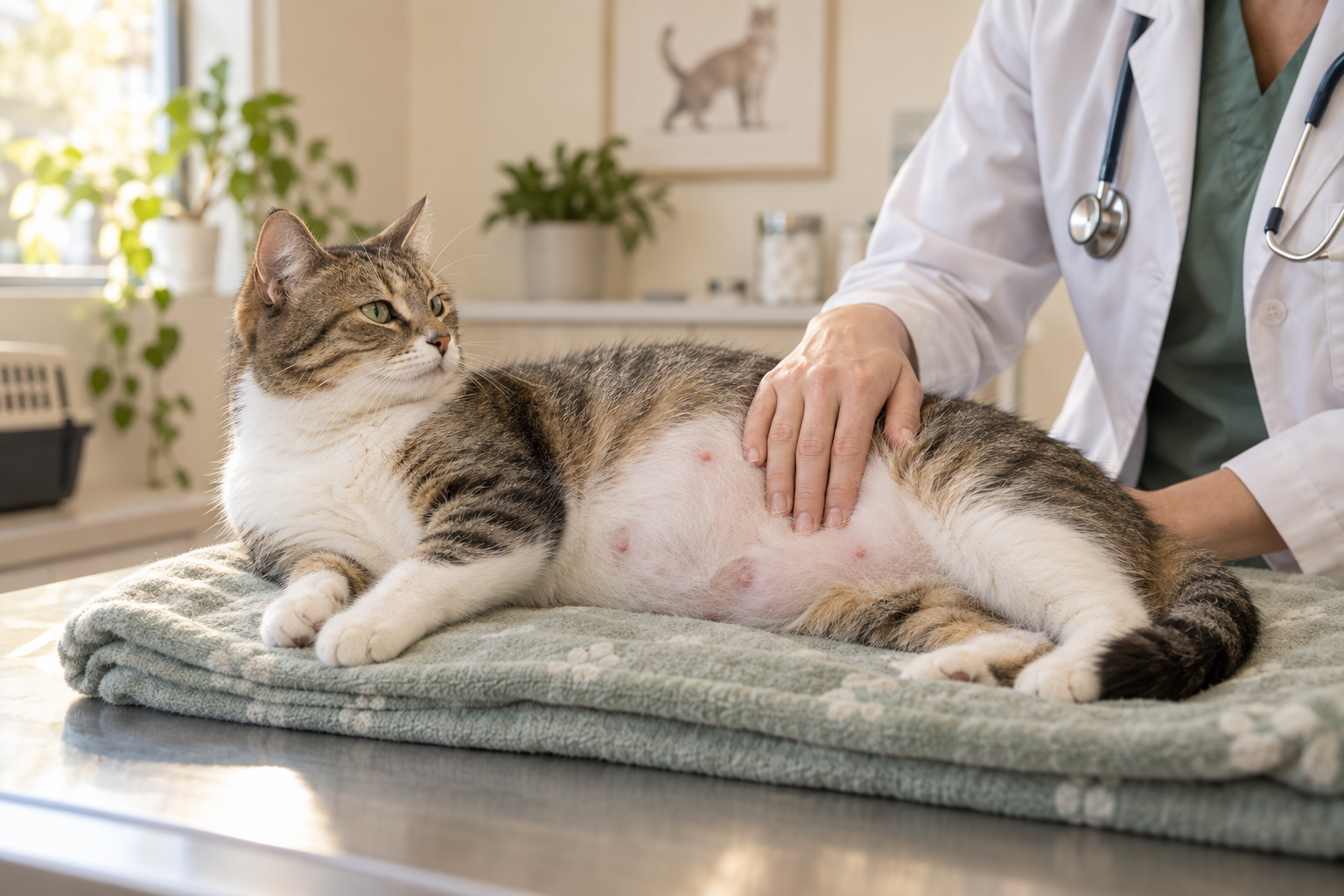
How Long Are Cats Pregnant? Cat Pregnancy Calculator & Due Date Tool
How long are cats pregnant? Cat pregnancy averages 63–65 days (about 9 weeks). Use our free cat pregnancy calculator to find the estimated due date, current week, and a week-by-week kitten care guide.
Cat Quality of Life Calculator, Free HHHHHMM Scale for Cats | Senior Cat QoL Tool
Free cat quality of life calculator using the HHHHHMM scale. Assess your senior cat

Dog BMI Calculator - Free Body Condition Score Tool for Dogs
Free dog BMI calculator and body condition score tool. Check whether your dog is overweight, underweight, or ideal using the 1-9 BCS scale, and get personalized diet and exercise next steps based on your dog
Free cat printables
Keep these cat care guides handy
A rotating selection of practical cat guides chosen from our free printable library.Cat Pregnancy Timeline
A week-by-week kittening calendar and checklist.
Kitten Growth Chart
Week-by-week weight and development milestones.
Cat Feeding Guide
Portions by weight, age, and life stage.