
Last updated: October 3, 2026
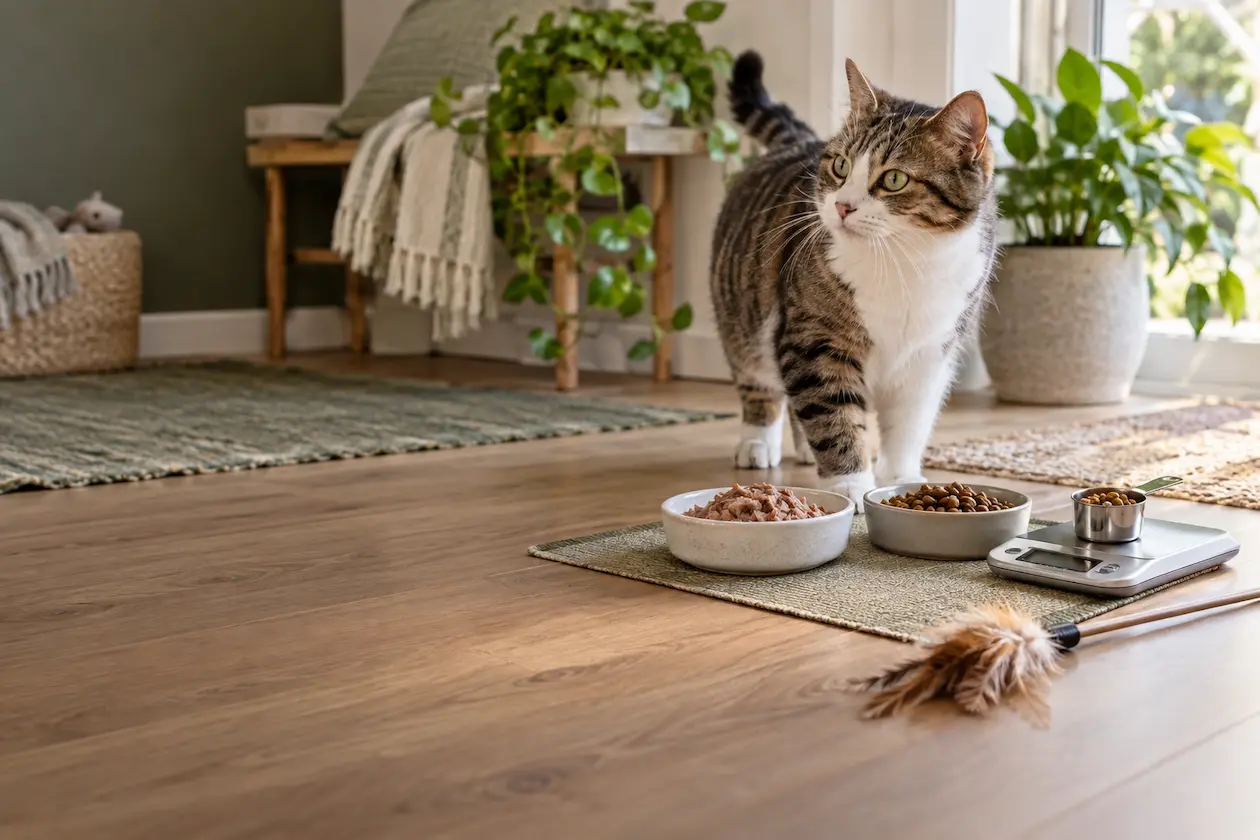
How To Use
This tool helps estimate the daily calorie requirements for your cat based on their weight, activity level, body condition score, and neuter status.
Simply fill out the fields and click Calculate to get started.
Quick Steps
- 1 Enter your Cat's Weight in pounds.
- 2 Select the Activity Level of your cat.
- 3 Select the Life Stage of your cat.
- 4 Select the Body Condition Score of your cat.
- 5 Select the Neutered/Spayed Status of your cat.
- 6 Select your Cat's Breed Type (optional).
- 7 Select the Feeding Frequency of your cat.
- 8 Select the Current Diet Type of your cat.
- 9 Click the Calculate button to see the estimated daily calorie requirement.
Cat Calorie Calculator
Fill Out The Fields Below
Result
Breed Types for Cats
| Breed Type | Description |
|---|---|
| Abyssinian | Known for their playful and curious nature, Abyssinians are active and enjoy interactive toys. |
| American Shorthair | Adaptable and easy-going, American Shorthairs are known for their robust health and friendly demeanor. |
| Bengal | Highly energetic and intelligent, Bengals thrive on interactive play and mental stimulation. |
| Birman | Gentle and affectionate, Birmans are social cats that enjoy companionship and gentle play. |
| British Shorthair | Laid-back and independent, British Shorthairs are calm companions that enjoy a relaxed indoor lifestyle. |
| Persian | Regal and loving, Persians have a calm temperament and require regular grooming due to their long coats. |
| Ragdoll | Affectionate and docile, Ragdolls are known for their relaxed nature and tendency to go limp when held. |
| Siamese | Vocal and social, Siamese cats are active and thrive on attention and interactive play. |
| Sphynx | Playful and affectionate, Sphynx cats are known for their lack of coat and warm, friendly demeanor. |
Feeding Frequencies
| Feeding Frequency | Description |
|---|---|
| Once a day | Suitable for cats with low energy levels or those prone to overeating. |
| Twice a day | Standard feeding frequency for most adult cats to maintain energy levels throughout the day. |
| Three times a day | Suitable for kittens or active adult cats to ensure adequate nutrition and energy. |
| Four times a day | Recommended for kittens or cats with high energy needs or specific health conditions. |
Diet Types for Cats
| Diet Type | Description |
|---|---|
| Dry Food | Convenient and helps maintain dental health, but ensure adequate water intake. |
| Wet Food | Provides additional hydration and can be more palatable for picky eaters. |
| Combination of Dry and Wet | Balances benefits of both types, offering hydration and dental health benefits. |
Life Stages for Cats
| Life Stage | Description |
|---|---|
| Young Adult (1-3 years) | Needs balanced nutrition for energy and maintaining health. |
| Adult (3-7 years) | Maintains optimal health with balanced nutrition and regular exercise. |
| Mature Adult (7-10 years) | May require adjustments in diet to support aging and maintain health. |
| Senior (10+ years) | Needs specialized nutrition to support aging joints, immune system, and overall health. |
Neuter/Spay Status Options for Cats
| Neuter/Spay Status | Description |
|---|---|
| Yes | Reduces reproductive health risks and behaviors like spraying or roaming. |
| No | Maintains natural reproductive health and behaviors. |
How to Calculate Your Cat's Daily Calories
A cat's daily calorie needs are determined by their Resting Energy Requirement (RER) multiplied by an activity factor. Our cat calorie calculator uses this veterinary-standard formula to give you a personalized estimate:
RER = 70 × (body weight in kg)^0.75
Daily Calories = RER × activity/life stage factor
Activity factors range from 1.0 for sedentary indoor cats to 1.6 for very active cats. Neutered cats typically need fewer calories (factor of 1.2) than intact cats (factor of 1.4). Use the calculator above to get your cat's exact number, just enter their weight, activity level, and life stage.
The activity or life stage factor you multiply RER by is called the MER (Maintenance Energy Requirement) factor. Here is a quick reference for the most common cat scenarios:
| Cat Type | MER Factor (× RER) | Notes |
|---|---|---|
| Kitten (growth) | 2.0–2.5× | Growing kittens need roughly double an adult cat's calories per pound. |
| Neutered adult | 1.2× | The most common setting for a typical indoor, spayed or neutered cat. |
| Intact adult | 1.4× | Un-neutered cats have a higher metabolic rate. |
| Active / outdoor | 1.4–1.6× | Cats that roam, hunt, or play hard burn more energy. |
| Weight loss | 0.8× | Use the ideal (target) weight, not current weight, when calculating for weight loss. |
To see the full energy formulas behind these factors, use our RER/MER Calculator.
Cat Calorie Needs by Weight
Here's a quick reference for approximate daily calorie needs based on weight. These assume a moderately active, neutered adult cat:
| Cat Weight | Daily Calories (kcal) | Wet Food (approx.) | Dry Food (approx.) |
|---|---|---|---|
| 5 lbs (2.3 kg) | 130–160 kcal | ~1.5 cans (5.5 oz) | ~1/3 cup |
| 8 lbs (3.6 kg) | 180–220 kcal | ~2 cans (5.5 oz) | ~1/2 cup |
| 10 lbs (4.5 kg) | 200–260 kcal | ~2.5 cans (5.5 oz) | ~2/3 cup |
| 12 lbs (5.4 kg) | 230–290 kcal | ~3 cans (5.5 oz) | ~3/4 cup |
| 15 lbs (6.8 kg) | 270–340 kcal | ~3.5 cans (5.5 oz) | ~1 cup |
| 18 lbs (8.2 kg) | 310–380 kcal | ~4 cans (5.5 oz) | ~1.1 cups |
Food amounts are approximate and vary by brand. Check your cat food's kcal/can or kcal/cup on the label. Indoor cats and less active cats should use the lower end of the range. For kittens, use our Kitten Calorie Calculator instead. To check carbohydrate content in your cat's food, try our Cat Food Carb Calculator. If your cat needs to lose weight, see our Cat Weight Loss Calculator.
Indoor vs Outdoor Cat Calorie Needs
One of the biggest factors in how many calories a cat needs is whether they live indoors or outdoors. Outdoor cats can burn 20–40% more calories than indoor cats due to roaming, hunting, and temperature regulation. Indoor cats, by contrast, spend more time resting and are more prone to weight gain if overfed.
Indoor Cat
- Activity factor: 1.0–1.2× RER
- 8 lb cat: ~170–200 kcal/day
- 10 lb cat: ~200–240 kcal/day
- 12 lb cat: ~220–270 kcal/day
- Key risk: Obesity from overfeeding and low activity
Outdoor Cat
- Activity factor: 1.4–1.6× RER
- 8 lb cat: ~220–280 kcal/day
- 10 lb cat: ~260–330 kcal/day
- 12 lb cat: ~290–370 kcal/day
- Key risk: Underfeeding if supplemental hunting isn't accounted for
If your indoor cat is gaining weight, try setting the activity level to "Low" in the calculator above. For a structured weight loss plan, use our Cat Weight Loss Calculator.
Cat Calorie Needs by Life Stage
A cat's calorie requirements change significantly throughout their life. Kittens need roughly twice the calories per pound of body weight compared to adult cats, while senior cats often need fewer calories to avoid weight gain as their metabolism slows.
| Life Stage | Age Range | Calorie Multiplier | Typical Daily kcal | Feeding Tips |
|---|---|---|---|---|
| Kitten | 0–12 months | 2.0–2.5× RER | 200–350 kcal | Feed kitten-specific food 3–4 times daily. High protein essential for growth. |
| Young Adult | 1–3 years | 1.2–1.4× RER | 200–280 kcal | Most active life stage. Transition to adult food at 12 months. |
| Adult | 3–10 years | 1.0–1.2× RER | 180–260 kcal | Monitor weight closely. Adjust calories if gaining or losing. |
| Senior | 10+ years | 0.8–1.0× RER | 150–220 kcal | Lower calories but higher protein. Consider senior-formula food. |
| Pregnant / Nursing | Any age | 2.0–3.0× RER | 300–500+ kcal | Free-feed kitten food during nursing. Calorie needs peak at 3–4 weeks postpartum. |
Typical daily kcal ranges assume a 9–11 lb cat. For kittens under 12 months, use our Kitten Calorie Calculator for more accurate age- and breed-specific estimates.
How to Read Cat Food Labels for Calories
Once you know how many calories your cat needs, the next step is figuring out how much food that translates to. Cat food labels list calorie content in different ways depending on the format:
Most common on wet food. A 5.5 oz can typically has 80–120 kcal. A 3 oz can has 40–70 kcal.
Used on dry food bags. Most dry cat food has 300–450 kcal per cup (8 oz measuring cup).
Standard metric format. Divide by the weight of a serving to find kcal per meal. Common on specialty and imported brands.
Example: Your cat needs 250 kcal/day. Your wet food has 95 kcal per 5.5 oz can. That's 250 ÷ 95 = 2.6 cans per day, about 1.3 cans in the morning and 1.3 cans in the evening. If you mix dry food (400 kcal/cup), give half the calories from each: 1.3 cans + ~⅓ cup dry.
To check carbohydrate levels in your cat's food (especially important for diabetic cats), use our Cat Food Carb Calculator.
Feeding Guide: Wet Food vs Dry Food Calories
Wet and dry cat food have very different calorie densities. A cup of dry food has roughly 3–4× the calories of the same volume of wet food because of moisture content. Here's how common food types compare:
| Food Type | Serving Size | Typical kcal | Cans/Cups for 250 kcal |
|---|---|---|---|
| Wet, Pâté (5.5 oz can) | 1 can (156g) | 100–120 kcal | ~2–2.5 cans |
| Wet, Gravy/Chunks (5.5 oz can) | 1 can (156g) | 70–95 kcal | ~2.5–3.5 cans |
| Wet, Small Can (3 oz) | 1 can (85g) | 40–70 kcal | ~3.5–6 cans |
| Dry, Standard Kibble | 1 cup (8 oz) | 350–400 kcal | ~⅔ cup |
| Dry, High-Protein / Grain-Free | 1 cup (8 oz) | 400–500 kcal | ~½ cup |
| Dry, Weight Management | 1 cup (8 oz) | 280–340 kcal | ~¾–1 cup |
Many cat owners use combination feeding, offering wet food at mealtimes and leaving a measured amount of dry food available. If you combine, split the calorie target between both. For example, if your cat needs 250 kcal/day, you might offer one 5.5 oz can of pâté (~110 kcal) and a third cup of kibble (~130 kcal).
For specific portion sizes based on your cat's weight, age, and feeding schedule, use our Cat Feeding Calculator. To understand the energy formulas behind these numbers, see our RER/MER Calculator. For healthy weight ranges by age and breed, see our Cat Weight Chart by Age & Growth Guide.
FAQs
Frequently Asked Questions
How much food does my cat need daily?
The amount of food your cat needs daily depends on factors such as age, weight, and activity level. Consult a vet to determine the precise amount for your cat.
What are the best food options for my cat's age and breed?
Different ages and breeds have varying nutritional requirements. Kittens need more protein and fat, while senior cats may require lower calorie options. Breed-specific diets can also address unique needs.
How can I balance my cat's diet for optimal health?
A balanced diet for cats includes a mix of proteins, fats, carbohydrates, vitamins, and minerals. Commercial cat foods are typically formulated to meet these needs, but consult your vet for specific dietary advice.
What symptoms indicate my cat might have a nutritional deficiency?
Symptoms of nutritional deficiency in cats can include lethargy, poor coat condition, weight loss, and digestive issues. If you notice these signs, consult your veterinarian.
How should I change my cat's diet if they are overweight or underweight?
For overweight cats, consider a calorie-restricted diet and increased activity. For underweight cats, high-calorie, nutrient-dense foods can help. Always make dietary changes under veterinary supervision.
How do I calculate calories for my cat?
Use our free cat calorie calculator by entering your cat's weight, activity level, life stage, neuter/spay status, and breed. The calculator uses veterinary-approved formulas to determine your cat's daily calorie needs based on these factors.
How many calories does a cat need?
Most adult cats need between 150 and 300 calories per day, depending on their weight, age, and activity level. A typical 10-pound neutered adult cat needs about 200-260 kcal per day. Kittens, pregnant, and nursing cats need considerably more, while senior and less active cats need fewer. Enter your cat's details in the calorie calculator above for a personalized number.
How many calories per day for my cat?
Daily calories for a cat depend on weight and activity: a 5 lb cat needs roughly 130-160 kcal, an 8 lb cat 180-220 kcal, a 10 lb cat 200-260 kcal, and a 15 lb cat 270-340 kcal per day. These figures assume a moderately active, neutered adult. Use the cat calorie calculator above to get the exact calories per day for your cat.
How do I calculate my cat's calories?
To calculate your cat's calories, first find the Resting Energy Requirement (RER) using RER = 70 × (body weight in kg)^0.75, then multiply by an activity or life stage factor (MER factor). For example, a neutered adult uses about 1.2×, an active cat 1.4-1.6×, and a kitten 2.0-2.5×. The calculator above does this math for you automatically once you enter your cat's weight and details.
What is the average calorie requirement for a cat?
Average calorie requirements for cats vary by weight, age, and activity level. An average 10-pound adult cat typically needs around 200-250 calories per day, but this can range from 150-300 calories depending on individual factors. Use our cat calorie calculator for a personalized estimate.
How many calories should an indoor cat eat per day?
Indoor cats are typically less active than outdoor cats and need fewer calories, usually 20-30% less. A 10-pound indoor cat generally needs 180-220 kcal per day, while an outdoor cat of the same weight may need 250-300 kcal. Use the activity level setting in our calculator to get an accurate estimate for your indoor cat.
How many kcal per day for a cat?
Daily kcal needs depend on your cat's weight, age, and activity level. As a general guide: a 5 lb cat needs 130-160 kcal, a 10 lb cat needs 200-260 kcal, and a 15 lb cat needs 270-340 kcal per day. These are estimates for moderately active, neutered adult cats, kittens and pregnant cats need significantly more.
How many calories should I feed my cat to lose weight?
For safe weight loss, reduce your cat's daily calories by 15-20% from their maintenance level. Never feed less than 60% of their maintenance calories without veterinary supervision, as rapid calorie restriction can cause hepatic lipidosis (fatty liver disease). Use our Cat Weight Loss Calculator for a personalized calorie deficit plan.
Do neutered cats need fewer calories?
Yes. Neutering or spaying reduces a cat's metabolic rate by roughly 20-25%. A neutered cat typically needs a calorie multiplier of about 1.2× their resting energy requirement, compared to 1.4× for intact cats. Our calculator accounts for this automatically when you select your cat's neuter/spay status.
How many calories are in a can of cat food?
A standard 5.5 oz (156g) can of wet cat food typically contains 80-120 kcal, depending on the brand and recipe. Premium or pâté-style foods tend to be higher in calories (100-120 kcal/can), while gravy or broth-based varieties may be lower (70-90 kcal/can). Always check the kcal/can on the label to calculate how many cans your cat needs per day.
Other Calculators for Cats
Cat Food Carb Calculator | Free Carbohydrate Calculator for Cat Food
Free cat food carb calculator. Calculate carbohydrate content in wet and dry cat food from the guaranteed analysis label. Compare carbs on a dry matter basis. Essential for low-carb and diabetic cat diets.
Kitten Calorie Calculator - Free Daily Calorie Needs Tool
Free kitten calorie calculator. Enter your kitten
Maine Coon Food Calculator | Maine Coon Calorie Calculator - Free Tool
Free Maine Coon food calculator and calorie tool. Calculate your Maine Coon cat\
Other Pet Nutrition Calculators
Bird Nutrition & Feed Calculator | How Much Do Birds Eat?
Free bird nutrition and feed calculator. Find out how much your bird should eat a day, in grams and calories, based on weight, size, type, age, and feeding frequency. Works for budgies, cockatiels, parrots, and more.
Cat Food Carb Calculator | Free Carbohydrate Calculator for Cat Food
Free cat food carb calculator. Calculate carbohydrate content in wet and dry cat food from the guaranteed analysis label. Compare carbs on a dry matter basis. Essential for low-carb and diabetic cat diets.
Dog Calorie Calculator by Breed — Free Daily Calorie & Feeding Tool
Free dog calorie calculator by breed. Find out exactly how many calories your dog needs per day by weight, breed, age, and activity level. Get instant kcal and feeding portions for Labradors, German Shepherds, Chihuahuas, and every breed in between. Try it now.
Free cat printables
Keep these cat care guides handy
A rotating selection of practical cat guides chosen from our free printable library.Kitten Growth Chart
Week-by-week weight and development milestones.
Cat Feeding Guide
Portions by weight, age, and life stage.
Cat Body Condition Chart
A printable body condition reference for cats.