
Last updated: October 3, 2026
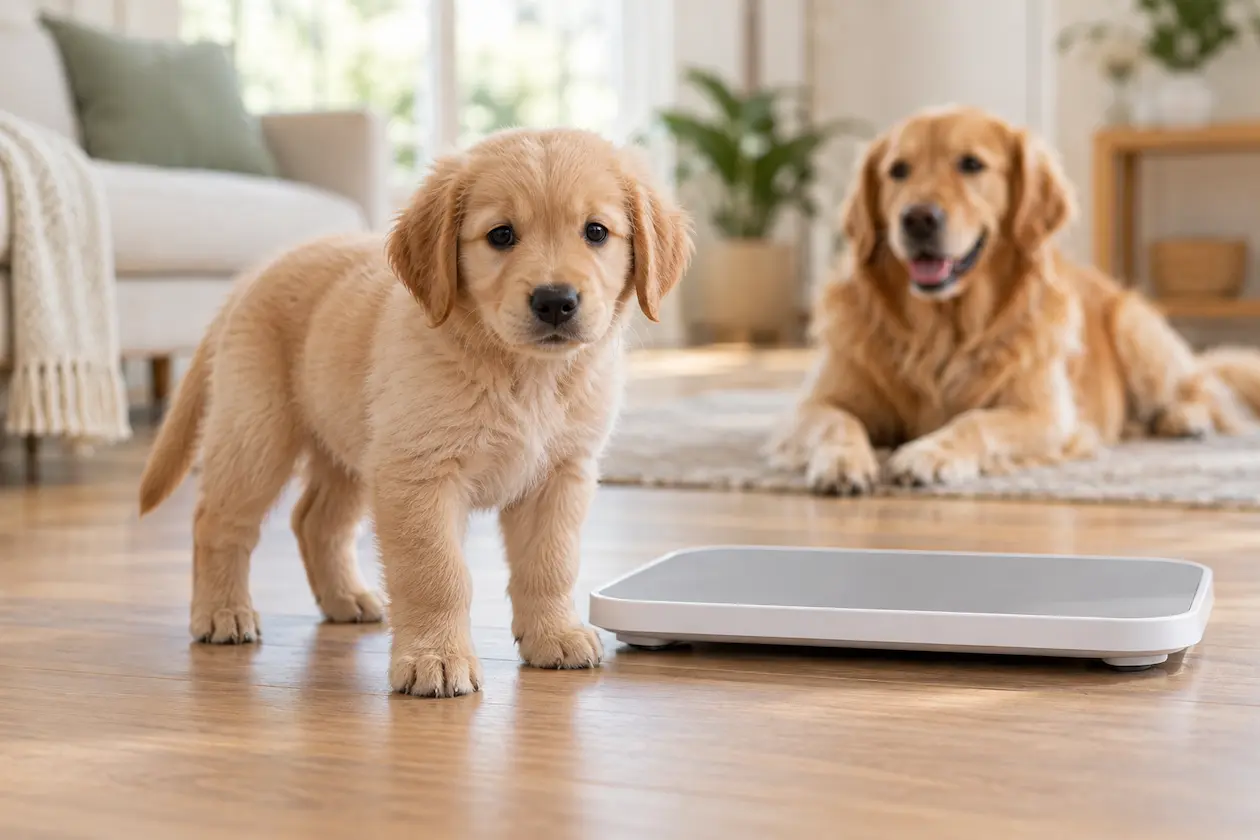
How To Use
Enter your puppy's current age and weight to predict how big they will get as an adult. Select your breed for the most accurate prediction, or choose a size category if breed is unknown.
Quick Steps
- 1 Enter your Puppy's Age in weeks.
- 2 Enter your Puppy's Current Weight in pounds.
- 3 Select your Breed (optional — auto-fills size category) or select a Size Category.
- 4 Click Calculate to see adult size predictions.
Puppy Growth Calculator
Fill Out The Fields Below
How Big Will My Puppy Get?
Predicting a puppy's adult size comes down to three things: current age and weight, breed or size category, and typical growth rate. Puppies grow fastest in their first few months and the pace slows as they approach maturity. Our calculator compares your puppy's current measurements against established canine growth curves to project an expected adult weight range. Because genetics, nutrition, and the parents' sizes all matter, treat the projection as a well-informed guide rather than an exact figure, especially for mixed-breed puppies.
A few quick rules of thumb help sanity-check the result. Small breeds often reach roughly half their adult weight by around 4 months, while large breeds tend to hit that halfway point closer to 5 or 6 months. Another common method for medium and large dogs is to take the weight at 16 weeks and roughly double it, then add a little more for continued filling out. The calculator does this math automatically and adjusts for your selected size category.
Puppy Growth Chart by Size Category
The chart below shows roughly what percentage of adult weight a puppy has reached at each age, grouped by adult size. Smaller breeds mature quickly, while giant breeds keep growing for up to two years. Use this as a general reference alongside your calculator results.
| Size Category | Adult Weight | Fully Grown | ~Half Adult Weight |
|---|---|---|---|
| Toy | Under 12 lbs | 8–10 months | ~11 weeks |
| Small | 12–25 lbs | 10–12 months | ~14 weeks |
| Medium | 25–50 lbs | 12–15 months | ~16 weeks |
| Large | 50–90 lbs | 15–18 months | ~5 months |
| Giant | Over 90 lbs | 18–24 months | ~6 months |
When Do Puppies Stop Growing?
Growth timelines vary dramatically by size. Toy and small breeds finish growing around 8–12 months, medium breeds fill out by 12–15 months, and large breeds keep developing until 15–18 months. Giant breeds such as Great Danes, Mastiffs, and Saint Bernards are the slowest to mature and may not reach their final adult weight until 18–24 months or even later.
A puppy's growth plates, the soft areas of cartilage at the ends of long bones, close once growth is complete. After that point the skeleton is set and the dog only adds muscle and body condition rather than height. Larger breeds' plates close later, which is why big dogs benefit from controlled exercise and joint-appropriate nutrition during their extended growth window.
Puppy Growth Milestones Every Owner Should Know
Weight is only one part of puppy development. Tracking these milestones alongside the numbers helps you judge whether your puppy is on a healthy track:
- 0–2 weeks: Puppies are entirely dependent on their mother, eyes and ears are still closed, and weight should climb steadily every single day.
- 3–4 weeks: Eyes and ears open, first teeth appear, and puppies start wobbling around and lapping at softened food.
- 5–8 weeks: Weaning completes, socialization begins, and puppies gain weight rapidly. Most go to their new homes at 8 weeks.
- 3–6 months: The fastest growth phase for most breeds. Baby teeth are replaced by adult teeth and puppies approach half or more of their adult size.
- 6–12 months: Growth slows as puppies fill out. Smaller breeds are essentially adults, while large and giant breeds are still developing.
Example: Projecting a 16-Week-Old Puppy's Adult Weight
Say you have a 16-week-old medium-breed puppy weighing 15 lbs. A widely used estimate for medium and large dogs is to double the 16-week weight and add a small amount for continued growth. That puts this puppy at roughly 30–34 lbs as an adult, which lines up neatly with the 25–50 lb medium-breed range once you account for individual variation and sex, since males usually finish heavier than females.
Entering the same age and weight into the calculator above produces a projected adult range instantly, and selecting a specific breed or size category sharpens the estimate. Re-run the projection every few weeks as your puppy grows, because predictions become more accurate the closer your puppy gets to the age when its size category typically stops growing.
Feeding for Healthy Puppy Growth
Proper nutrition during the growth window sets the foundation for lifelong health. Puppies need a diet formulated specifically for growth, with more protein, fat, and calories than adult dog food, and large-breed puppies benefit from formulas that carefully control calcium and calories to prevent growing too fast. Because their stomachs are small, young puppies do best with three to four small meals a day rather than one or two large ones. Underfeeding slows development, while overfeeding, especially in large breeds, raises the risk of joint problems and an overweight adult.
To match your puppy's calorie needs to its current weight and growth stage, use our Puppy Calorie Calculator. To confirm your growing puppy is at a healthy body condition rather than under or overweight, the Dog BMI Calculator provides a body condition score. Once your puppy is fully grown, the Dog Weight Calculator compares its weight to breed-specific ideal ranges.
FAQs
Frequently Asked Questions
How accurate is the puppy size prediction?
Predictions are estimates based on established canine growth curves and are most accurate for purebred or size-typical dogs. Individual dogs vary due to genetics, nutrition, and health. The result is a range — use it as a guide rather than an exact figure.
When do puppies stop growing?
Toy and small breeds reach adult size around 10–12 months. Medium breeds finish growing at 12–15 months. Large breeds take 18–24 months and giant breeds can take up to 24–36 months to fully mature.
Is my puppy's weight healthy for their age?
Growth rates vary by breed and size. Puppies should gain weight steadily without becoming chubby or looking thin. You can feel but not prominently see the ribs of a healthy-weight puppy. Ask your vet at each check-up.
What if I don't know my puppy's breed?
Select the size category that best matches your puppy's expected adult size. If your puppy is a mix, use the size category of the larger parent breed as a rough guide. DNA tests can also give breed breakdown.
How often should I weigh my puppy?
Weigh puppies weekly for the first 3 months, then monthly until adulthood. Most vets have a scale in reception — pop in for a quick weigh-in anytime.
Does neutering affect my puppy's adult size?
Early neutering (before growth plates close) may result in a slightly taller but leaner dog, as hormones influence when growth plates close. The effect is minor in most breeds. Discuss timing with your vet.
Other Calculators for Dogs
Dog Calorie Calculator by Breed — Free Daily Calorie & Feeding Tool
Free dog calorie calculator by breed. Find out exactly how many calories your dog needs per day by weight, breed, age, and activity level. Get instant kcal and feeding portions for Labradors, German Shepherds, Chihuahuas, and every breed in between. Try it now.
Puppy Calorie Calculator | Puppy Nutrition Calculator by Breed - Free Tool
Free puppy calorie calculator and nutrition tool. Calculate your puppy
Senior Dog Calorie Calculator - Free Daily Calorie Tool
Free senior dog calorie calculator. Calculate your older dog\
Other Pet Weight Calculators
Australian Shepherd Weight Calculator | Is Your Aussie a Healthy Weight? | The Pet Calculator
Check your Australian Shepherd\
Beagle Weight Calculator | Healthy Weight for 13-Inch & 15-Inch Beagles
Free Beagle weight calculator — check your Beagle\
Bearded Dragon Weight Chart by Age | Free Weight Calculator
Free bearded dragon weight calculator plus a bearded dragon weight chart by age. Check if your bearded dragon is a healthy weight, from hatchling to adult, with growth milestones and care tips.
Free dog printables
Keep these dog care guides handy
A rotating selection of practical dog guides chosen from our free printable library.Puppy Calorie Guide
Calorie targets by breed size and age.
Dog Quality of Life Checklist
Track the HHHHHMM quality-of-life measures.
Raw Feeding Reference Card
A printable BARF and 80/10/10 portion guide.