
Last updated: October 3, 2026
Dog Health
Dog Pregnancy Test: How to Tell If Your Dog Is Pregnant
Wondering whether your dog is expecting? Early at-home signs are easy to misread, and there is no home test that works on dogs. Here is what the early signs really tell you, the veterinary tests that actually confirm pregnancy and when each one works, and a week-by-week timeline of what to expect across the roughly 63 days of a dog pregnancy.
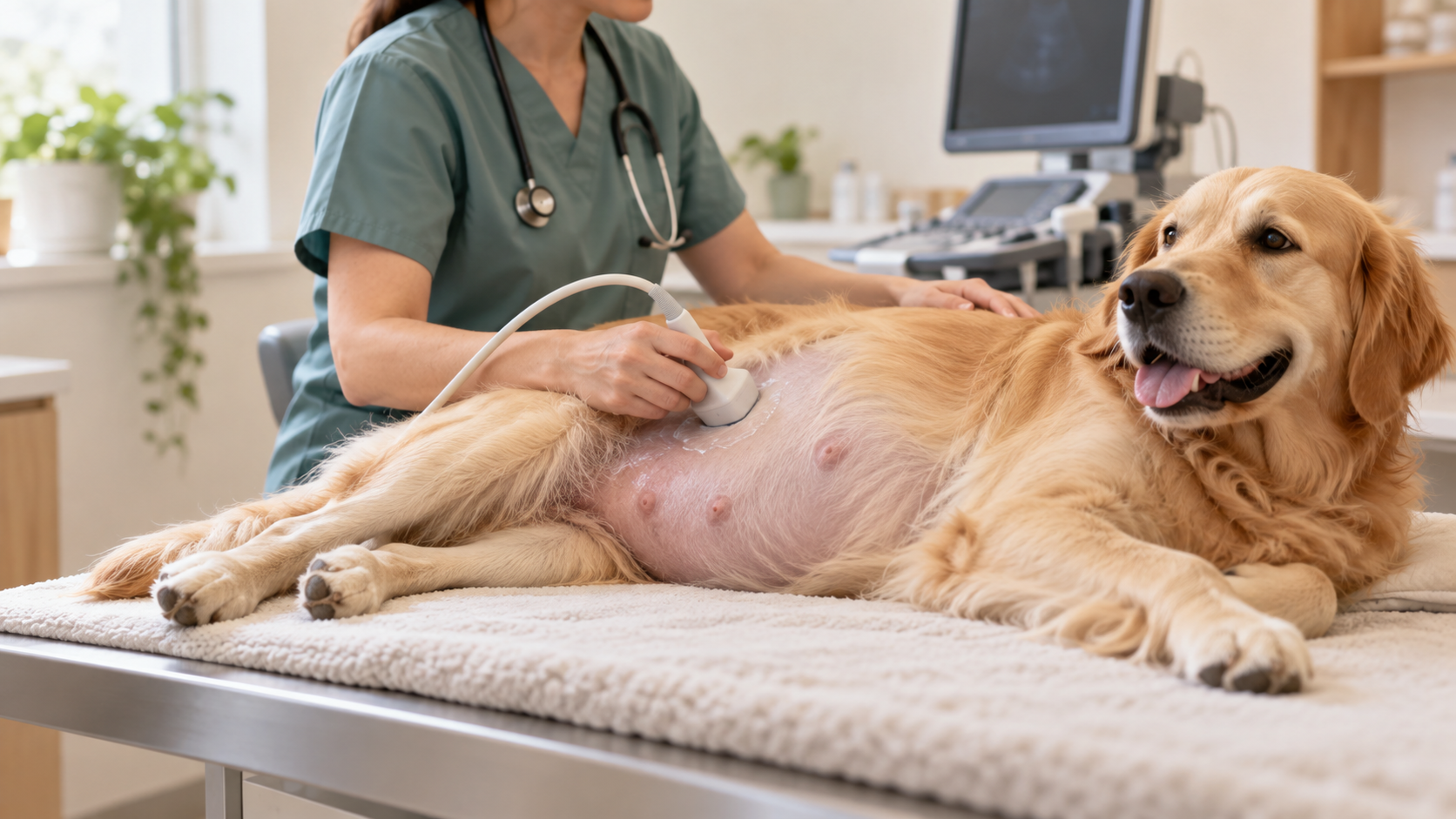
Human pregnancy tests do not work on dogs, and only a vet can confirm a pregnancy. Home tests detect a hormone dogs do not produce, and early signs are easy to confuse with a false pregnancy. If you think your dog may be pregnant, book a veterinary visit so your vet can run the right test and check that mother and puppies are healthy.
Early Signs a Dog May Be Pregnant
Suggestive, but not proof. These signs point toward a vet visit, not a diagnosis.
Appetite changes and mild nausea
Around weeks three to four, some dogs briefly go off their food or seem a little nauseous, a bit like morning sickness in people. It usually passes within days, and appetite often returns and then increases as the pregnancy progresses. On its own this is a weak sign, since many things affect appetite.
Nipple and mammary changes
The nipples may become slightly larger, firmer, and pinker in the first few weeks, and mammary tissue develops more noticeably later on. These changes can also appear with a false pregnancy, so they hint at pregnancy rather than confirm it.
Lower energy and behavior changes
A pregnant dog may rest more, seem less interested in vigorous play, or shift in temperament, becoming more affectionate or more withdrawn. Behavior changes are subtle and easy to attribute to other causes, so treat them as a prompt to check rather than an answer.
Later weight and abdominal gain
Clearer physical changes, such as steady weight gain and a fuller, rounder abdomen, tend to show from around week five onward. By this stage a vet can usually confirm the pregnancy easily, so obvious belly growth is a late sign rather than an early one.
How Vets Confirm Pregnancy
Because early at-home signs are unreliable, veterinary testing is the only way to know for sure. Which test your vet uses depends on how far along your dog is, and they are often combined for the fullest picture.
- Relaxin blood test, from about day 21 to 28. This is the most reliable pregnancy-specific test. Relaxin is a hormone produced by the developing placenta, so it is present only during pregnancy and gives a clear positive or negative. It confirms that a dog is pregnant but does not tell you how many puppies there are.
- Ultrasound, from about day 25 to 28. Ultrasound can confirm a pregnancy, check that the puppies are alive by detecting heartbeats, and give a rough idea of the number, though counting this way is not exact. It is a good early way to confirm viability.
- Abdominal palpation, from about day 28 to 35. An experienced vet can gently feel the uterus to detect the fluid-filled sacs around each puppy. This works best in a specific window, since it becomes harder later as the puppies grow and fill the abdomen. It should be done by a vet, not attempted at home, to avoid harm.
- X-ray, from about day 45 to 55. Once the puppies skeletons have calcified they show up on an X-ray, which makes this the most accurate way to count them before birth. Knowing the number helps everyone recognize when whelping is complete.
If you know or can estimate the mating date, our dog pregnancy calculator can help you map out likely test windows and an estimated due date to discuss with your vet.
Dog Pregnancy Timeline, Week by Week
Dog pregnancy lasts about 63 days, roughly nine weeks. Here is what is happening and what to do at each stage. Use it as a guide, and let your vet date the pregnancy precisely.
| Week and stage | What is happening | What to do |
|---|---|---|
| Weeks 1 to 2 (days 1 to 14) | Mating and fertilization. Embryos are microscopic and travel through the reproductive tract. There is no reliable way to detect pregnancy this early, and your dog usually looks and acts normal. | Note the mating dates. Keep feeding and exercise routines normal. Avoid any medications or vaccines unless your vet clears them. |
| Weeks 3 to 4 (days 15 to 28) | Embryos implant in the uterus. Some dogs show a brief drop in appetite or mild nausea, a little like morning sickness, and the nipples may start to enlarge and turn pinker. This is the first window for veterinary confirmation. | Book a vet visit. A relaxin blood test from about day 21 to 28 and an ultrasound from about day 25 to 28 can confirm pregnancy and check viability. |
| Weeks 5 to 6 (days 29 to 42) | The puppies develop quickly and the abdomen begins to enlarge. Appetite usually returns and rises. Mammary tissue continues to develop. A vet can often feel the puppies by gentle palpation early in this stage. | Gradually transition to a higher calorie diet as your vet advises. Keep exercise gentle and regular. Confirm the litter with your vet if you have not already. |
| Weeks 7 to 8 (days 43 to 56) | Puppies grow rapidly and their skeletons calcify, which makes them visible on X-ray from about day 45 to 55. Your dog is visibly pregnant, eats more, and may start seeking out a quiet nesting spot. | Ask your vet about an X-ray to count puppies and plan for whelping. Set up a clean, quiet whelping area so she can get used to it. |
| Week 9 (days 57 to 63 and birth) | The pregnancy nears full term at about 63 days. Appetite may drop in the final days, and a fall in body temperature often signals labor is close. Nesting behavior increases. | Monitor twice-daily temperature if your vet suggests it. Have your vet or an emergency clinic number ready in case of a whelping problem. |
Why Human Pregnancy Tests Do Not Work on Dogs
It is a common question, and the answer is simple. Home human pregnancy tests work by detecting a hormone called hCG, or human chorionic gonadotropin, in urine. That hormone is produced during human pregnancy, but dogs do not produce it at all. Because there is no hCG for the test to find, a human pregnancy test cannot detect a dog pregnancy and will not give a meaningful result, no matter how far along your dog is or how carefully you use it.
Dogs signal pregnancy through a different hormone, relaxin, which is produced by the developing placenta. That is why the reliable canine test is a relaxin blood test run by your vet rather than anything you can buy for home use. If you want a definite answer, a veterinary test is the way to get one.
Caring for a Pregnant Dog
Once pregnancy is confirmed, good care through the roughly nine weeks gives mother and puppies the best start. Your vet is the anchor of the plan, but the essentials are straightforward:
- Regular vet visits. Keep to the checkups your vet recommends so they can monitor the pregnancy, confirm viability and, later, the puppy count, and catch any problems early.
- Adjusted nutrition. Energy needs rise sharply in the second half of pregnancy. Vets often recommend gradually moving to a higher calorie diet, such as a quality puppy or performance formula, fed in smaller, more frequent meals as the abdomen fills. Increase intake gradually rather than all at once, and follow your vet on amounts. Our dog nutrition calculator and dog feeding calculator can help you sanity-check portions to discuss with your vet.
- Gentle, steady exercise. Keep her moving with light, regular activity, and avoid strenuous or high-impact exertion, especially in the later weeks.
- Whelping preparation. In the last couple of weeks, set up a clean, quiet whelping box in a warm, low-traffic spot so she can settle in before labor. Have your vet or an emergency clinic number on hand in case of a whelping complication.
- Monitor body condition. Aim for healthy weight gain rather than excess. Checking her body condition score and tracking her weight helps you and your vet keep her on track.
When to See a Vet
See your vet as soon as you suspect a pregnancy, so it can be confirmed and dated and a care plan put in place. During the pregnancy, contact your vet promptly if your dog stops eating for more than a day, seems weak or lethargic, has any vaginal discharge that is bloody or foul-smelling, or seems unwell in any way. Around the due date, reach out right away if she is straining without producing a puppy, more than a couple of hours pass between puppies, or she seems distressed, as whelping problems can be an emergency. When in doubt, a phone call to your vet is always the safe choice.
Frequently Asked Questions About Dog Pregnancy Tests
Common questions about confirming pregnancy, timing, and what actually works
How soon can you tell if a dog is pregnant?
There is no reliable way to confirm pregnancy in the first two weeks. The earliest dependable tests come from about day 21 to 28. A relaxin hormone blood test can detect a pregnancy-specific hormone from around day 21 to 28, and an ultrasound can usually confirm a pregnancy and check that the puppies are viable from about day 25 to 28. Early at-home signs before this point are unreliable and easy to confuse with a false pregnancy, so a vet visit is the only way to know for sure.
Can I use a human pregnancy test on my dog?
No. Home human pregnancy tests detect a hormone called hCG (human chorionic gonadotropin) in urine. Dogs do not produce hCG, so a human test cannot detect a dog pregnancy and will not give a meaningful result no matter when you use it. The pregnancy-specific test for dogs measures relaxin instead, and it is a blood test run by your veterinarian.
What is the most reliable dog pregnancy test?
The most reliable pregnancy-specific test is the relaxin blood test, because relaxin is produced by the developing placenta and is present only during pregnancy. It is accurate from about day 21 to 28 onward. Ultrasound is also highly reliable from about day 25 to 28 and adds the benefit of confirming viability and a rough count, while an X-ray from about day 45 to 55 gives the most accurate puppy count by showing their skeletons. Your vet will choose the right test for how far along your dog is.
How long are dogs pregnant?
Dog pregnancy lasts about 63 days, or roughly nine weeks, measured from ovulation. Because the exact date of conception can be hard to pin down, the range is normal and your vet may date the pregnancy more precisely with ultrasound. Counting from the mating date can be less accurate, since sperm can survive for several days before fertilization actually happens.
What are the first signs a dog is pregnant?
Early signs are subtle and unreliable on their own. Around weeks three to four some dogs show a brief dip in appetite or mild nausea, slightly enlarged and pinker nipples, lower energy, and small changes in behavior such as being more affectionate or more withdrawn. Weight gain and a fuller abdomen come later. Because these signs overlap with a false pregnancy and other conditions, they are a reason to see your vet for confirmation, not proof on their own.
Explore More Dog Health Guides
Confirm the timeline and know when to call the vet.
Free dog printables
Keep these dog care guides handy
A rotating selection of practical dog guides chosen from our free printable library.Puppy Calorie Guide
Calorie targets by breed size and age.
Dog Body Condition Chart
A printable 1–9 body condition reference.
Dog Quality of Life Checklist
Track the HHHHHMM quality-of-life measures.