
Last updated: October 3, 2026
Cat Food Carb Calculator
Our cat food carb calculator (also called a carbohydrate calculator for cat food or carb calculator cat food) helps you determine the carbohydrate content in your cat's food. This is especially important for diabetic cats, cats on low-carb diets, and weight management.
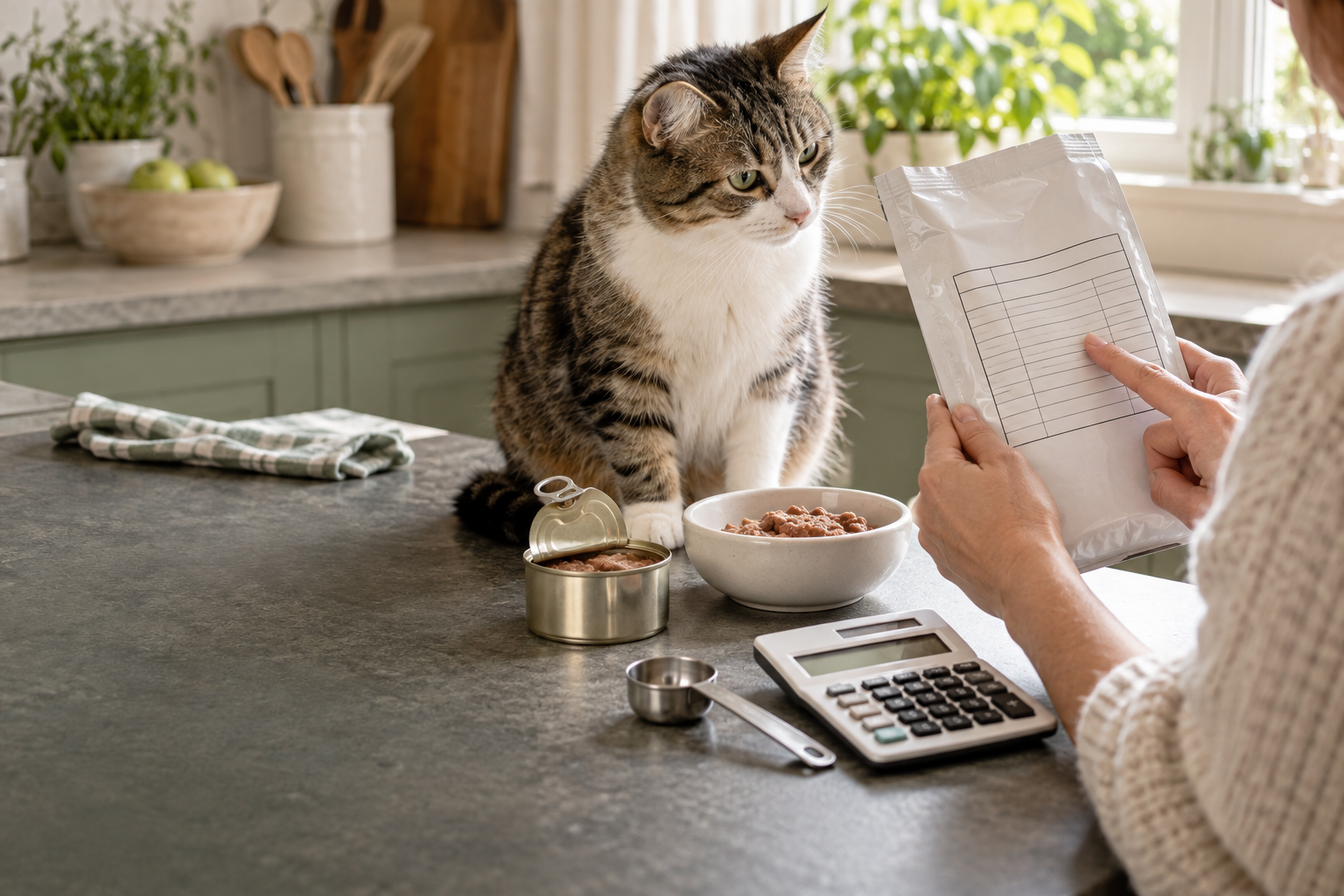
Why Calculate Carbohydrates in Cat Food?
Carbohydrate content is rarely listed on cat food labels, but it's important to know because:
- Diabetic cats: Need low-carbohydrate diets to manage blood sugar
- Weight management: High-carb foods can contribute to obesity
- Natural diet: Cats are obligate carnivores and don't need many carbohydrates
- Food comparison: Helps you compare different cat foods accurately
Carbohydrate Calculator
Results:
How to Calculate Carbs in Cat Food
Cat food labels rarely list carbohydrate content, so here is how to calculate carbs in cat food yourself using the guaranteed analysis values. Subtract every listed nutrient from 100%, and what remains is the carbohydrate (nitrogen-free extract) percentage:
Carbohydrate Formula (Dry Matter Basis)
Carbs = 100% − Protein% − Fat% − Fiber% − Moisture% − Ash%
Get these values from the "Guaranteed Analysis" on your cat food label. Ash is often not listed, use 6% for dry food or 1.5% for wet food as a default. Moisture is typically ~10% for dry food and 75–80% for wet food.
Converting to Dry Matter Basis
As-fed values include moisture. To compare dry and wet foods accurately: Dry Matter % = (As-Fed % ÷ (100 − Moisture %)) × 100. Our calculator does this automatically.
As-Fed vs Dry Matter Basis
- As-Fed Basis: Includes moisture content (what you see on the label)
- Dry Matter Basis: Removes moisture for accurate comparison between dry and wet foods
- Dry Matter % = (As-Fed % / (100 - Moisture %)) × 100
Wet vs Dry Cat Food: Carbohydrate Comparison
One of the biggest differences between wet and dry cat food is carbohydrate content. Dry kibble requires starch to hold its shape, while wet food can be made with minimal carbs. Here's a typical comparison on a dry matter basis:
| Food Type | Typical Carbs (as-fed) | Typical Carbs (dry matter) | Notes |
|---|---|---|---|
| Premium Wet Food | 1–5% | 3–15% | Best for low-carb and diabetic diets |
| Average Wet Food | 3–10% | 10–25% | Check the label, varies widely |
| Premium Dry Food | 15–25% | 20–30% | Higher carbs than wet due to kibble binding |
| Average Dry Food | 25–40% | 30–45% | Often too high for cats, use calculator to check |
Always compare on a dry matter basis for an accurate comparison between wet and dry foods. Our calculator above converts as-fed values to dry matter automatically. For more on your cat's overall nutrition, try our Cat Calorie Calculator.
What is a Good Carbohydrate Percentage?
| Carbohydrate Level | Dry Matter % | Assessment |
|---|---|---|
| Very Low | < 5% | Excellent for diabetic cats, very low-carb diets |
| Low | 5-10% | Good quality, appropriate for most cats |
| Moderate | 10-20% | Acceptable for healthy cats |
| High | > 20% | May contribute to obesity, avoid for diabetic cats |
Worked Example: Reading a Cat Food Label
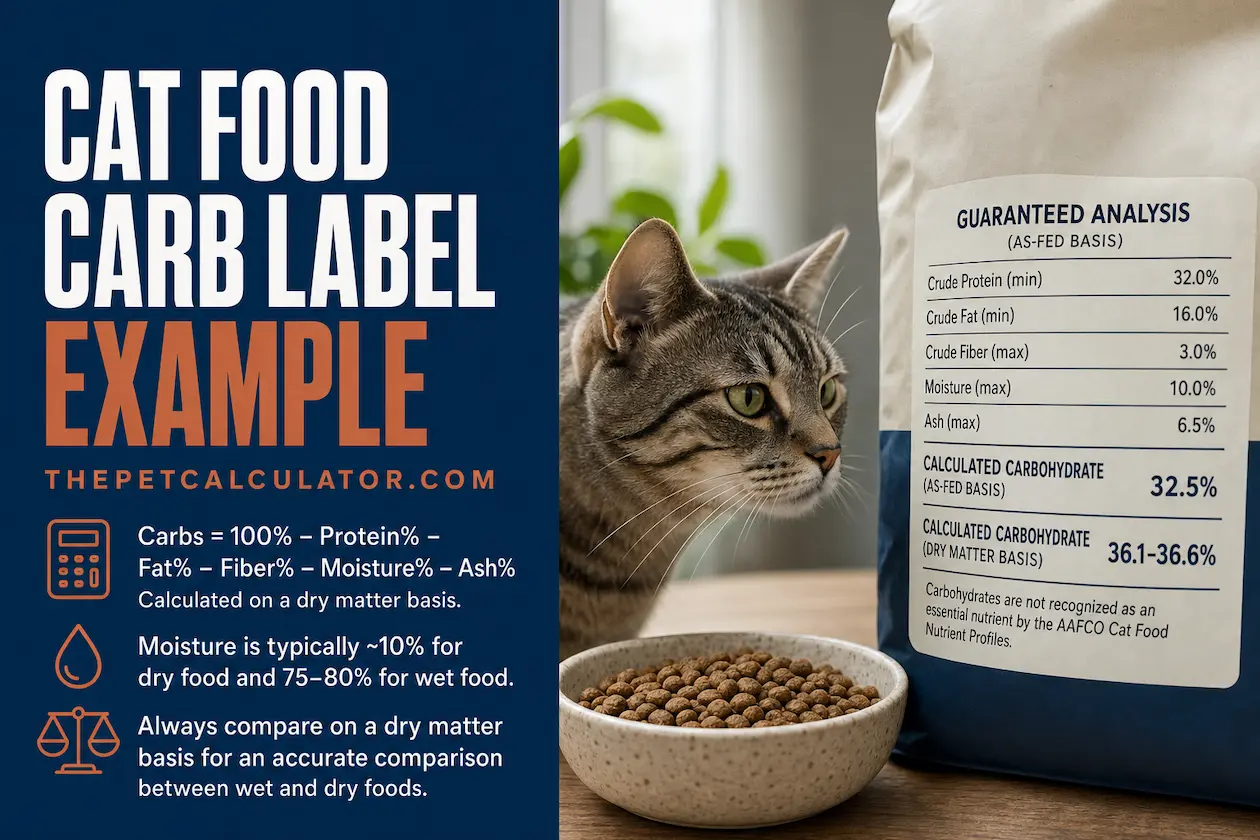
The easiest way to understand the carbohydrate formula is to walk through a real label. Imagine a bag of dry cat food with the following guaranteed analysis: Crude Protein 32%, Crude Fat 16%, Crude Fiber 3%, Moisture 10%, and Ash 6.5%. Here's how the math works step by step.
Step 1: Add up the known values
32% + 16% + 3% + 10% + 6.5% = 67.5%
Step 2: Subtract from 100% to get carbs (as-fed)
100% − 67.5% = 32.5% carbohydrates (as-fed)
Step 3: Convert to dry matter basis
Dry matter = 100% − 10% moisture = 90%. Carbs (dry matter) = (32.5 ÷ 90) × 100 = 36.1%
A dry matter carbohydrate content of 36% is high for an obligate carnivore. This food would not be a good choice for a diabetic cat or a cat that needs to lose weight. Compare that to a premium wet food that might come out at 6% dry matter carbs.
Now try the same steps with a wet food label: Crude Protein 11%, Crude Fat 6%, Crude Fiber 1%, Moisture 78%, Ash 1.5%. Adding those gives 97.5%, so carbs are just 2.5% as-fed. On a dry matter basis that becomes (2.5 ÷ 22) × 100 = 11.4%, still meaningfully lower than the dry food above. This is why comparing on a dry matter basis matters so much.
Carbohydrates and Diabetic Cats
Feline diabetes is closely linked to diet. Because cats are obligate carnivores, their bodies are not designed to process large amounts of carbohydrates. A diet high in dry-matter carbs forces the pancreas to produce more insulin, which over time can contribute to insulin resistance and type 2 diabetes, particularly in overweight indoor cats.
Many veterinarians recommend a low-carbohydrate, high-protein diet for diabetic cats. The goal is typically under 10% carbohydrates on a dry matter basis, and often under 7%. Some diabetic cats have even achieved remission (no longer needing insulin) after switching from high-carb dry kibble to a low-carb wet food, though this should always be done under veterinary supervision with blood glucose monitoring.
- Target: Under 10% dry matter carbs, ideally under 7% for diabetic cats
- Favor wet food: Canned foods are usually far lower in carbs than kibble
- Watch for hidden carbs: Peas, potatoes, corn, rice, and tapioca all add carbs
- Never change diet suddenly: Adjust insulin with your vet as carbs drop, since blood sugar can fall quickly
Use the calculator above to screen any food you are considering. If the dry matter carbohydrate number climbs above 10%, it is worth looking for a lower-carb alternative for a diabetic or pre-diabetic cat. To plan portions once you have chosen a food, try our Cat Feeding Calculator, and check overall daily calories with our Cat Calorie Calculator.
Common Mistakes When Calculating Cat Food Carbs
The carbohydrate formula is simple, but a few common errors can throw off your results. Avoid these pitfalls to get an accurate number.
- Forgetting ash: Ash is the mineral content left after burning. If you leave it out entirely, you will overestimate carbs by 5–8%. When ash is not on the label, use 6% for dry food or 1.5% for wet food.
- Comparing as-fed values across food types: A wet food at 3% as-fed carbs and a dry food at 30% as-fed carbs are not directly comparable because of their very different moisture levels. Always convert to dry matter first.
- Using minimum vs maximum values: Guaranteed analysis lists protein and fat as minimums and fiber and moisture as maximums. This means the real carb number is an estimate, not an exact figure. Treat it as a close approximation.
- Ignoring moisture differences: A dry food listed at 10% moisture has very different math from a wet food at 78% moisture. Enter the actual label value, not a guess.
- Trusting marketing claims: "Grain-free" does not mean low-carb. Grain-free foods often replace grains with potatoes or peas, which are just as carb-heavy. Always run the numbers.
FAQs
Frequently Asked Questions
How do I calculate carbs in cat food?
To calculate carbs in cat food, subtract every listed nutrient from 100%: Carbs = 100% - Protein% - Fat% - Fiber% - Moisture% - Ash%. Take these values from the guaranteed analysis on the label. If ash is not listed, use 6% for dry food or 1.5% for wet food. Our cat food carb calculator above does this for you and also converts the result to a dry matter basis.
What is a good carb percentage for cats?
A good carb percentage for cats is under 10% on a dry matter basis, and premium foods often come in at 5% or less. Cats are obligate carnivores, so anything above 20% dry matter carbs is high and best avoided, especially for diabetic or overweight cats.
How do I calculate carbohydrates in cat food?
Carbohydrates in cat food are calculated using the formula: 100% - % Protein - % Fat - % Fiber - % Moisture - % Ash. Use our calculator above by entering the values from your cat food label.
What is a good carbohydrate percentage for cat food?
Cats are obligate carnivores and don't need many carbohydrates. Good cat foods typically have less than 10% carbohydrates on a dry matter basis. Some premium foods have 5% or less.
Why do I need to know the carbohydrate content in cat food?
Knowing carbohydrate content is important for diabetic cats, cats on low-carb diets, and weight management. High carbohydrate foods can contribute to obesity and diabetes in cats.
How do I find the carbohydrate content on a cat food label?
Carbohydrate content is rarely listed on cat food labels. You need to calculate it using the guaranteed analysis values: 100% - Protein% - Fat% - Fiber% - Moisture% - Ash%. Our calculator does this for you.
What is the difference between dry matter basis and as-fed basis?
As-fed basis includes moisture content. Dry matter basis removes moisture for accurate comparison. Our calculator shows both values. Dry matter basis is more accurate for comparing different foods.
Are carbohydrates bad for cats?
Cats don't need carbohydrates, but small amounts (under 10% dry matter) are generally fine. High carbohydrate foods (over 20%) can contribute to obesity and diabetes, especially in indoor cats.
Other Calculators for Cats
Cat Calorie Calculator - Daily Calories & Feeding Amounts for Cats
Free cat calorie calculator. Enter your cat
Kitten Calorie Calculator - Free Daily Calorie Needs Tool
Free kitten calorie calculator. Enter your kitten
Maine Coon Food Calculator | Maine Coon Calorie Calculator - Free Tool
Free Maine Coon food calculator and calorie tool. Calculate your Maine Coon cat\
Other Pet Nutrition Calculators
Bird Nutrition & Feed Calculator | How Much Do Birds Eat?
Free bird nutrition and feed calculator. Find out how much your bird should eat a day, in grams and calories, based on weight, size, type, age, and feeding frequency. Works for budgies, cockatiels, parrots, and more.
Cat Calorie Calculator - Daily Calories & Feeding Amounts for Cats
Free cat calorie calculator. Enter your cat
Dog Calorie Calculator by Breed — Free Daily Calorie & Feeding Tool
Free dog calorie calculator by breed. Find out exactly how many calories your dog needs per day by weight, breed, age, and activity level. Get instant kcal and feeding portions for Labradors, German Shepherds, Chihuahuas, and every breed in between. Try it now.
Free cat printables
Keep these cat care guides handy
A rotating selection of practical cat guides chosen from our free printable library.Kitten Growth Chart
Week-by-week weight and development milestones.
Cat Feeding Guide
Portions by weight, age, and life stage.
Cat Body Condition Chart
A printable body condition reference for cats.