
Last updated: October 3, 2026
Cat Health
Cat Fever: Signs and What to Do
A normal cat temperature sits around 100.5 to 102.5 degrees F, higher than a person’s, so a warm-feeling cat is not proof of a fever. Here is how to spot the real signs, why the only reliable check is a thermometer, and when a fever becomes an emergency.
This guide is general information, not veterinary advice. Every cat is different. If your cat is unwell or you are worried, contact your veterinarian, who can examine your cat and give advice for their specific situation.
Call your vet or an emergency clinic now if your cat has any of these
- A measured temperature above 104 degrees F (above 40 degrees C)
- Collapse, extreme weakness, or unresponsiveness
- Not eating or drinking, or refusing food for more than a day
- Fast, open-mouth, or labored breathing
Never give your cat human fever or pain medicine. Paracetamol, also known as acetaminophen or Tylenol, and ibuprofen are toxic to cats and can be fatal even in small amounts. Do not give any medication unless your vet prescribed it for your cat.
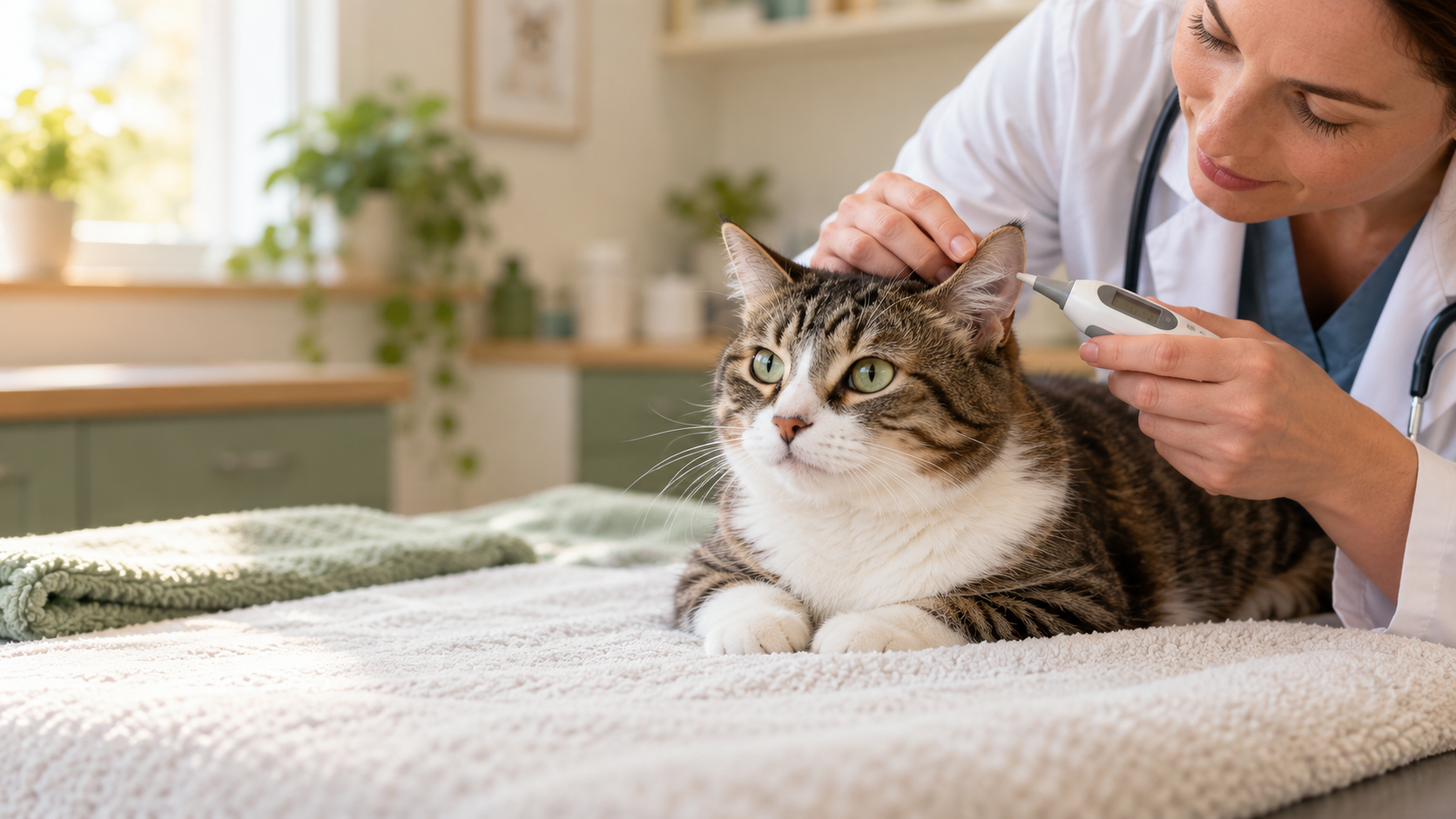
Signs a Cat May Have a Fever
Clues to watch for, and why they are only clues
Lethargy and hiding
A feverish cat often becomes quiet, sleeps more than usual, and may hide away in a corner or under furniture. A normally social cat that withdraws is a common early sign that something is wrong, though it is not specific to fever.
Reduced appetite and shivering
Fever frequently comes with a smaller appetite or refusing food altogether, and some cats shiver or seem to have chills. Faster breathing and a raised heart rate can also occur as the body works harder.
A warm feel, which can mislead
Owners often notice warm ears, paws, or a dry nose. This can happen with a fever, but it can also happen for harmless reasons, and a cool nose does not rule a fever out. Feeling your cat is a prompt to check properly, not a diagnosis.
The only reliable check is a thermometer
Because touch is unreliable, a fever can only be confirmed by measuring the temperature. A rectal reading, usually taken by a vet, is how it is actually measured. Many owners are better off letting the vet check rather than attempting it at home.
Normal Cat Temperature Reference
Use this as a starting point, not a diagnosis. Your vet can measure the temperature accurately and confirm the cause.
| Temperature reading | What it usually means | What to do |
|---|---|---|
| Below 100 degrees F (below 37.8 degrees C) | Low (hypothermia range) | A reading this low can be as serious as a high fever. Contact your vet, especially if your cat is weak, cold to the touch, or very still. |
| 100.5 to 102.5 degrees F (38.1 to 39.2 degrees C) | Normal for a cat | This is the typical healthy range. A brief reading slightly outside it after activity or stress is often not a concern on its own. |
| 103 to 104 degrees F (39.4 to 40 degrees C) | Elevated, likely a fever | A reading in this range usually means a fever. Watch closely and call your vet, particularly if your cat is also lethargic or off their food. |
| Above 104 degrees F (above 40 degrees C) | High fever | Treat as urgent and contact your vet or an emergency clinic now, especially with collapse, not eating, or breathing trouble. |
| Above 106 degrees F (above 41.1 degrees C) | Dangerous | This level can damage organs. Seek emergency veterinary care immediately. |
Why Feeling the Ears or Nose Does Not Work
It is a common belief that a warm, dry nose or hot ears means a cat has a fever. In reality, a cat’s nose and ears change temperature with the room, sun exposure, activity, and stress, so they tell you very little about core body temperature. A cat with a real fever can have a cool nose, and a perfectly healthy cat can have warm ears after a nap in a sunny spot.
Because a fever is defined by the actual reading, the only accurate way to confirm one is with a thermometer, and a rectal or vet-taken temperature is how it is truly measured. If you are not confident doing this, or your cat resists, do not force it. Let your vet take the reading. Watching for behavior changes like lethargy, hiding, and appetite loss is useful for deciding when to call, but it is not a substitute for a measured temperature.
Never Give Your Cat Human Fever or Pain Medicine
This is the single most important safety point on this page. Do not give your cat paracetamol (also called acetaminophen or Tylenol), ibuprofen, aspirin, or any other human medicine to bring a fever down. These drugs are toxic to cats. Paracetamol in particular can be fatal to a cat even in a small dose, because cats cannot process it the way people can, and ibuprofen can cause severe stomach and kidney damage.
Only ever give medication that your veterinarian has prescribed for your cat specifically, at the exact dose they advise. If your cat has already swallowed any human medicine, treat it as an emergency and contact your vet or an animal poison line right away. When in doubt, the safe move is always to call your vet rather than to medicate at home.
When to See a Vet
A fever is a symptom that the body is fighting something, such as an infection or inflammation, so it is worth taking seriously. Book a veterinary appointment if you have measured a temperature above about 103 to 104 degrees F, or if your cat is behaving as though unwell with lethargy, hiding, or reduced appetite for more than a day. For a reading above 104 degrees F, collapse, refusal to eat, or any breathing trouble, do not wait for a routine appointment, use the emergency signs at the top of this page.
A fever rarely travels alone. If your cat is mainly quiet and low in energy, our guide to why your cat is lethargic may help you decide how urgent things are. For a broader picture of the warning signs that mean a cat needs a vet, see our overview of sick cat symptoms.
Frequently Asked Questions About Cat Fever
Common questions about cat temperature, fever signs, and what is safe
How do I know if my cat has a fever?
The only accurate way to know is to take your cat’s temperature with a thermometer, because a fever is defined by the actual reading. Warning signs that a fever may be present include lethargy, hiding, reduced appetite, shivering, faster breathing, and a body that feels warm. Feeling the ears or the nose is not a reliable check. If you suspect a fever, the safest step is to have your vet examine your cat and measure the temperature properly.
What is a normal temperature for a cat?
A normal cat body temperature is roughly 100.5 to 102.5 degrees F, which is about 38.1 to 39.2 degrees C. This is higher than a normal human temperature, so a cat that feels warm is not necessarily unwell. A reading above about 103 to 104 degrees F generally counts as a fever, and a reading above 104 degrees F should be treated as urgent.
Can I give my cat medicine to bring a fever down?
No. Never give your cat human fever or pain medicine. Paracetamol, also called acetaminophen or Tylenol, and ibuprofen are toxic to cats and can be fatal even in small amounts. Do not give any medication unless your veterinarian has prescribed it for your cat specifically. If you think your cat has a fever, call your vet rather than reaching for anything in the medicine cabinet.
How is a fever in cats treated?
Treatment depends on the underlying cause, which is why a fever needs a veterinary diagnosis. A fever is a symptom, not a disease, and it often points to an infection, inflammation, or another illness. Your vet may run tests, treat the cause (for example with antibiotics for a bacterial infection), and support your cat with fluids and, when appropriate, cat-safe medication. Do not try to treat a fever at home with human drugs.
Explore More Cat Health Guides
Understand your cat's symptoms and know when to call the vet.
Free cat printables
Keep these cat care guides handy
A rotating selection of practical cat guides chosen from our free printable library.Cat Quality of Life Checklist
Track the HHHHHMM quality-of-life measures.
Kitten Calorie Guide
Calorie targets by kitten age and weight.
Cat Feeding Guide
Portions by weight, age, and life stage.