
Last updated: October 3, 2026
Domestic Shorthair Cat Weight
Average weight and a growth chart by age for male and female domestic shorthair (DSH) cats. The domestic shorthair is a mixed-ancestry, non-pedigree cat (the most common house cat), so healthy weight varies more than it does for a formal breed. Use this guide as general guidance and confirm your cat's ideal weight with your vet.
Domestic Shorthair Cat Weight by Age
Typical weight ranges for male and female domestic shorthair cats at each life stage
| Age | Male Weight | Female Weight | Notes |
|---|---|---|---|
| Birth | 3–4 oz (85–115g) | 3–4 oz (85–115g) | Newborn, eyes closed |
| 1 month | 9–13 oz (255–370g) | 8–12 oz (225–340g) | Weaning begins |
| 2 months | 1.8–2.8 lbs (0.8–1.3 kg) | 1.5–2.5 lbs (0.7–1.1 kg) | Ready for adoption |
| 3 months | 2.8–4.0 lbs (1.3–1.8 kg) | 2.5–3.5 lbs (1.1–1.6 kg) | Rapid growth phase |
| 4 months | 4.0–5.5 lbs (1.8–2.5 kg) | 3.5–4.5 lbs (1.6–2.0 kg) | Active, playful |
| 6 months | 5.5–7.5 lbs (2.5–3.4 kg) | 4.5–6.5 lbs (2.0–2.9 kg) | Adolescent, filling out |
| 9 months | 7.5–10.0 lbs (3.4–4.5 kg) | 6.0–8.5 lbs (2.7–3.9 kg) | Growth slowing |
| 12 months | 9.0–12.0 lbs (4.1–5.4 kg) | 7.0–10.0 lbs (3.2–4.5 kg) | Near adult size |
| 18 months | 10.0–14.0 lbs (4.5–6.4 kg) | 7.5–11.0 lbs (3.4–5.0 kg) | Fully grown |
| 2+ years (adult) | 11.0–15.0 lbs (5.0–6.8 kg) | 8.0–12.0 lbs (3.6–5.4 kg) | Maintenance weight |
Want personalized calorie recommendations for your domestic shorthair?
Every cat is different. Get exact calorie needs based on your cat's weight, activity level, and life stage.
Try the Cat Calorie Calculator →How to Tell if Your Domestic Shorthair Is a Healthy Weight
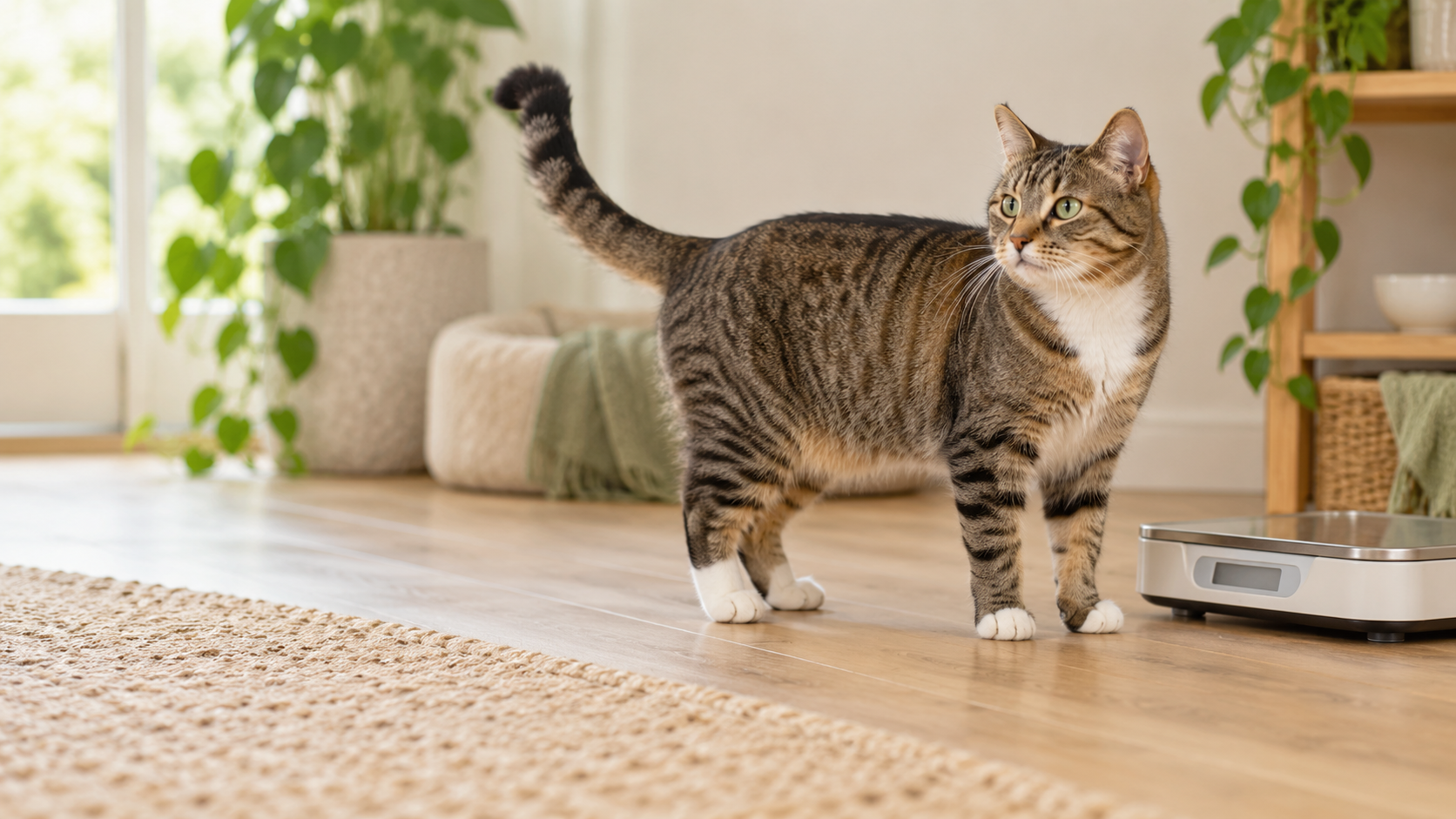
Because domestic shorthairs come in so many builds, the scale alone can mislead. A stocky, large-framed cat at 14 lbs may be perfectly healthy, while a small-framed cat at the same weight could be overweight. Body condition, which is what you can see and feel, is a more reliable guide than any single target number.
Underweight
- Ribs, spine, hip bones visible
- No fat covering over ribs
- Severe waist tuck
- Muscle wasting visible
- Dull coat, low energy
Ideal Weight
- Ribs easily felt with light pressure
- Thin fat covering over ribs
- Visible waist from above
- Abdominal tuck from side
- Well-proportioned, balanced look
Overweight
- Ribs hard to feel under fat
- No visible waist
- Belly hangs or is rounded
- Fat deposits near base of tail
- Swaying gait when walking
Run a quick check at home: with your cat standing, place your thumbs on the spine and feel along the ribs. You should feel each rib under a thin layer of fat, like the back of your hand. Look down from above for a gentle waist behind the ribs, and from the side for a slight tummy tuck. If the ribs are buried and the waist is gone, your cat is likely carrying extra weight.
Weigh your cat on the same scale every few weeks and track the trend rather than a single reading. Check whether your cat sits in a healthy range with our Cat BMI Calculator, or compare against other breeds in our average cat weight by breed guide.
What Affects a Domestic Shorthair Cat's Size
No two domestic shorthairs are built the same. Several factors explain why a healthy adult can land anywhere from 8 to 15 lbs, and why your cat's ideal weight may differ from the neighbor's cat of the same age.
- Genetics and mixed ancestry: The domestic shorthair is not a standardized breed, so it inherits size from whatever cats are in its background. A cat with heavy-set relatives will naturally be larger than one descended from petite cats, and neither is wrong.
- Sex: Males are typically 2–3 lbs heavier than females and tend to have broader heads and heavier bones. This is the single most predictable difference in the breed.
- Neuter status: Spaying or neutering lowers a cat's metabolic rate and often increases appetite, so fixed cats gain weight more easily. Portion control after the procedure matters more than the surgery itself.
- Indoor vs outdoor: Indoor cats burn fewer calories and are more prone to weight gain, while active outdoor or indoor-outdoor cats often stay leaner. Enrichment and play help indoor cats hold a healthy weight.
- Diet and feeding style: Free-feeding calorie-dense dry food is a common cause of creeping weight gain. Measured meals and a mix that includes wet food make it easier to keep a domestic shorthair at a lean, healthy weight.
For an amount tailored to your individual cat, run the numbers through our Cat Weight Calculator. Remember that these figures are general guidance: your vet can set the right target for your specific cat's frame and health.
Domestic Shorthair vs Other Cats: Weight Comparison
Domestic shorthairs sit squarely in the medium-sized range. Seeing where they fall against popular pedigree breeds helps put a healthy domestic shorthair weight in context, and shows why a single ideal number does not fit every cat.
| Cat Type | Adult Male | Adult Female | Build |
|---|---|---|---|
| Domestic Shorthair | 11–15 lbs | 8–12 lbs | Medium, variable |
| Siamese | 8–12 lbs | 6–10 lbs | Long, lean, athletic |
| Ragdoll | 15–20 lbs | 10–15 lbs | Large, muscular |
| Maine Coon | 15–25 lbs | 10–15 lbs | Very large, heavy-boned |
| Domestic Longhair | 11–16 lbs | 8–13 lbs | Medium, variable (coat adds bulk) |
A 13-pound domestic shorthair and a 13-pound Siamese are in very different places on the healthy scale: for a large-framed domestic shorthair that can be a solid adult weight, while for a lean Siamese it would usually be overweight. Explore more cats in our Cat Weight Guides.
Frequently Asked Questions About Domestic Shorthair Cat Weight
Common questions about domestic shorthair cat growth and healthy weight
How much should a domestic shorthair cat weigh?
Most healthy adult domestic shorthair cats weigh between 8 and 15 lbs (3.6–6.8 kg). Because the domestic shorthair is a mixed-ancestry cat rather than a standardized breed, there is a wider range than with pedigree cats. The right number depends on your cat's frame and sex, so use body condition, not the scale alone, to judge a healthy weight, and confirm with your vet.
What is the average weight for a male domestic shorthair cat?
Adult male domestic shorthair cats typically weigh 11–15 lbs (5.0–6.8 kg), and large-framed males can sit a little above that while still being healthy. Males are usually 2–3 lbs heavier than females of the same background. A neutered male on a house-cat diet can gain weight easily, so watch body condition rather than aiming for a fixed number.
What is the average weight for a female domestic shorthair cat?
Adult female domestic shorthair cats usually weigh 8–12 lbs (3.6–5.4 kg). Small-framed females may be healthy nearer 7–8 lbs, while larger-boned females can reach 12 lbs or a little more. As with males, the goal is a lean, well-proportioned body rather than a target weight.
When do domestic shorthair cats stop growing?
Most domestic shorthair cats reach their adult size around 12 months, then continue to fill out in muscle and frame until roughly 18 months to 2 years. Larger-framed cats can keep developing slightly past 2 years. Because domestic shorthairs vary in ancestry, some mature faster or slower than others.
Are domestic shorthair cats bigger than other cats?
Domestic shorthairs are medium-sized cats, so they are generally smaller than large breeds like the Maine Coon or Ragdoll and similar to or slightly heavier than lean breeds like the Siamese. Their mixed ancestry means individual cats vary a lot: a domestic shorthair with heavy-set relatives can be noticeably larger than one with a lighter build.
Check Your Cat's Weight & Health
Use our free calculators for personalized recommendations.
Free cat printables
Keep these cat care guides handy
A rotating selection of practical cat guides chosen from our free printable library.Kitten Calorie Guide
Calorie targets by kitten age and weight.
Cat Body Condition Chart
A printable body condition reference for cats.
Cat Feeding Guide
Portions by weight, age, and life stage.