
Last updated: October 3, 2026
Russian Blue Cat Weight Chart by Age
Ideal weight ranges for male and female Russian Blue cats from birth to adulthood. The Russian Blue is fine-boned yet dense and muscular under a plush double coat, so use this chart to track healthy growth and spot problems the coat can hide.
Russian Blue Cat Weight by Age
Typical weight ranges for male and female Russian Blue cats at each life stage
| Age | Male Weight | Female Weight | Notes |
|---|---|---|---|
| Birth | 3–4 oz (85–115g) | 3–4 oz (85–115g) | Newborn, eyes closed |
| 1 month | 9–13 oz (255–370g) | 8–11 oz (225–310g) | Weaning begins |
| 2 months | 1.8–2.6 lbs (0.8–1.2 kg) | 1.5–2.3 lbs (0.7–1.0 kg) | Ready for adoption |
| 3 months | 2.8–3.8 lbs (1.3–1.7 kg) | 2.3–3.3 lbs (1.0–1.5 kg) | Rapid growth phase |
| 4 months | 3.8–5.0 lbs (1.7–2.3 kg) | 3.3–4.3 lbs (1.5–2.0 kg) | Active, playful |
| 6 months | 5.5–7.5 lbs (2.5–3.4 kg) | 4.5–6.5 lbs (2.0–2.9 kg) | Adolescent, still lean |
| 9 months | 7.5–10.0 lbs (3.4–4.5 kg) | 5.5–8.0 lbs (2.5–3.6 kg) | Growth slowing |
| 12 months | 9.0–12.0 lbs (4.1–5.4 kg) | 6.5–9.5 lbs (2.9–4.3 kg) | Near adult size, still filling out |
| 18 months | 9.5–14.0 lbs (4.3–6.4 kg) | 7.0–11.0 lbs (3.2–5.0 kg) | Muscle and frame maturing |
| 2+ years (adult) | 10.0–15.0 lbs (4.5–6.8 kg) | 7.0–12.0 lbs (3.2–5.4 kg) | Fully grown, maintenance weight |
Want personalized calorie recommendations for your Russian Blue?
Every cat is different. Get exact calorie needs based on your Russian Blue's weight, activity level, and life stage.
Try the Cat Calorie Calculator →Russian Blue Cat Body Condition Guide
The Russian Blue has a short, dense double coat that stands out from the body and can make the cat look heavier and rounder than it really is. Because of that plush coat, appearance alone is unreliable, so hands-on rib checks matter more with this breed than with most others. Feel along the ribs and spine rather than trusting your eyes.
Underweight
- Ribs, spine, hip bones visible
- No fat covering over ribs
- Severe waist tuck
- Muscle wasting visible
- Dull coat, low energy
Ideal Weight
- Ribs easily felt with light pressure
- Thin fat covering over ribs
- Visible waist from above
- Abdominal tuck from side
- Lean, firm, muscular feel
Overweight
- Ribs hard to feel under fat
- No visible waist
- Belly hangs or is rounded
- Fat deposits near base of tail
- Coat hides a thickening body
To check at home, part or press through the coat with your fingers so you are feeling the body, not the fur. With your cat standing, run your thumbs along the spine and feel the ribs: each one should be detectable under a thin layer of fat, like the back of your hand. Look down from above for a gentle waist behind the ribs, and from the side for a slight tummy tuck. Because a Russian Blue can carry hidden weight under all that plush, weighing monthly and tracking the trend is the most reliable check.
Check if your cat is at a healthy weight with our Cat BMI Calculator, or see weight charts for other breeds in our Cat Weight Guides. For feeding amounts, try the Cat Weight Calculator.
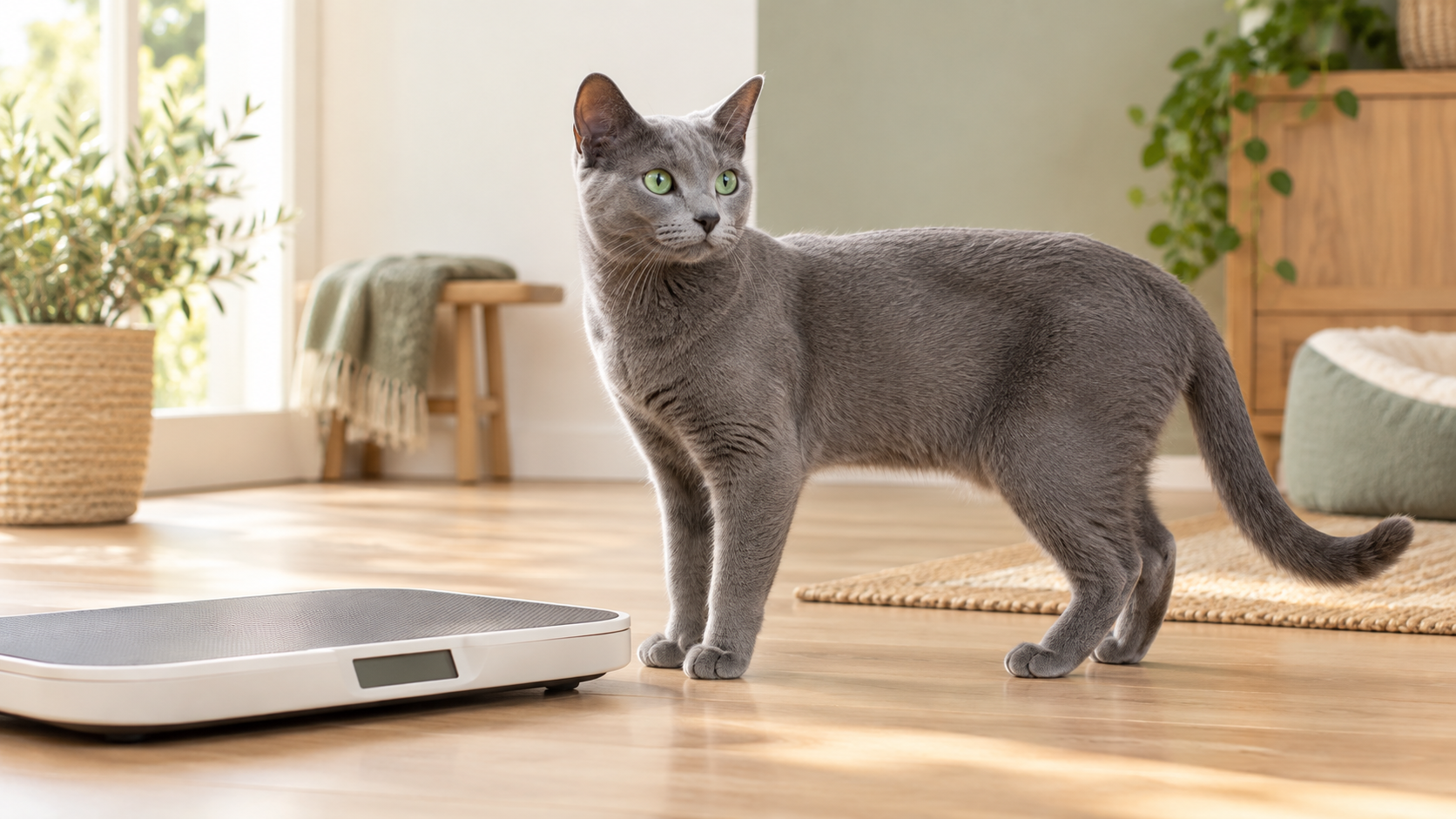
Russian Blue Size, Build, and Character
The Russian Blue is an elegant, medium-sized cat that is often mistaken for something larger. Its long legs, graceful lines, and thick silver-blue coat give it presence, but the frame underneath is fine-boned. What makes the breed feel surprisingly heavy in your hands is dense muscle: a fit Russian Blue is compact and solid rather than soft.
- Fine-boned but muscular: The skeleton is light and elegant, yet the body is firm and well-muscled. This combination means a healthy adult often weighs more than its slender silhouette suggests.
- Dense double coat: The short plush coat stands away from the body and adds visual bulk. It is the single biggest reason owners misjudge their cat's weight, so rib checks beat eyeballing.
- Slow to mature: Russian Blues reach near-adult size by about 12 months but keep developing muscle and frame until roughly 2 years of age.
- Prone to overeating: The breed is well known for loving food and begging for more. Free-feeding a Russian Blue is a common route to gradual, coat-hidden weight gain, so measured meals matter.
For an amount tailored to your individual cat, run the numbers through our Cat Calorie Calculator. These figures are general guidance: your vet can set the right target for your specific cat's frame and health.
Russian Blue vs Other Cat Breeds: Weight Comparison
Russian Blues sit in the medium-sized range, close to the Siamese in weight but with a rounder look thanks to the coat. Seeing where they fall against other popular breeds helps put a healthy Russian Blue weight in context.
| Breed | Adult Male | Adult Female | Build |
|---|---|---|---|
| Russian Blue | 10–15 lbs | 7–12 lbs | Fine-boned, dense, muscular |
| Siamese | 8–12 lbs | 6–10 lbs | Long, lean, athletic |
| Domestic Shorthair | 11–15 lbs | 8–12 lbs | Medium, variable |
| Ragdoll | 15–20 lbs | 10–15 lbs | Large, muscular |
| Maine Coon | 15–25 lbs | 10–15 lbs | Very large, heavy-boned |
A 12-pound Russian Blue and a 12-pound Ragdoll are in very different places on the healthy scale: for the Russian Blue that is a solid adult weight at the top of the range, while for the Ragdoll it would be underweight. This is why breed-specific charts matter more than a single ideal number for all cats. Explore more breeds in our average cat weight by breed guide, or browse all of our Cat Weight Guides.
Frequently Asked Questions About Russian Blue Cat Weight
Common questions about Russian Blue cat growth and healthy weight
How much should a Russian Blue weigh?
Adult male Russian Blue cats typically weigh 10–15 lbs (4.5–6.8 kg) and females weigh 7–12 lbs (3.2–5.4 kg). The Russian Blue is fine-boned but dense and muscular, so a healthy cat feels solid and heavier than it looks. Judge weight by body condition, feeling for the ribs under the plush coat, and confirm the right target with your vet.
Are Russian Blue cats big?
Russian Blues are a medium-sized breed, not a large one. They can look bigger than they are because of their thick double coat and elegant, long-legged frame, but underneath they are fine-boned and lean. Most adults fall in the 7–15 lb range depending on sex, which is similar to a Siamese and lighter than large breeds like the Maine Coon or Ragdoll.
When do Russian Blues stop growing?
Russian Blue cats reach their full size at around 2 years of age. They mature more slowly than many medium breeds: they reach near-adult size by about 12 months, then keep filling out in muscle and frame through the second year. The dense adult coat also comes in over this period, which adds to the impression of a larger cat.
Why does my Russian Blue look bigger than the scale says?
The Russian Blue has a short, dense double coat that stands out from the body and makes the cat look rounder and heavier than it actually is. This is why you should not judge weight by appearance alone. Run your hands along the ribs and spine: you should feel each rib under a thin layer of fat. If the coat looks full but the ribs are easy to feel, the cat is likely at a healthy weight.
Do Russian Blue cats gain weight easily?
Yes, Russian Blues are known to love their food and can be prone to overeating, so they gain weight easily if fed free-choice. Combined with the coat that hides extra pounds, this makes portion control and regular weigh-ins important. Measured meals, active play, and monthly body-condition checks help keep a Russian Blue at its lean, muscular ideal.
Check Your Cat's Weight & Health
Use our free calculators for personalized recommendations.
Free cat printables
Keep these cat care guides handy
A rotating selection of practical cat guides chosen from our free printable library.Cat Feeding Guide
Portions by weight, age, and life stage.
Kitten Calorie Guide
Calorie targets by kitten age and weight.
Cat Body Condition Chart
A printable body condition reference for cats.