
Last updated: October 3, 2026
Sphynx Cat Weight Chart by Age
Ideal weight ranges for male and female Sphynx cats from birth to adulthood. The Sphynx is a hairless, muscular, medium-sized cat with a high metabolism and a naturally rounded belly. Use this chart to track healthy growth and confirm your cat's ideal weight with your vet.
Sphynx Cat Weight by Age
Typical weight ranges for male and female Sphynx cats at each life stage
| Age | Male Weight | Female Weight | Notes |
|---|---|---|---|
| Birth | 3–4 oz (85–115g) | 3–4 oz (85–115g) | Newborn, hairless, eyes closed |
| 1 month | 9–13 oz (255–370g) | 8–11 oz (225–310g) | Weaning begins, needs warmth |
| 2 months | 1.5–2.5 lbs (0.7–1.1 kg) | 1.3–2.2 lbs (0.6–1.0 kg) | Ready for adoption |
| 3 months | 2.5–3.5 lbs (1.1–1.6 kg) | 2.0–3.0 lbs (0.9–1.4 kg) | Rapid growth phase |
| 4 months | 3.5–4.5 lbs (1.6–2.0 kg) | 3.0–4.0 lbs (1.4–1.8 kg) | Active, big appetite |
| 6 months | 4.5–6.0 lbs (2.0–2.7 kg) | 3.5–5.0 lbs (1.6–2.3 kg) | Adolescent, filling out |
| 9 months | 6.0–8.0 lbs (2.7–3.6 kg) | 4.5–6.5 lbs (2.0–2.9 kg) | Growth slowing |
| 12 months | 7.0–9.5 lbs (3.2–4.3 kg) | 5.5–7.5 lbs (2.5–3.4 kg) | Near adult size |
| 18 months | 8.0–11.0 lbs (3.6–5.0 kg) | 6.0–8.5 lbs (2.7–3.9 kg) | Fully grown, muscular |
| 2+ years (adult) | 8.0–12.0 lbs (3.6–5.4 kg) | 6.0–9.0 lbs (2.7–4.1 kg) | Maintenance weight |
Want personalized calorie recommendations for your Sphynx?
Every cat is different. Get exact calorie needs based on your Sphynx's weight, activity level, and life stage.
Try the Cat Calorie Calculator →Sphynx Cat Body Condition Guide
The Sphynx has one big advantage when it comes to judging weight: with no coat to hide the body, you can see the shape directly and feel the ribs, spine, and muscle without parting any fur. This makes body condition scoring easier than in almost any other breed. The one thing to remember is that a soft, rounded lower belly is normal. Most cats have a primordial pouch, a loose flap of skin and fat along the belly, and on a hairless cat it simply shows more. A small rounded belly is not a sign of fat on its own, so judge weight by the ribs and waist rather than the tummy.
Underweight
- Ribs, spine, hip bones sharply visible
- No muscle padding over ribs
- Severe waist tuck, hollow flanks
- Muscle wasting along the back
- Feels cool, low energy
Ideal Weight
- Ribs easily felt with light pressure
- Firm, muscular body, warm to the touch
- Visible waist from above
- Small, soft primordial-pouch belly
- Broad chest, solid feel
Overweight
- Ribs hard to feel under fat
- No visible waist, whole body looks bulky
- Belly is firm and bulging, not just soft
- Fat deposits near base of tail
- Rolls or wrinkles that feel padded
To tell a normal pouch from real excess weight, run your hands along the ribcage. On a healthy Sphynx you should feel each rib under a thin layer of muscle, like the back of your hand, and see a gentle waist behind the ribs from above. If the ribs are buried, the waist has disappeared, and the belly feels firm and packed rather than soft and swinging, your cat is likely carrying extra fat.
Sphynx Size, Metabolism & Character
Sphynx cats look delicate but are anything but. Under that hairless skin is a broad-chested, muscular, medium-sized cat that feels heavier than it appears. Three things about the breed directly affect weight, and understanding them helps you feed correctly.
- High metabolism: With no fur to insulate them, Sphynx cats spend extra energy staying warm and run a faster metabolism than most furred breeds. They often eat noticeably more for their size, and many owners free-feed or offer several meals a day.
- Muscular, solid build: A healthy Sphynx is dense and firm, with a broad chest and strong legs. That muscle is why a lean Sphynx can still weigh a solid 8 to 12 lbs despite looking slim.
- Warmth-seeking and active: Sphynx cats are playful, social, and always looking for a warm spot, whether a lap, a blanket, or a sunbeam. Their activity burns calories, but keeping them warm reduces how hard their body has to work to hold a healthy weight.
Check if your cat is at a healthy weight with our Cat BMI Calculator, or compare against other breeds in our average cat weight by breed guide. For feeding amounts, try the Cat Weight Calculator.
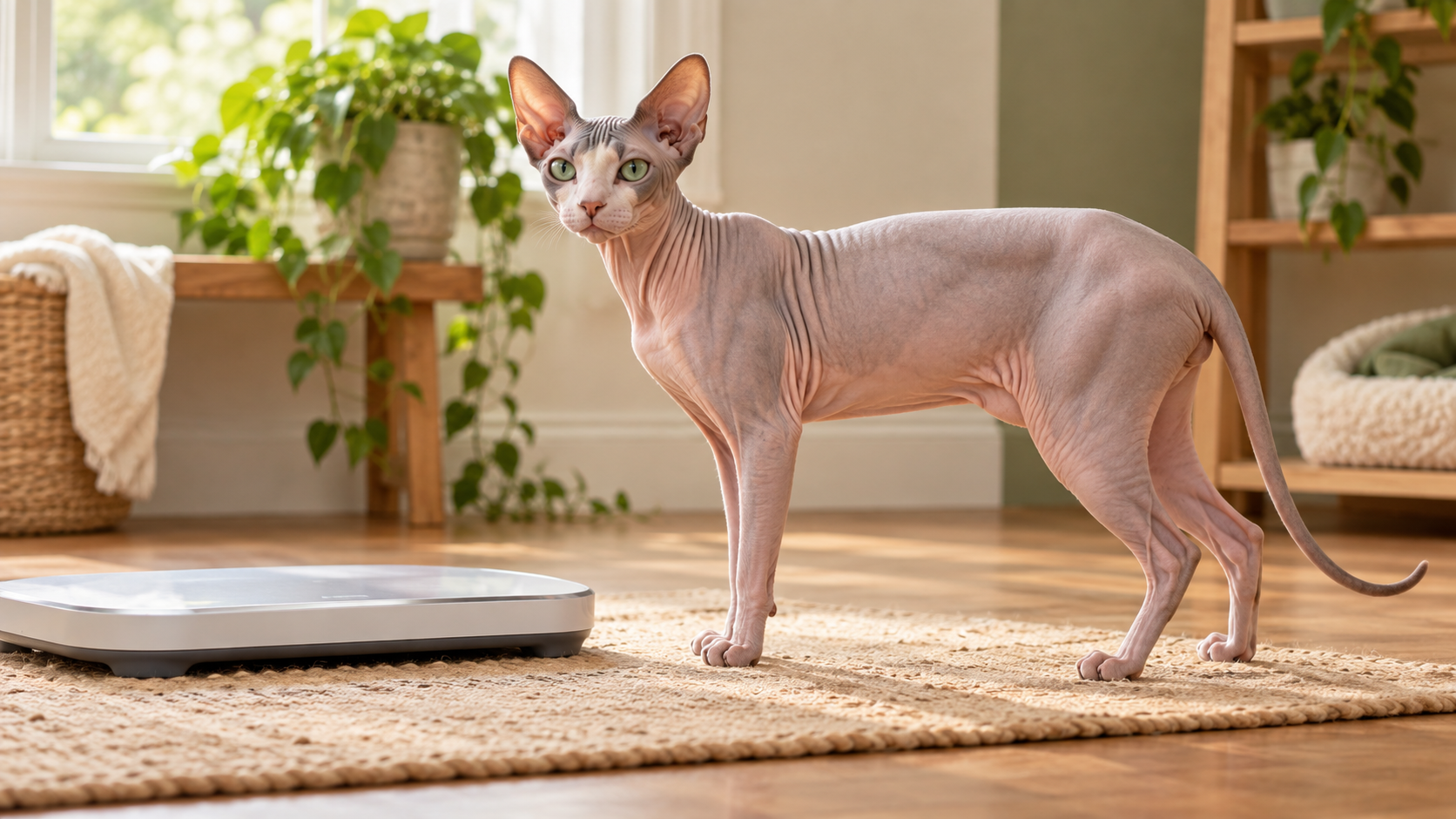
How to Weigh Your Sphynx Cat at Home
Because Sphynx cats have a fast metabolism and can gain or lose condition quickly, tracking the actual number is the most reliable way to catch a problem early. A change of even half a pound is meaningful on a 6 to 12 pound cat, so record the weight rather than relying on how the belly looks.
- Step on a bathroom scale yourself and record your own weight.
- Pick up your Sphynx and step back on the scale while holding them.
- Subtract your weight from the combined total. The difference is your cat's weight.
- For more precision, use a digital kitchen or baby scale and let your cat sit in a shallow box or basket placed on top, then tare the scale first.
Weigh at the same time of day, ideally before a meal, and aim for once a month for healthy adults or once a week for kittens and cats on a weight plan. Record the numbers so you can see the trend over time. If your Sphynx loses more than 10 percent of their body weight without a diet change, contact your vet, since unexplained weight loss can be an early sign of dental disease, heart problems, or other issues the breed can be prone to.
Sphynx Cat Feeding Guide by Life Stage
Sphynx cats have a higher calorie need than most breeds because of their warmth-burning metabolism, but that need still changes as they age. Feeding for the life stage, not just the breed, is the key to building healthy muscle without tipping into excess fat. These are general starting points; always adjust based on your cat's body condition and your vet's guidance.
| Life Stage | Daily Calories | Feeding Approach |
|---|---|---|
| Kitten (0–6 months) | 220–350 kcal | Free-feed kitten formula; frequent small meals to fuel rapid growth and warmth |
| Adolescent (6–12 months) | 220–320 kcal | Still on kitten food; several measured meals a day to build muscle |
| Adult (1–7 years) | 220–320 kcal | Calorie-dense adult food; Sphynx often eat more than similar-sized furred cats |
| Senior (7+ years) | 200–280 kcal | Adjust for lower activity; watch for weight loss that signals illness |
A quality, protein-rich diet helps Sphynx cats hold the dense muscle that defines a healthy weight, and keeping them warm reduces how many calories they burn just staying comfortable. For an amount tailored to your individual cat, run the numbers through our Cat Calorie Calculator.
Sphynx vs Other Cat Breeds: Weight Comparison
Sphynx cats sit in the medium-sized range, and their weight can surprise people because a lean, hairless cat still packs solid muscle. Seeing where they fall against other popular breeds helps put a healthy Sphynx weight in context.
| Breed | Adult Male | Adult Female | Build |
|---|---|---|---|
| Sphynx | 8–12 lbs | 6–9 lbs | Medium, hairless, muscular |
| Siamese | 8–12 lbs | 6–10 lbs | Long, lean, athletic |
| Domestic Shorthair | 11–15 lbs | 8–12 lbs | Medium, variable |
| Devon Rex | 6–9 lbs | 5–8 lbs | Small, fine-boned |
| Maine Coon | 15–25 lbs | 10–15 lbs | Very large, heavy-boned |
A 9-pound Sphynx and a 9-pound Devon Rex are in different places on the healthy scale: for the Sphynx that is a solid adult weight, while for the smaller Devon Rex it would sit at the top of the range. This is why breed-specific charts matter more than a single ideal number for all cats. Explore more breeds in our Cat Weight Guides.
Frequently Asked Questions About Sphynx Cat Weight
Common questions about Sphynx cat growth and healthy weight
How much should a Sphynx cat weigh?
Adult male Sphynx cats typically weigh 8–12 lbs (3.6–5.4 kg) and females weigh 6–9 lbs (2.7–4.1 kg). The Sphynx is a medium-sized, surprisingly heavy and muscular cat, so a healthy one feels solid and warm in the hand rather than bony. Because they are hairless, you can see and feel body condition directly, which makes it easy to judge whether they are at a healthy weight.
How big do Sphynx cats get?
Sphynx cats are medium-sized. Males usually reach 8–12 lbs (3.6–5.4 kg) and females 6–9 lbs (2.7–4.1 kg), with a broad chest, rounded belly, and dense muscle that makes them heavier than they look. They finish growing between 12 and 18 months, though some males keep filling out in muscle until about 2 years.
Why do Sphynx cats have round bellies?
A rounded, slightly pot-bellied appearance is normal for the Sphynx and is largely due to the natural primordial pouch, a loose flap of skin and fat along the lower belly that most cats have but that shows clearly on a hairless cat. Sphynx cats also eat more than most breeds to fuel a high metabolism, so a full stomach after meals adds to the look. A soft, rounded belly is not the same as being overweight: check the ribs and waist instead. If the ribs are hard to feel and the whole body looks bulky, that points to excess weight, whereas a firm cat with an easily felt ribcage and a small rounded belly is usually just fine.
When do Sphynx cats stop growing?
Most Sphynx cats reach their adult size around 12 months, then continue to build muscle and fill out their frame until roughly 18 months to 2 years. Males tend to keep developing slightly longer than females. If your Sphynx is still gaining a little weight as muscle past their first birthday, that is normal for the breed.
Do Sphynx cats need to eat more than other cats?
Yes. Because they have no coat to insulate them, Sphynx cats burn extra energy staying warm and tend to have a faster metabolism than furred breeds. Many Sphynx cats eat noticeably more for their size, and free-feeding or several measured meals a day is common. Feed a quality, calorie-dense diet, keep them warm, and use body condition to fine-tune portions so the extra food builds a healthy weight rather than excess fat.
Check Your Cat's Weight & Health
Use our free calculators for personalized recommendations.
Free cat printables
Keep these cat care guides handy
A rotating selection of practical cat guides chosen from our free printable library.Cat Quality of Life Checklist
Track the HHHHHMM quality-of-life measures.
Kitten Calorie Guide
Calorie targets by kitten age and weight.
Kitten Growth Chart
Week-by-week weight and development milestones.