
Last updated: October 3, 2026
Dog Weight Guides
Dog Crate Size Guide
The right crate gives your dog a safe, den-like space to settle in, and getting the size right is mostly about your dog's measurements and weight rather than the breed on the box. This guide shows you how to measure your dog, matches common crate sizes to weight ranges and example breeds, and covers puppies, crate types, and the mistakes that are easy to avoid.
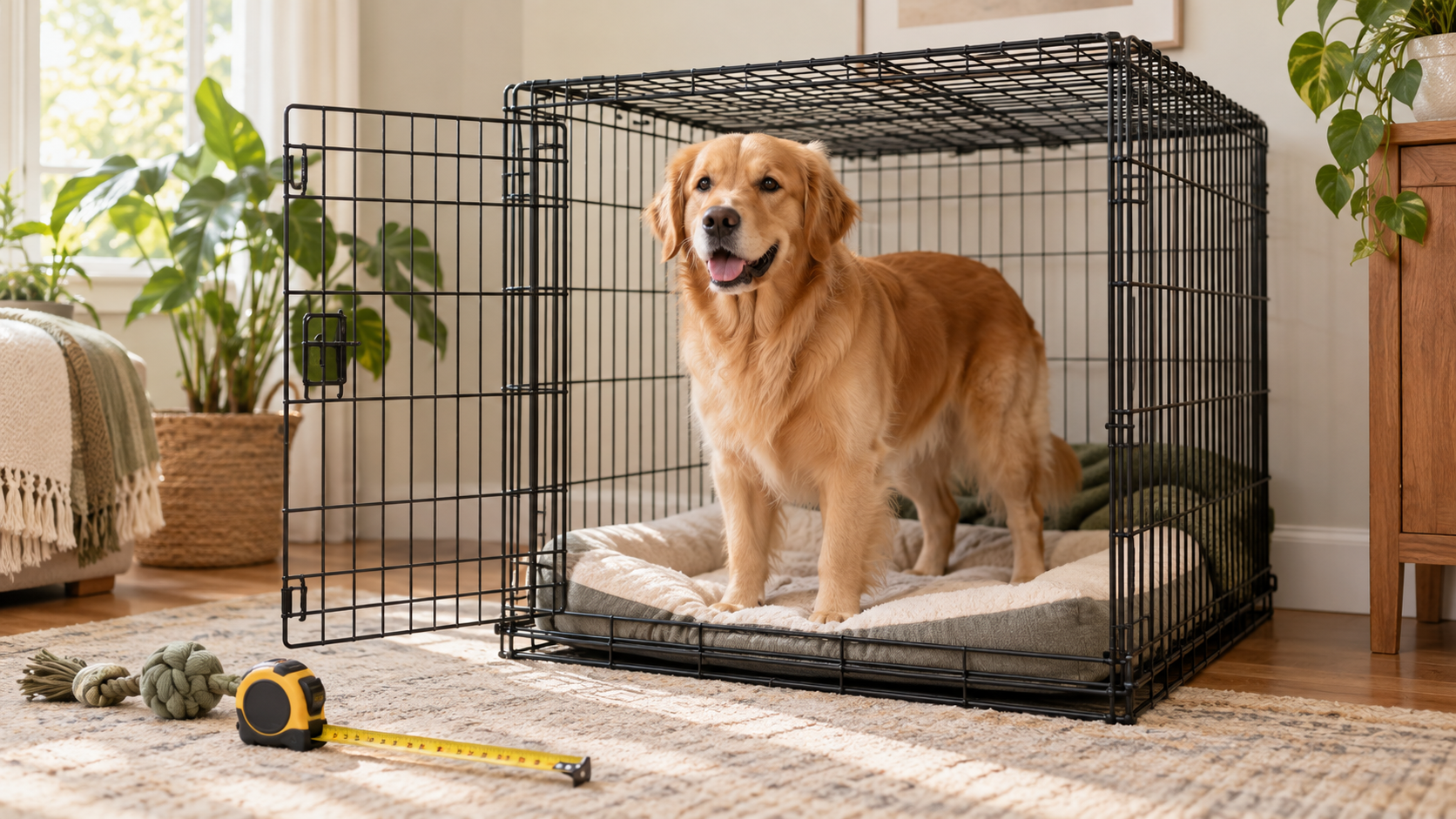
Want a size in seconds?
Use our interactive Dog Crate Size Calculator to get a recommended crate size from your dog's weight and measurements, then use this guide to understand the numbers behind it.
Open the Dog Crate Size CalculatorHow to Measure Your Dog for a Crate
Two quick measurements decide the size, so it is worth doing them before you buy
Measure the length
With your dog standing, measure from the tip of the nose to the base of the tail, where the tail joins the body. Do not include the tail itself, or you will end up with a crate that is longer than it needs to be. Add roughly 2 to 4 inches to give room to lie down fully stretched. This figure is the minimum crate length.
Measure the height
Have your dog sit, then measure from the floor to the top of the head. For breeds with tall, upright ears, measure to the tips of the ears instead, since the crate needs to clear them. Add about 2 to 4 inches so your dog can sit and stand without ducking. This figure is the minimum crate height.
What the crate must allow
A correctly sized crate lets your dog do three things comfortably: stand up without lowering the head, turn around in a full circle, and lie down flat on the side. If any of those feels cramped, the crate is too small. These three checks matter more than any weight chart, because two dogs of the same weight can be built very differently.
Do not oversize it
Bigger is not better. A crate with a lot of spare room can undermine house-training, because a dog may sleep at one end and toilet at the other. It can also feel less secure than a snug, den-like space. Aim for enough room to stand, turn, and lie down, and no more. For a growing puppy, a divider keeps the space right sized as it grows.
Dog Crate Size Chart by Weight
Use this as a starting point. Always confirm against your dog's own measurements, since body shape varies within any weight range.
| Crate length | Approx. dog weight | Example breeds |
|---|---|---|
| 24 inch | Up to about 25 lb | Chihuahua, Yorkshire Terrier, Maltese, Pomeranian, Shih Tzu, Miniature Dachshund |
| 30 inch | About 26 to 40 lb | French Bulldog, Pug, Boston Terrier, Miniature Schnauzer, Cavalier King Charles Spaniel |
| 36 inch | About 41 to 65 lb | Beagle, Cocker Spaniel, Border Collie, Bulldog, Australian Shepherd, Staffordshire Bull Terrier |
| 42 inch | About 66 to 90 lb | Labrador Retriever, Golden Retriever, Boxer, German Shepherd, Doberman, Vizsla |
| 48 inch | About 91 lb and up | Rottweiler, Great Dane, Mastiff, Bernese Mountain Dog, Newfoundland, Saint Bernard |
Crate sizes refer to the length of the crate in inches. Where your dog sits between two sizes, or is tall or long for the weight, size up to the larger crate. If you are unsure of your dog's adult weight, our dog weight calculator and breed weight calculators can help you estimate it.
Breed Examples by Size Class
Thinking in size classes makes it easier to place a breed on the chart, but always measure the individual dog, since size varies within every breed.
- Toy and small breeds (24 inch). Chihuahuas, Yorkshire Terriers, Pomeranians, and Shih Tzus are light and compact, and a 24 inch crate is usually plenty.
- Small to medium breeds (30 inch). French Bulldogs, Pugs, Boston Terriers, and Cavalier King Charles Spaniels are stocky but low, so a 30 inch crate tends to fit.
- Medium breeds (36 inch). Beagles, Cocker Spaniels, Border Collies, and Australian Shepherds land in the middle and generally suit a 36 inch crate.
- Large breeds (42 inch). Labrador Retrievers, Golden Retrievers, German Shepherds, and Boxers are the classic 42 inch dogs. Our Labrador weight calculator and German Shepherd weight calculator can confirm the adult weight to plan around.
- Giant breeds (48 inch and up). Great Danes, Mastiffs, Rottweilers, and Newfoundlands need a 48 inch crate, and the very largest may need a specialty size beyond the standard range.
Sizing a Crate for a Puppy
Puppies grow fast, which creates a common dilemma: buy small now and replace it later, or buy big and risk setting back house-training. The answer is to do both at once. Buy the crate that will fit your puppy as an adult, then use a divider panel to close off the extra space while the puppy is small.
A divider keeps the usable area just big enough to stand, turn around, and lie down. That snug space supports house-training, because dogs naturally avoid soiling the spot where they sleep. As your puppy grows, you slide the divider back a little at a time to open up more room, so the crate grows with the dog. Most wire crates include a divider for exactly this reason.
To choose the adult size, estimate how big your puppy will get. For mixed breeds or unfamiliar breeds, our dog weight calculator can give you a projected adult weight to match against the chart above. Buying once for the full-grown size is cheaper than buying two or three crates as the puppy outgrows them.
Types of Crates
The sizing rules are the same for all of them, but the material changes how the crate suits your dog and home
Wire crates
The most popular choice for home use and house-training. They fold flat for storage, give good airflow, and almost always include a divider panel, which makes them ideal for a growing puppy. Many have two doors and a slide-out tray for easy cleaning.
Plastic crates
Enclosed on the sides with a solid shell, so they feel cozier and more den-like, which suits dogs that like to burrow away. Many plastic crates are approved for airline travel, making them a good pick if you fly with your dog. Airflow is lower than a wire crate, so watch temperature in warm weather.
Soft-sided crates
Light, collapsible, and easy to carry, these suit calm dogs that are already crate-trained and used for travel, camping, or trips. The fabric is easy to chew or claw through, so they are not a good fit for puppies, chewers, or anxious dogs that may try to escape.
Heavy-duty crates
Built from reinforced metal for strong, determined, or anxious dogs that can bend, chew, or escape a standard crate. They are heavier and more expensive, but they hold up where a regular wire crate would not. Worth it for a dog that has already broken out of an ordinary crate.
Common Crate Sizing Mistakes
Most crate problems come down to a handful of avoidable slips:
- Buying by breed name alone. Two dogs of the same breed can differ a lot in size. Measure your actual dog rather than trusting a breed label on the packaging.
- Going too big. Extra room can wreck house-training, because a puppy may sleep at one end and toilet at the other. Snug and den-like beats spacious.
- Going too small. If your dog cannot stand up, turn around, and lie down flat, the crate is too small and unfair to the dog. This is the more serious error of the two.
- Forgetting to add allowance. Measuring the dog exactly and buying that size leaves no room to move. Add about 2 to 4 inches to both the length and the height.
- Measuring to the tip of the tail. Measure to the base of the tail, not the tip, or you will oversize the crate and pay for space your dog does not use.
- Skipping the divider for a puppy. Buying the adult-size crate is right, but only if you use a divider to keep the space small while the puppy learns. Without it, house-training gets harder.
Getting the fit right is part of keeping your dog comfortable and at a healthy weight overall. Our guide to the dog body condition score can help you check your dog is in good shape, which also affects how they settle and move in the crate.
Frequently Asked Questions About Dog Crate Sizes
Common questions about measuring, choosing, and sizing a crate for your dog
What size crate does my dog need?
Match the crate to your dog, not just the label. Measure your dog from the nose to the base of the tail and from the floor to the top of the head or ears when sitting, then add roughly 2 to 4 inches to each figure. The right crate lets your dog stand up without ducking, turn around fully, and lie down stretched out, without so much extra room that it stops feeling like a den. As a starting point, most dogs up to about 25 lb suit a 24 inch crate, 26 to 40 lb a 30 inch, 41 to 65 lb a 36 inch, 66 to 90 lb a 42 inch, and 91 lb and up a 48 inch.
How do I measure my dog for a crate?
Take two measurements. For length, measure from the tip of the nose to the base of the tail, where the tail meets the body, not the tip of the tail, and add about 2 to 4 inches. For height, have your dog sit and measure from the floor to the top of the head, or to the tips of the ears for breeds with tall, upright ears, then add about 2 to 4 inches. Choose a crate whose length and height meet or slightly exceed both figures. Rounding up to the next common crate size is usually fine, as long as it is not far larger than your dog needs.
What size crate should I buy for a puppy?
Buy the crate that fits your puppy full grown, then use a divider panel to close off the extra space while the puppy is small. This gives your puppy just enough room to stand, turn, and lie down, which supports house-training, because dogs avoid soiling the small area where they sleep. As the puppy grows, you slide the divider back to open up more room. Buying for the adult size means one purchase instead of several. If you are unsure how big your puppy will get, our breed weight calculators can give you an estimate of the adult weight to plan around.
Can a dog crate be too big?
Yes. A crate that is much larger than the dog can work against house-training, especially with a puppy. When there is spare room, a dog may sleep at one end and use the other end as a toilet, which is the opposite of what the crate is meant to encourage. A crate that is too big can also feel less secure and den-like. The aim is enough space to stand, turn around, and lie down comfortably, and no more. For a growing puppy, a divider lets you keep the usable space right sized as it grows.
What type of dog crate is best?
It depends on how you will use it. Wire crates are the most common for home and house-training, because they fold flat, offer good airflow, and usually come with a divider. Plastic crates are enclosed and cozier, and many are approved for airline travel. Soft-sided crates are light and easy to carry for calm, crate-trained dogs, but they are easy to chew or scratch through. Heavy-duty metal crates are built for strong or anxious dogs that can escape or damage a standard crate. Whichever type you choose, the sizing rules stay the same.
Find Your Dog's Crate Size
Get a recommended crate size in seconds, then explore the rest of our dog weight guides.
Free dog printables
Keep these dog care guides handy
A rotating selection of practical dog guides chosen from our free printable library.Dog Body Condition Chart
A printable 1–9 body condition reference.
Dog Quality of Life Checklist
Track the HHHHHMM quality-of-life measures.
Raw Feeding Reference Card
A printable BARF and 80/10/10 portion guide.