
Last updated: October 3, 2026
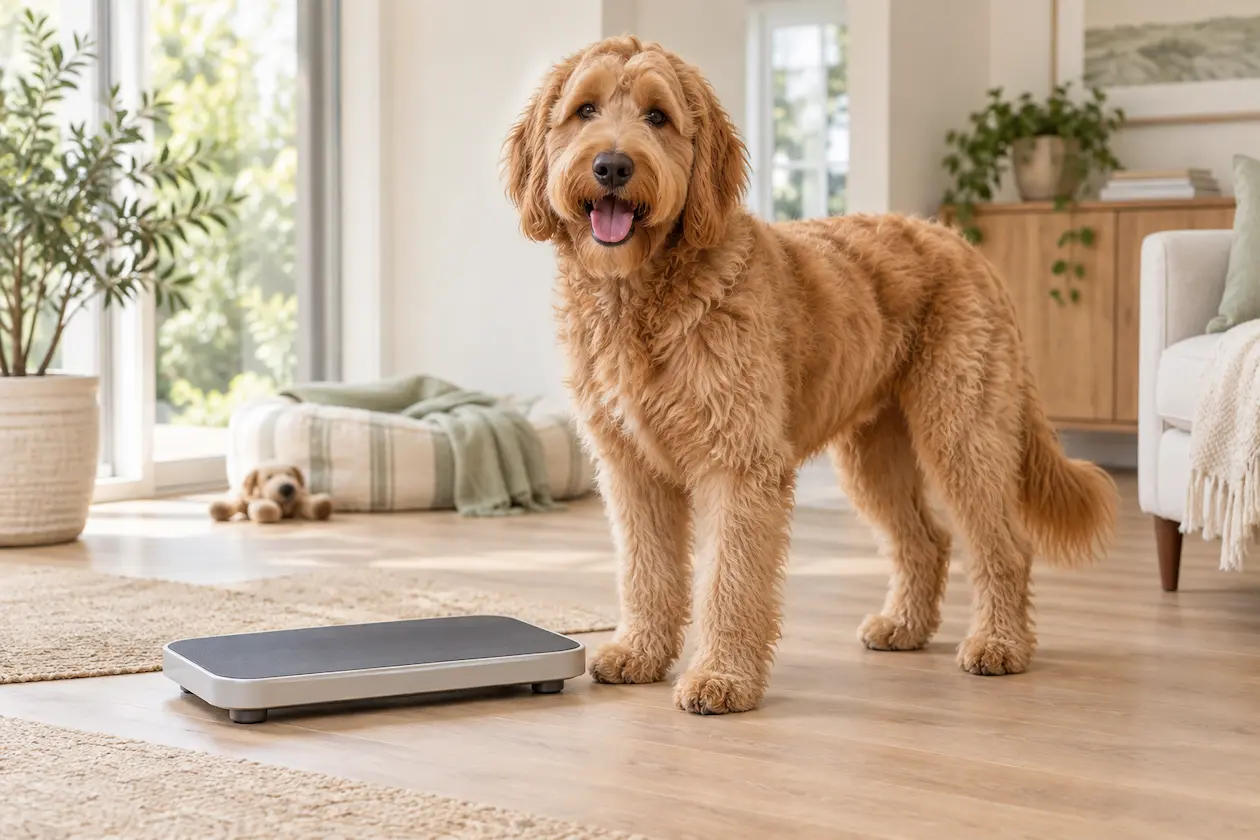
How To Use
Enter your Goldendoodle's sex, age, and current weight to check if they are within the healthy weight range for their stage of life.
Quick Steps
- 1 Select your Goldendoodle's Sex.
- 2 Select their Age.
- 3 Enter their Current Weight in pounds.
- 4 Click Calculate to see the weight assessment and full growth chart.
Goldendoodle Weight Calculator
Fill Out The Fields Below
About Goldendoodle Weight
The Goldendoodle is a Golden Retriever and Poodle cross bred in a range of sizes, so there is no single adult weight. Depending on the Poodle parent, adults fall into four broad size groups: Petite/Toy (10–25 lbs), Miniature (25–35 lbs), Medium (40–50 lbs), and Standard (50–90 lbs). This calculator reflects a Miniature Goldendoodle, the most popular variant, with adults typically 25–35 lbs. Petite, Medium, and Standard Goldendoodle sizes are covered in detail in the page sections below. Goldendoodles are active, friendly family dogs, and keeping them lean protects the hips, joints, and (in Standards) reduces bloat risk.
Key Weight Characteristics
- • Four size groups: Petite/Toy (10–25 lbs), Miniature (25–35 lbs), Medium (40–50 lbs), Standard (50–90 lbs)
- • Mini Goldendoodles are usually full grown by 11–13 months; Standards by 16–18 months, filling out to 2 years
- • Generation (F1, F1b, multigen) shifts adult size, coat type, and shedding
- • Prone to hip dysplasia, ear infections, progressive retinal atrophy (PRA), and hypothyroidism; bloat risk in Standards
Body Condition Check
- ✓ Feel through the wavy or curly coat with light pressure — you should feel the ribs easily; the coat hides weight gain.
- ✓ Looking from above, a clear waist should be visible behind the ribs once you account for the fluffy coat.
- ✓ From the side, the belly should tuck up — a straight or sagging underline suggests excess weight.
- ✓ Goldendoodles are naturally lean and athletic — keeping them at the middle of their size range protects hips and joints.
What Is a Goldendoodle and How Big Does It Get?
A Goldendoodle is a cross between a Golden Retriever and a Poodle. Because Poodles come in several sizes, Goldendoodles do too, so there is no single adult weight. The size your puppy grows into is set mainly by the Poodle parent used in the cross.
Goldendoodles are usually sorted into four size groups. The Miniature Goldendoodle is the most popular, which is why the calculator above reflects that size by default.
| Size | Adult weight | Height at shoulder | Poodle parent |
|---|---|---|---|
| Petite / Toy | 10–25 lbs (4.5–11 kg) | 10–14 in | Toy Poodle |
| Miniature | 25–35 lbs (11–16 kg) | 14–17 in | Mini Poodle |
| Medium | 40–50 lbs (18–23 kg) | 17–21 in | Small Standard Poodle |
| Standard | 50–90 lbs (23–41 kg) | 20–24 in | Standard Poodle |
The calculator reflects a Miniature Goldendoodle. If your dog is a Petite, Medium, or Standard, use the size-specific ranges throughout this page.
Mini Goldendoodle Full Grown Weight and Size
A full-grown Miniature Goldendoodle weighs 25–35 lbs (11–16 kg) and stands 14–17 inches at the shoulder. Males usually settle at the higher end of the range and females slightly lower, though there is plenty of overlap.
Most Mini Goldendoodles reach their adult weight by 11–13 months. After that they may add a little muscle and chest depth, but the number on the scale stays roughly steady. If your Mini is noticeably above 35 lbs as an adult, it may be a Medium Goldendoodle or simply carrying extra weight, which the calculator above will flag.
The Petite/Toy Goldendoodle is the smaller cousin at 10–25 lbs, often produced from a Toy Poodle. These finish growing early, usually by 10–12 months.
Goldendoodle Growth Chart by Age
The calculator above uses a Miniature Goldendoodle growth curve. Puppies grow fastest in the first six months, then slow down as they approach their adult weight. Use the chart in the calculator to see whether your dog is tracking the expected curve for its age and sex.
Larger sizes follow the same shape but on a bigger scale, and take longer to level off. As a rough guide, a Standard Goldendoodle at 6 months is often around half its adult weight, while a Mini at 6 months is closer to three quarters of the way there.
When Is a Goldendoodle Fully Grown?
Smaller Goldendoodles mature faster than larger ones:
- Petite / Mini Goldendoodle: full grown by 11–13 months.
- Medium Goldendoodle: reaches adult height around 13–15 months.
- Standard Goldendoodle: full height by 16–18 months, then continues to fill out in muscle and chest until about 2 years.
Height is usually reached before final weight. A dog can look tall and leggy at a year old and then broaden over the following months, which is normal, especially for Standards.
F1 vs F1b vs Multigen: How Generation Shifts Size, Coat, and Shedding
Goldendoodle generation labels describe how much Poodle is in the mix, which affects coat type and shedding more than final size:
- F1: a first cross of Golden Retriever x Poodle (about 50/50). Coats are usually wavy, and shedding is low but not zero.
- F1b: an F1 bred back to a Poodle (about 75% Poodle). Curlier coats and the lowest shedding, often the pick for allergy-sensitive homes.
- Multigen (F2b and beyond): Goldendoodle-to-Goldendoodle or later crosses, bred for consistent coat and predictable size.
As a rule, more Poodle genetics means a curlier, lower-shedding coat and a body that leans toward the Poodle parent in size. Coat type also changes how you assess weight, since curlier coats hide the ribs and waist more easily.
Goldendoodle Feeding Guide
How much to feed depends on size group, age, and activity level. These are starting points for a quality dry food, split into two meals a day:
- Petite / Mini (10–35 lbs): roughly 3/4 to 1.5 cups per day.
- Medium (40–50 lbs): roughly 2 to 2.5 cups per day.
- Standard (50–90 lbs): roughly 3 to 4 cups per day.
Puppies need more frequent meals (three a day until about 6 months). For a precise calorie target, use our dog nutrition calculator, and adjust portions to keep your dog lean rather than following the bag alone.
Goldendoodle Health Issues
Goldendoodles can inherit conditions from either parent breed. The most common concerns are:
- Hip dysplasia: a malformed hip joint that excess weight makes worse. Keeping your dog lean is the single best thing you can do for its joints.
- Ear infections: floppy, hairy ears trap moisture. Clean ears regularly and keep the hair inside trimmed.
- Progressive retinal atrophy (PRA): an inherited eye disease that leads to gradual vision loss. Reputable breeders test parents for it.
- Hypothyroidism: an underactive thyroid that can cause weight gain, lethargy, and coat problems. It is manageable with daily medication.
- Bloat (GDV) in Standards: deep-chested Standard Goldendoodles are at risk of this life-threatening emergency. Feed smaller meals and avoid hard exercise right after eating.
Buying from a breeder who health-tests both parents meaningfully reduces the odds of these conditions.
Body Condition: Is Your Goldendoodle a Healthy Weight?
A Goldendoodle's wavy or curly coat easily hides weight changes, so assess by feel rather than by looks. Part or press through the coat with your fingertips.
Underweight
Ribs, spine, and hip bones are easy to feel with no fat covering and may be visible even through the coat. There is an obvious tuck and no muscle over the back. Increase food and check with your vet.
Ideal
You can feel the ribs through the coat with light pressure but they are not sticking out. A waist is visible from above and the belly tucks up from the side. This is the target.
Overweight
You have to press firmly through the coat to find the ribs, the waist is gone, and the belly is rounded rather than tucked. Reduce portions, cut treats, and increase exercise.
Temperament and Living With a Goldendoodle
Goldendoodles are among the most popular family dogs for good reason: they are friendly, patient, playful, and highly trainable, combining the gentle nature of the Golden Retriever with the intelligence of the Poodle. They bond closely with their people and generally do well with children and other pets.
Exercise needs scale with size. Petite and Mini Goldendoodles are happy with 30–45 minutes of activity a day, while Medium and Standard dogs need an hour or more plus mental enrichment. All sizes are smart enough to get bored, so puzzle toys, training games, and varied walks help prevent destructive behavior. Their coats need brushing several times a week and professional grooming every 6–8 weeks.
Goldendoodle Quick Reference
| Size | Adult weight | Height | Full grown |
|---|---|---|---|
| Petite / Toy | 10–25 lbs | 10–14 in | 10–12 mo |
| Miniature | 25–35 lbs | 14–17 in | 11–13 mo |
| Medium | 40–50 lbs | 17–21 in | 13–15 mo |
| Standard | 50–90 lbs | 20–24 in | 16–18 mo (fills out to 2 yr) |
Related tools: Golden Retriever weight calculator, Poodle weight calculator, and the dog nutrition calculator.
FAQs
Frequently Asked Questions
How big does a Goldendoodle get?
It depends entirely on the size group. Petite/Toy Goldendoodles reach 10–25 lbs (4.5–11 kg), Miniature Goldendoodles 25–35 lbs (11–16 kg), Medium Goldendoodles 40–50 lbs (18–23 kg), and Standard Goldendoodles 50–90 lbs (23–41 kg). The size is set mainly by the Poodle parent used in the cross.
What is a Mini Goldendoodle full grown weight?
A full-grown Miniature Goldendoodle typically weighs 25–35 lbs (11–16 kg) and stands 14–17 inches at the shoulder. Males tend to land at the upper end and females slightly lower. Most Mini Goldendoodles reach their adult weight by 11–13 months.
When is a Goldendoodle fully grown?
Smaller Goldendoodles mature faster. Petite and Mini Goldendoodles are usually full grown by 11–13 months. Medium Goldendoodles finish around 13–15 months. Standard Goldendoodles reach full height by 16–18 months and keep filling out in muscle and chest until about 2 years old.
How big will my Goldendoodle get from its parents?
The best predictor is the size of the parents, especially the Poodle. A Toy Poodle parent produces Petite Goldendoodles, a Miniature Poodle produces Mini or Medium Goldendoodles, and a Standard Poodle produces Standard Goldendoodles. A rough guide is that a puppy often reaches roughly the average of both parents adult weights.
How much should a Goldendoodle weigh at 6 months?
For a Miniature Goldendoodle, expect around 22–30 lbs for males and 20–28 lbs for females at 6 months. Petite Goldendoodles will be lighter (around 10–18 lbs) and Standards much heavier (often 35–55 lbs) at the same age.
What is the difference between F1, F1b, and multigen Goldendoodles?
An F1 Goldendoodle is a first cross of a Golden Retriever and a Poodle (50/50). An F1b is an F1 bred back to a Poodle (about 75% Poodle), which usually means a curlier, lower-shedding coat. Multigen (F2b and beyond) are Goldendoodle-to-Goldendoodle or later crosses bred for consistent coat and size. More Poodle genetics generally means curlier coat and less shedding.
Do Goldendoodles shed?
Goldendoodles are low-shedding rather than truly non-shedding. F1b and multigen dogs with curlier coats shed the least, while F1 dogs with wavy or flatter coats shed a little more. No Goldendoodle is guaranteed hypoallergenic, but many people with mild allergies tolerate the curlier-coated dogs well.
Are Goldendoodles hypoallergenic?
No dog is fully hypoallergenic, but Goldendoodles are often marketed that way because the Poodle coat sheds little dander. Curlier F1b and multigen coats are the best bet for allergy-sensitive homes. Spend time with the specific dog before committing if allergies are a concern.
How much bigger will a Standard Goldendoodle get than a Mini?
A Standard Goldendoodle (50–90 lbs) can be two to three times the weight of a Miniature (25–35 lbs) and four to eight times a Petite (10–25 lbs). Standing height also differs sharply, from around 10–14 inches for a Petite up to 20–24 inches for a Standard.
Is my Goldendoodle overweight?
Feel through the wavy or curly coat with light pressure. You should be able to feel the ribs without pressing hard, see a waist from above, and see the belly tuck up from the side. The coat easily hides weight gain, so go by feel rather than by looks.
How much should I feed my Goldendoodle?
Feeding depends on the size group and activity level. A Mini Goldendoodle needs roughly 1 to 1.5 cups of quality dry food per day split into two meals, a Medium 2 to 2.5 cups, and a Standard 3 to 4 cups. Use our dog nutrition calculator for a precise calorie target and adjust to keep your dog lean.
What health problems do Goldendoodles have?
Goldendoodles can inherit conditions from both parent breeds: hip dysplasia, ear infections (from floppy, hairy ears), progressive retinal atrophy (PRA), hypothyroidism, and, in Standards, gastric dilatation-volvulus (bloat). Reputable breeders health-test both parents to reduce these risks.
Why do Goldendoodles get ear infections?
Their floppy ears trap moisture and heat, and hair growing inside the ear canal reduces airflow, creating an environment where yeast and bacteria thrive. Regular ear cleaning and keeping ear hair trimmed helps prevent chronic infections.
Do Standard Goldendoodles get bloat?
Larger, deep-chested Standard Goldendoodles carry the same bloat (GDV) risk as Standard Poodles and Golden Retrievers. Feed two or three smaller meals a day rather than one large one, avoid heavy exercise right after eating, and learn the warning signs of a swollen, hard abdomen and unproductive retching.
How long do Goldendoodles live?
Goldendoodles typically live 10–15 years. Smaller Mini and Petite Goldendoodles tend to live at the longer end of that range, while larger Standards are usually at the shorter end. Keeping your dog lean is one of the biggest factors in a longer, healthier life.
How much does a Goldendoodle cost?
Goldendoodle puppies from health-testing breeders usually cost $2,000–$4,000, with F1b and multigen dogs often priced higher. Ongoing costs include professional grooming every 6–8 weeks (typically $60–$120 per session), quality food, and routine veterinary care.
Are Goldendoodles good with kids?
Yes. Goldendoodles are one of the most popular family dogs because they are friendly, patient, and playful, taking the gentle temperament of the Golden Retriever and the smarts of the Poodle. As with any dog, supervise interactions with young children and teach kids to handle the dog calmly.
How much exercise does a Goldendoodle need?
Exercise needs scale with size. Petite and Mini Goldendoodles do well with 30–45 minutes of activity a day, while Medium and Standard dogs need 60+ minutes plus mental enrichment. All sizes are intelligent and can become bored and destructive without enough activity.
Which is bigger, a Goldendoodle or a Labradoodle?
They overlap heavily because both are Poodle crosses bred in the same size groups. A Standard Goldendoodle and a Standard Labradoodle are similar in size (roughly 50–90 lbs). The main differences are coat and temperament rather than weight.
Other Calculators for Dogs
Dog Calorie Calculator by Breed — Free Daily Calorie & Feeding Tool
Free dog calorie calculator by breed. Find out exactly how many calories your dog needs per day by weight, breed, age, and activity level. Get instant kcal and feeding portions for Labradors, German Shepherds, Chihuahuas, and every breed in between. Try it now.

Puppy Calorie Calculator | Puppy Nutrition Calculator by Breed - Free Tool
Free puppy calorie calculator and nutrition tool. Calculate your puppy
Senior Dog Calorie Calculator - Free Daily Calorie Tool
Free senior dog calorie calculator. Calculate your older dog\
Other Pet Weight Calculators
Australian Shepherd Weight Calculator | Is Your Aussie a Healthy Weight? | The Pet Calculator
Check your Australian Shepherd\
Beagle Weight Calculator | Healthy Weight for 13-Inch & 15-Inch Beagles
Free Beagle weight calculator — check your Beagle\
Bearded Dragon Weight Chart by Age | Free Weight Calculator
Free bearded dragon weight calculator plus a bearded dragon weight chart by age. Check if your bearded dragon is a healthy weight, from hatchling to adult, with growth milestones and care tips.
Free dog printables
Keep these dog care guides handy
A rotating selection of practical dog guides chosen from our free printable library.Dog Pregnancy Timeline
A week-by-week whelping calendar and checklist.
Raw Feeding Reference Card
A printable BARF and 80/10/10 portion guide.
Dog Feeding Guide
Portion guidance by weight, age, and life stage.