
Last updated: October 3, 2026
How To Use
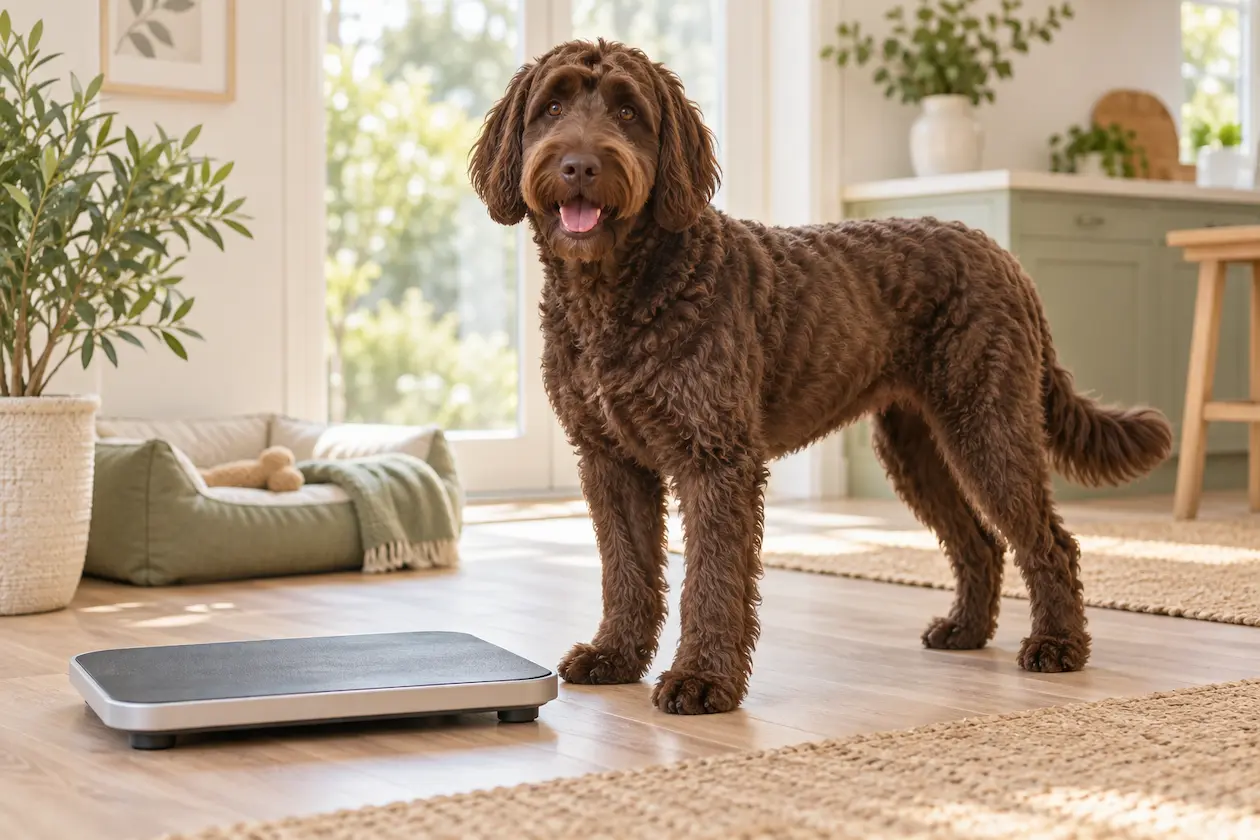
Enter your Labradoodle's sex, age, and current weight to check if they are within the healthy weight range for their stage of life.
Quick Steps
- 1 Select your Labradoodle's Sex.
- 2 Select their Age.
- 3 Enter their Current Weight in pounds.
- 4 Click Calculate to see the weight assessment and full growth chart.
Labradoodle Weight Calculator
Fill Out The Fields Below
About Labradoodle Weight
The Labradoodle is a crossbreed of a Labrador Retriever and a Poodle, first bred as a low-shedding guide dog and now one of the most popular family crossbreeds. Adult size depends heavily on the Poodle parent and comes in three sizes: Miniature (15–25 lbs, from a Toy or Miniature Poodle), Medium (30–45 lbs), and Standard (50–65 lbs, from a Standard Poodle). This calculator reflects a Standard Labradoodle, the most common size searched for; Miniature and Medium sizes are covered in detail in the page sections below. Generation (F1, F1b, Australian Labradoodle) also influences coat and size consistency, so expect some variation within a litter.
Key Weight Characteristics
- • Cross of Labrador Retriever x Poodle; three sizes: Miniature (15–25 lbs), Medium (30–45 lbs), Standard (50–65 lbs)
- • Size follows the Poodle parent — Mini/Medium from smaller Poodles, Standard from a Standard Poodle
- • Miniature fully grown by ~12 months; Standard fills out until 18 months to 2 years
- • Low-shedding wavy or curly coat, but prone to hip and elbow dysplasia, ear infections, PRA, and Addison's disease
Body Condition Check
- ✓ The wavy or curly coat can hide weight changes — run your hands firmly along the ribcage to feel fat cover.
- ✓ You should be able to feel ribs easily with light pressure but not see them through the coat.
- ✓ Looking from above, a clear waist should be visible behind the ribs.
- ✓ Active family dogs — a Labradoodle carrying excess weight puts added strain on hip and elbow joints.
What Is a Labradoodle and How Big Do They Get?
A Labradoodle is a crossbreed of a Labrador Retriever and a Poodle. Because the Poodle comes in three sizes, Labradoodles do too, and the single biggest factor in how big your dog gets is which size of Poodle was used as a parent.
There are three broad size groups: Miniature (15–25 lbs), Medium (30–45 lbs), and Standard (50–65 lbs). The calculator above defaults to a Standard Labradoodle, the most commonly searched size. Use the overview table below to find the group that matches your dog.
| Size | Poodle parent | Adult weight | Adult height |
|---|---|---|---|
| Miniature | Toy / Miniature Poodle | 15–25 lbs (7–11 kg) | 14–16 in |
| Medium | Small Standard / Miniature Poodle | 30–45 lbs (14–20 kg) | 17–20 in |
| Standard | Standard Poodle | 50–65 lbs (23–29 kg) | 21–24 in |
Labradoodle Full Grown Weight and Size
A full grown Standard Labradoodle weighs 50–65 lbs and stands 21–24 inches at the shoulder. Males generally finish at the heavier end (around 55–65 lbs) and females at the lighter end (around 45–60 lbs). Most Standards reach their full height by 12 months but continue to broaden through the chest and fill out with muscle until 18 months to 2 years of age.
Medium Labradoodles settle at 30–45 lbs and 17–20 inches, while Miniatures finish at 15–25 lbs and 14–16 inches. If your adult dog sits well outside the range for its size group, weigh it, feel its body condition, and speak to your vet. A Labradoodle that looks "big" is often simply carrying extra weight rather than being a larger size variety.
Mini Labradoodle Full Grown
A full grown Mini Labradoodle weighs 15–25 lbs (roughly 7–11 kg) and stands 14–16 inches tall. Minis are produced by crossing a Labrador with a Toy or Miniature Poodle, which is why they come in noticeably smaller than the Standard. Within the Mini group there is still a fair spread: a dog from a Toy Poodle line can finish closer to 15 lbs, while one from a larger Miniature Poodle can reach the mid-20s.
Mini Labradoodles mature faster than Standards. Most reach close to their adult weight by around 12 months, with only minor filling out afterward. Because the difference between a lean and an overweight Mini can be just a few pounds, portion control matters even more at this size. A single extra pound on an 18 lb dog is a much larger proportion of body weight than it is on a Standard.
Labradoodle Growth Chart by Age
The interactive calculator at the top of this page shows a full month-by-month growth chart for a Standard Labradoodle, split by sex. Enter your dog's details to see where it sits against the healthy range for its age. Mini and Medium Labradoodles follow the same growth curve shape but at lower weights, so expect a Mini to reach roughly the same percentage of its adult weight at each age.
As a rule of thumb across all sizes, a Labradoodle reaches about half its adult weight by 4–5 months, around 75% by 6–7 months, and close to its final weight by its first birthday, with Standards adding a little more into their second year.
When Is a Labradoodle Fully Grown?
How long a Labradoodle takes to finish growing depends on its size. Smaller dogs mature earlier:
- Miniature Labradoodle: essentially fully grown by around 12 months.
- Medium Labradoodle: full adult size by 12–15 months.
- Standard Labradoodle: full height by about 12 months, but keeps filling out with muscle and chest depth until 18 months to 2 years.
A Labradoodle that still looks lanky and "leggy" at a year old is usually a Standard that has hit its adult height but has not yet developed its adult build. Keep feeding to body condition through this stage rather than free-feeding, as growth-stage weight gain is easy to add and hard to remove.
Australian Labradoodle vs F1 and F1b Generations
Generation labels tell you how the dog was bred, and they strongly affect coat type and how predictable the size will be.
- F1: a first-generation cross of a purebred Labrador and a purebred Poodle. Coats range from straight to wavy, shedding varies, and size within a litter is the least predictable.
- F1b: an F1 Labradoodle bred back to a Poodle, so about 75% Poodle. Coats are usually curlier and lower-shedding, which suits allergy-sensitive homes, and dogs often run slightly smaller.
- Australian Labradoodle: a multi-generation line bred to a standard, sometimes with other breeds such as Cocker Spaniel in its background. Size and coat are the most consistent of all.
If a predictable adult size matters to you, a later-generation or Australian Labradoodle from a breeder who publishes adult weights is a safer bet than an F1.
Labradoodle Feeding Guide
Feed your Labradoodle according to its adult size and activity level, and always measure portions rather than eyeballing them. As a starting point for a quality dry food, split across two meals a day:
- Miniature (15–25 lbs): about 1 to 1.5 cups per day.
- Medium (30–45 lbs): about 1.5 to 2.5 cups per day.
- Standard (50–65 lbs): about 2.5 to 3.5 cups per day.
These are guidelines only, so adjust up or down based on body condition, not the number on the scale. Labradoodles inherit the Labrador's love of food, so treats should stay under 10% of daily calories. For a tailored daily calorie target, use our Dog Nutrition Calculator.
Labradoodle Health Conditions
As a cross, Labradoodles can inherit health conditions from either parent breed. The most important to know about are:
- Hip and elbow dysplasia: joint malformations common to both parent breeds. Excess weight accelerates their progression, which is a key reason to keep your dog lean.
- Ear infections: the floppy, hairy ears trap moisture. Regular checking and drying after swimming or baths helps prevent recurring infections.
- Progressive retinal atrophy (PRA): an inherited eye disease leading to gradual vision loss. Responsible breeders test parents for it.
- Addison's disease: a hormonal disorder seen in Poodle lines, causing lethargy, vomiting, and weakness. It is manageable once diagnosed.
- Exercise-induced collapse: a genetic condition carried in some Labrador lines where intense exercise triggers weakness or collapse. Awareness and DNA testing of parents reduce the risk.
Buying from a breeder who health-tests both the Labrador and Poodle parents is the single best way to lower these risks.
Labradoodle Body Condition Score: Feel Through the Coat
A Labradoodle's wavy or curly coat easily hides weight changes, so you cannot judge condition by eye, so you have to use your hands. Part or press through the coat and feel along the ribcage. Assess your dog against these three states.
Underweight
Ribs, spine, and hip bones are felt with almost no fat cover and may be visible even through the coat. There is a severe tuck at the abdomen and obvious loss of muscle. Feed up gradually and rule out parasites or illness with your vet.
Ideal
Ribs are easily felt through the coat with only a thin layer of fat over them. Viewed from above there is a clear waist behind the ribs, and from the side the belly tucks up. This is the target for every size of Labradoodle.
Overweight
Ribs are hard to feel under a thick fat layer, the waist disappears, and the belly hangs level or sags. Fat pads may form at the base of the tail. Reduce portions, cut treats, and increase gentle exercise.
Temperament, Exercise, and Living With a Labradoodle
Labradoodles are friendly, intelligent, and deeply people-focused, a blend of the Labrador's easygoing warmth and the Poodle's cleverness. They are typically excellent with children and other pets, and they thrive on being part of family life. The flip side is that they dislike being left alone for long stretches and can develop separation anxiety or destructive habits when bored.
Exercise needs scale with size. A Miniature is usually satisfied with 30–45 minutes of activity a day, while Medium and Standard Labradoodles need 60–90 minutes of walks, play, and training. Their intelligence means mental work such as puzzle feeders, scent games, and obedience matters as much as physical exercise. A well-exercised Labradoodle is far easier to keep at a healthy weight and far calmer in the home.
Labradoodle Quick Reference
| Measure | Miniature | Medium | Standard |
|---|---|---|---|
| Adult weight | 15–25 lbs | 30–45 lbs | 50–65 lbs |
| Adult height | 14–16 in | 17–20 in | 21–24 in |
| Fully grown | ~12 months | 12–15 months | 18 mo – 2 yr |
| Daily food | 1–1.5 cups | 1.5–2.5 cups | 2.5–3.5 cups |
| Lifespan | 12–15 years | ||
Related tools: the Labrador Weight Calculator and Poodle Weight Calculator cover the parent breeds, and the Dog Nutrition Calculator gives a tailored feeding target.
FAQs
Frequently Asked Questions
How big do Labradoodles get when full grown?
It depends on the size variety. A Miniature Labradoodle is fully grown at around 15–25 lbs (14–16 inches tall), a Medium Labradoodle at 30–45 lbs (17–20 inches), and a Standard Labradoodle at 50–65 lbs (21–24 inches). Standard Labradoodles are the most common size and are what this calculator defaults to.
How big does a Mini Labradoodle get full grown?
A Mini (Miniature) Labradoodle typically reaches 15–25 lbs (roughly 7–11 kg) and stands 14–16 inches at the shoulder when full grown. Minis come from crossing a Labrador with a Toy or Miniature Poodle, and most reach their adult size by about 12 months.
What is the average weight of a Standard Labradoodle?
A Standard Labradoodle usually weighs 50–65 lbs (about 23–29 kg) as an adult. Males tend to sit toward the top of that range and females toward the bottom. This is the size produced by crossing a Labrador with a Standard Poodle.
When is a Labradoodle fully grown?
Miniature Labradoodles are usually fully grown by around 12 months. Medium Labradoodles reach adult size by 12–15 months. Standard Labradoodles reach full height by about 12 months but keep filling out in muscle and chest until 18 months to 2 years.
How much should a 6 month old Labradoodle weigh?
A Standard Labradoodle at 6 months typically weighs 34–52 lbs depending on sex, sitting at roughly 70–75% of adult weight. Mini and Medium Labradoodles will weigh proportionally less. Use the growth chart above with your dog selected as male or female for a closer estimate.
How can I tell what size my Labradoodle puppy will be?
The Poodle parent is the biggest clue: a Toy or Miniature Poodle parent points to a Mini, and a Standard Poodle parent points to a Standard. Breeders also estimate from the puppy weight at 8–12 weeks. As a rough guide, many Labradoodles reach close to half their adult weight by around 4–5 months.
What is the difference between an F1 and F1b Labradoodle?
An F1 Labradoodle is a first-generation cross of a purebred Labrador and a purebred Poodle, so coats and sizes vary the most within a litter. An F1b is an F1 Labradoodle bred back to a Poodle, making it about 75% Poodle, so it tends to produce a curlier, lower-shedding coat that is often better for allergy sufferers.
What is an Australian Labradoodle?
An Australian Labradoodle is a multi-generation Labradoodle that also has other breeds (such as Cocker Spaniel) in its background and is bred to a set standard. Because it is many generations in, size and coat are far more consistent and predictable than in an early-generation F1 Labradoodle.
Do Labradoodles shed?
Most Labradoodles shed very little, especially F1b and multi-generation dogs with curlier, more Poodle-like coats. No dog is truly 100% hypoallergenic, and early-generation (F1) Labradoodles with wavier coats can shed more. Regular brushing and professional grooming every 6–10 weeks keep the coat healthy.
Are Labradoodles hypoallergenic?
Labradoodles are often described as hypoallergenic and are lower-shedding than many breeds, but no dog is entirely allergen-free. Curlier F1b and Australian Labradoodles are usually the best bet for allergy-sensitive homes. Always spend time with the specific dog before committing.
What health problems do Labradoodles have?
Labradoodles can inherit conditions from both parent breeds, including hip and elbow dysplasia, ear infections, progressive retinal atrophy (PRA), Addison’s disease, and, in Standard-Poodle lines, exercise-induced collapse. Buying from a breeder who health-tests both parents lowers the risk considerably.
How much exercise does a Labradoodle need?
Labradoodles are active family dogs. Minis are content with about 30–45 minutes of activity a day, while Medium and Standard Labradoodles usually need 60–90 minutes of walking, play, and mental work. Under-exercised Labradoodles gain weight and can become bored and destructive.
How much should I feed a Labradoodle?
Feed to the dog’s adult size and activity level. As a rough starting point, a Mini eats around 1 to 1.5 cups of quality dry food a day, a Medium 1.5 to 2.5 cups, and a Standard 2.5 to 3.5 cups, split into two meals. Adjust by body condition, not just the label, and measure every portion.
Are Labradoodles prone to getting overweight?
Yes. Labradoodles inherit the Labrador’s strong food drive, so they readily overeat if allowed. Because the coat hides body shape, weight can creep on unnoticed. Feel the ribs through the coat and check for a waist from above every couple of weeks.
How long do Labradoodles live?
Labradoodles typically live 12–15 years, with smaller Minis often living toward the upper end. Keeping your dog lean, exercised, and up to date on veterinary care is the single biggest thing you can do to protect their lifespan.
How much does a Labradoodle cost?
Labradoodle puppies from a reputable breeder generally cost between $1,500 and $3,000, with Australian Labradoodles and sought-after colors often higher. Ongoing costs include professional grooming every 6–10 weeks, quality food, and routine veterinary care.
Are Labradoodles good family dogs?
Very much so. Labradoodles are friendly, people-focused, and generally good with children and other pets, combining the Labrador’s easygoing nature with the Poodle’s intelligence. They do best in active households and dislike being left alone for long periods.
Other Calculators for Dogs
Dog Calorie Calculator by Breed — Free Daily Calorie & Feeding Tool
Free dog calorie calculator by breed. Find out exactly how many calories your dog needs per day by weight, breed, age, and activity level. Get instant kcal and feeding portions for Labradors, German Shepherds, Chihuahuas, and every breed in between. Try it now.
Puppy Calorie Calculator | Puppy Nutrition Calculator by Breed - Free Tool
Free puppy calorie calculator and nutrition tool. Calculate your puppy
Senior Dog Calorie Calculator - Free Daily Calorie Tool
Free senior dog calorie calculator. Calculate your older dog\
Other Pet Weight Calculators
Australian Shepherd Weight Calculator | Is Your Aussie a Healthy Weight? | The Pet Calculator
Check your Australian Shepherd\
Beagle Weight Calculator | Healthy Weight for 13-Inch & 15-Inch Beagles
Free Beagle weight calculator — check your Beagle\
Bearded Dragon Weight Chart by Age | Free Weight Calculator
Free bearded dragon weight calculator plus a bearded dragon weight chart by age. Check if your bearded dragon is a healthy weight, from hatchling to adult, with growth milestones and care tips.
Free dog printables
Keep these dog care guides handy
A rotating selection of practical dog guides chosen from our free printable library.Dog Quality of Life Checklist
Track the HHHHHMM quality-of-life measures.
Dog Feeding Guide
Portion guidance by weight, age, and life stage.
Raw Feeding Reference Card
A printable BARF and 80/10/10 portion guide.