
Last updated: October 3, 2026
Body Condition Assessment
Cat Body Condition Score: Visual Size & Shape Guide
Learn how to assess your cat's body condition using visual and tactile evaluation. Includes a complete Body Condition Score guide and average cat dimensions.
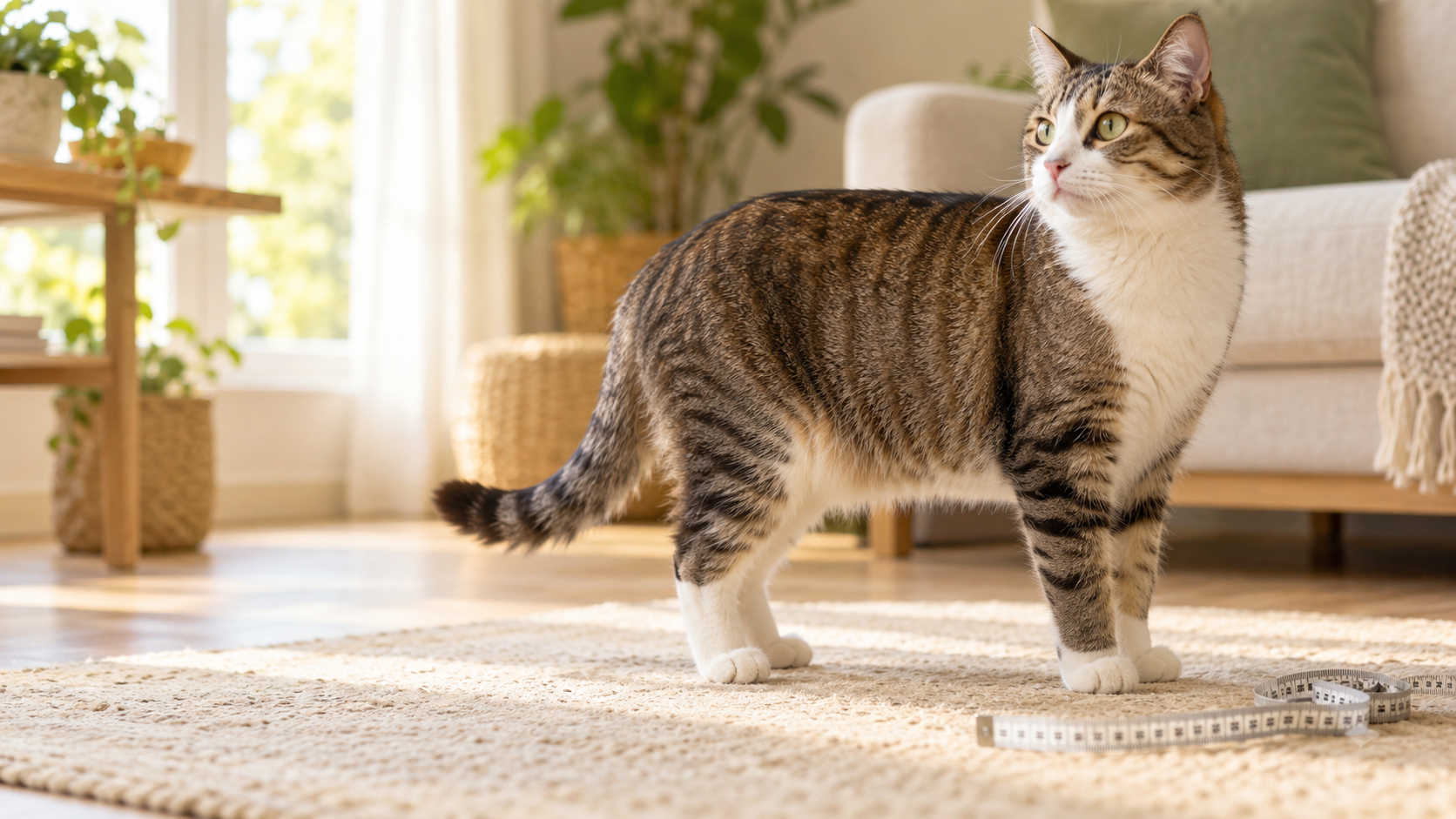
Cat Body Condition Score Guide
Use this 1-5 scale to assess your cat's body condition visually and tactually
This guide uses the 1-5 scale, where 3 is ideal. Many veterinarians use a 1-9 scale (WSAVA and Purina) instead, where 4-5 is ideal. See the section below to convert between the two before comparing your vet's records.
| BCS | Description | Estimated BMI | Typical Weight | Category |
|---|---|---|---|---|
| 1 | Emaciated Ribs, spine, and hip bones are highly visible. No body fat. Severe abdominal tuck. | 12 | 4-6 lbs | Underweight |
| 2 | Thin Ribs, spine, and hip bones are easily visible. Minimal body fat. Obvious abdominal tuck. | 14.5 | 5-8 lbs | Underweight |
| 3 | Ideal Ribs easily felt but not visible. Waist visible behind ribs. Minimal abdominal fat. | 21.5 | 8-12 lbs | Ideal |
| 4 | Overweight Ribs are difficult to feel under fat. Waist is barely visible or absent. Abdominal fat pad present. | 26 | 12-18 lbs | Overweight |
| 5 | Obese Ribs cannot be felt under heavy fat layer. No waist. Large abdominal fat pad. Fat deposits on back and base of tail. | 30.5 | 15-25+ lbs | Overweight |
The 1-9 BCS Scale vs the 1-5 Scale
Two rating systems describe the same body condition, so knowing which one you are reading matters
Body Condition Score comes in two common versions, and they can be confusing side by side. This guide and our Cat BMI Calculator use the 1-5 scale, where 3 out of 5 is ideal. Most veterinary clinics, along with the WSAVA (World Small Animal Veterinary Association) and Purina charts, use a more detailed 1-9 scale, where 4 to 5 out of 9 is ideal. Both systems assess exactly the same thing (how much fat covers the ribs, whether a waist is visible, and how much abdominal fat is present). The 1-9 scale simply splits each step into finer increments.
If your vet writes "BCS 6/9" on the chart, that is not the same as 6 on a 1-5 scale. It means mildly overweight. Use the table below to translate between the two so your records line up.
| 1-5 Scale | 1-9 Scale | Condition |
|---|---|---|
| 1 | 1 | Emaciated |
| 2 | 2-3 | Thin / underweight |
| 3 | 4-5 | Ideal |
| 4 | 6-7 | Overweight |
| 5 | 8-9 | Obese |
Quick rule: ideal is 3 out of 5, or 4 to 5 out of 9. Each point on the 1-9 scale above or below ideal represents roughly 10 percent over or under a cat's healthy body weight, which is why many vets prefer it for tracking small changes.
How to Assess Your Cat's Body Condition
Step-by-step guide to evaluating your cat's health
Feel the Ribs
Run your hands along your cat's rib cage. In an ideal cat (BCS 3), ribs should be easily felt but not visible. If ribs are highly visible (BCS 1-2), your cat is underweight. If ribs are difficult to feel under fat (BCS 4-5), your cat is overweight.
Check the Waist
Look at your cat from above. An ideal cat (BCS 3) should have a visible waist behind the ribs. If the waist is very pronounced (BCS 1-2), your cat is underweight. If there's no visible waist (BCS 4-5), your cat is overweight.
Examine the Abdomen
Look at your cat from the side. An ideal cat (BCS 3) should have minimal abdominal fat and a slight tuck. If there's a severe abdominal tuck (BCS 1-2), your cat is underweight. If there's a large abdominal fat pad (BCS 4-5), your cat is overweight.
Feel the Spine and Hips
Feel along your cat's spine and hip bones. In an ideal cat (BCS 3), bones should be easily felt but not prominent. If bones are highly visible (BCS 1-2), your cat is underweight. If bones are difficult to feel (BCS 4-5), your cat is overweight.
What Each Body Condition Score Means
A plain-language read on what each score tells you and what to do next
BCS 1 to 2: Underweight
The ribs, spine, and hip bones stand out and there is little or no fat cover. A cat this thin has usually lost condition for a reason, whether that is dental pain, parasites, hyperthyroidism, kidney disease, or simply not eating enough. Book a vet visit rather than just adding food, because weight loss in cats often signals an underlying illness. Once medical causes are ruled out, use our Cat Nutrition Calculator to plan a safe calorie target for gradual, healthy weight gain.
BCS 3: Ideal
You can feel the ribs with light pressure but cannot see them, a waist is visible when you look down from above, and there is only a slight tummy tuck from the side. This is the target for most adult cats. Keep doing what you are doing, weigh your cat every month or two, and repeat the body check so you catch any drift early.
BCS 4 to 5: Overweight to Obese
The ribs are hard to feel under a layer of fat, the waist is faint or gone, and a rounded fat pad sits on the belly. Even a couple of extra pounds on a cat is a lot in proportion to its frame, and excess weight raises the risk of diabetes, arthritis, and urinary problems. Ask your vet for a target weight, then use our Cat Weight Loss Calculator to build a steady plan. See the section below for practical steps.
Average Cat Dimensions
General size measurements for domestic cats
Length
18-20 in
45-50 cm
From nose to base of tail
Height
9-10 in
23-25 cm
At shoulder
Tail Length
10-12 in
25-30 cm
From base to tip
Note: These are general averages for domestic cats. Dimensions vary significantly by breed and individual. Body Condition Score (BCS) is more important than dimensions for assessing health, as it accounts for body frame and muscle mass.
Why Body Condition Score Matters
Understanding why BCS is more reliable than weight alone
Accounts for Body Frame
BCS accounts for body frame differences. A small-framed cat may be healthy at 7 pounds, while a large-framed cat may be healthy at 15 pounds. Weight alone doesn't tell the whole story. BCS evaluates actual body fat and muscle mass.
More Accurate Assessment
BCS is often more accurate than weight alone because it evaluates body fat directly through visual and tactile assessment. Two cats of the same weight can have very different body conditions - one may be muscular and lean, while the other may be overweight.
Early Detection
BCS helps detect weight changes early, before they become severe. Regular BCS assessment allows you to catch weight gain or loss trends and adjust diet and exercise accordingly. Monthly BCS checks are recommended.
Veterinary Standard
BCS is the standard assessment tool used by veterinarians worldwide. It provides a consistent, objective way to evaluate body condition. Using BCS helps you communicate effectively with your veterinarian about your cat's health.
BMI Calculation from BCS
How Body Condition Score relates to estimated BMI
In our Cat BMI Calculator, BMI is estimated based on your cat's Body Condition Score (BCS), not from weight alone. This is because BCS is the primary and more reliable assessment tool for pets.
BCS 1-2 (Underweight)
BMI = 12 + (BCS - 1) × 2.5
BCS 1 = BMI 12, BCS 2 = BMI 14.5
BCS 3 (Ideal)
BMI = 21.5 (midpoint of 18-25 range)
BCS 4-5 (Overweight/Obese)
BMI = 26 + (BCS - 4) × 4.5
BCS 4 = BMI 26, BCS 5 = BMI 30.5
How to Help an Overweight Cat
A body condition score of 4 or 5 is common and very fixable with a steady plan
Slow and steady wins here. Cats should lose no more than about 0.5 to 2 percent of their body weight per week, because crash dieting can trigger a dangerous liver condition called hepatic lipidosis. Aim to bring your cat down to its target body condition over months, not weeks, and confirm the target weight with your vet first.
- Measure every meal. Use a proper measuring cup or a kitchen scale rather than free-pouring. Work out the daily calories with our Cat Nutrition Calculator, then split them across meals.
- Switch to timed meals. Leaving a bowl out all day makes portion control impossible. Two or three set meals give you control and help you notice appetite changes.
- Choose the right food. A vet-recommended weight management or high-protein diet keeps your cat full on fewer calories. Our guide to the best cat food for weight loss walks through what to look for.
- Add movement. Short wand-toy sessions, food puzzles, and a climbing tower turn eating and play into exercise.
- Recheck monthly. Redo the rib, waist, and tummy checks each month and weigh your cat so you can adjust the plan.
Body Condition in Kittens and Senior Cats
The same scale applies across life stages, but a few things change with age
Kittens
Growing kittens are meant to be lean and often carry a slightly rounded belly right after eating, which is normal and not the same as an adult fat pad. You can still use the rib and waist checks, but do not try to slim a healthy kitten. They need the calories to grow. Focus on steady growth against a normal curve rather than a strict body condition target, and raise any concern about a pot-bellied or bony kitten with your vet, since worms and other issues are common at this age.
Senior Cats
Older cats tend to lose muscle over the spine and hips even when their body condition score looks fine, so feel for muscle mass as well as fat. Unexplained weight loss in a senior cat is a red flag for hyperthyroidism, kidney disease, or diabetes and deserves a prompt vet check. Our senior cat weight guide covers healthy ranges and monitoring for older cats.
Frequently Asked Questions About Body Condition Score
Common questions about assessing cat body condition and health
What is a Body Condition Score (BCS) for cats?
Body Condition Score (BCS) is a visual and tactile assessment tool used to evaluate your cat's body fat using a 1-5 scale. A score of 1 indicates emaciated, 3 is ideal, and 5 is obese. BCS is often more reliable than weight alone because it accounts for body frame and muscle mass. Use our Cat BMI Calculator to assess your cat's BCS.
How do I determine my cat's Body Condition Score?
Assess your cat's BCS by feeling their ribs, spine, and hip bones, and observing their waist and abdominal area. For BCS 3 (ideal), ribs should be easily felt but not visible, waist should be visible behind ribs, and there should be minimal abdominal fat. Use the descriptions in our guide to match your cat's condition.
What is a healthy BMI for a cat?
A healthy BMI for cats typically ranges from 18-25, though this can vary by breed and body type. In our Cat BMI Calculator, BMI is estimated based on your cat's Body Condition Score (BCS), not from weight. BCS is the primary and more reliable assessment tool for cat health.
What is a cat body type chart?
A cat body type chart visually shows the differences between underweight, ideal, and overweight cats. It helps owners identify their cat's body condition by comparing visual characteristics like waist visibility, rib prominence, and abdominal fat. Our guide includes descriptions for each BCS level to help you assess your cat.
What are average cat dimensions?
Average cat dimensions include: length 18-20 inches (45-50 cm) from nose to base of tail, height 9-10 inches (23-25 cm) at shoulder, and tail length 10-12 inches (25-30 cm). However, these are general averages and vary significantly by breed and individual. Body Condition Score is more important than dimensions for assessing health.
What should I do if my cat has a BCS of 1-2 (underweight)?
If your cat has a BCS of 1-2 (underweight), consult your veterinarian immediately. Underweight cats may have underlying health issues that need to be addressed. A veterinarian can help create a safe weight gain plan and rule out medical causes. Use our Cat Nutrition Calculator to determine appropriate calorie intake for weight gain.
What should I do if my cat has a BCS of 4-5 (overweight)?
If your cat has a BCS of 4-5 (overweight), consult your veterinarian for a weight loss plan. They may recommend a calorie-restricted diet and increased exercise. Use our Cat Weight Loss Calculator to create a personalized weight loss plan, or our Cat Nutrition Calculator to determine appropriate calorie intake for weight loss.
How often should I check my cat's body condition?
It's recommended to assess your cat's body condition monthly. Regular monitoring helps you catch weight changes early and adjust their diet and exercise accordingly. Use our Cat BMI Calculator regularly to track changes in body condition over time.
Why does my vet use a 1-9 BCS scale instead of 1-5?
Both scales measure the same thing, but the 1-9 scale (used by WSAVA and Purina) splits each step into finer increments so vets can track small changes over time. On the 1-9 scale, 4 to 5 is ideal, 6 to 7 is overweight, and 8 to 9 is obese. On the 1-5 scale this guide uses, 3 is ideal. A score of 6/9, for example, maps to a 4 on the 1-5 scale, not to a 6.
How do I convert a 1-9 body condition score to the 1-5 scale?
Use this quick map: 1/9 equals 1/5 (emaciated), 2-3/9 equals 2/5 (thin), 4-5/9 equals 3/5 (ideal), 6-7/9 equals 4/5 (overweight), and 8-9/9 equals 5/5 (obese). Each point above or below ideal on the 1-9 scale is roughly 10 percent over or under a healthy body weight.
Can I use body condition score for kittens and senior cats?
Yes, the rib, waist, and tummy checks work at every age, but interpret them with life stage in mind. Kittens should be lean and growing, so do not try to slim a healthy kitten. Senior cats often lose muscle even at a normal score, so feel for muscle over the spine and hips and treat any unexplained weight loss as a reason to see the vet.
Assess Your Cat's Body Condition
Use our free Cat BMI Calculator to assess your cat's body condition and get personalized recommendations.
Free cat printables
Keep these cat care guides handy
A rotating selection of practical cat guides chosen from our free printable library.Cat Quality of Life Checklist
Track the HHHHHMM quality-of-life measures.
Kitten Calorie Guide
Calorie targets by kitten age and weight.
Cat Feeding Guide
Portions by weight, age, and life stage.