
Last updated: October 3, 2026
Maine Coon Cat Weight Chart by Age
Ideal weight ranges for male and female Maine Coons from birth to adulthood. The Maine Coon is the largest domestic cat breed and grows slowly, filling out until 3–5 years of age. Use this chart to track healthy growth, and remember that these figures are general guidance you should confirm with your vet.
Maine Coon Weight by Age
Typical weight ranges for male and female Maine Coons at each life stage
| Age | Male Weight | Female Weight | Notes |
|---|---|---|---|
| Birth | 4–6 oz (115–170g) | 3.5–5 oz (100–140g) | Newborn, eyes closed, larger than average kitten |
| 1 month | 15–22 oz (425–625g) | 13–19 oz (370–540g) | Weaning begins |
| 2 months | 2.5–3.5 lbs (1.1–1.6 kg) | 2.0–3.0 lbs (0.9–1.4 kg) | Ready for adoption, already big-pawed |
| 3 months | 4.0–5.5 lbs (1.8–2.5 kg) | 3.5–4.5 lbs (1.6–2.0 kg) | Rapid growth phase |
| 4 months | 5.5–7.5 lbs (2.5–3.4 kg) | 4.5–6.0 lbs (2.0–2.7 kg) | Bigger than many adult cats of small breeds |
| 6 months | 7.5–11.0 lbs (3.4–5.0 kg) | 6.0–8.5 lbs (2.7–3.9 kg) | Adolescent, lanky and still filling out |
| 9 months | 9.5–14.0 lbs (4.3–6.4 kg) | 7.5–10.5 lbs (3.4–4.8 kg) | Growth continues, well past a normal cat |
| 12 months | 11.0–16.0 lbs (5.0–7.3 kg) | 8.5–12.0 lbs (3.9–5.4 kg) | Big but nowhere near finished |
| 18 months | 13.0–19.0 lbs (5.9–8.6 kg) | 9.5–13.0 lbs (4.3–5.9 kg) | Filling out in frame and muscle |
| 2 years | 14.0–21.0 lbs (6.4–9.5 kg) | 10.0–13.5 lbs (4.5–6.1 kg) | Muscle and bone still maturing |
| 3 years | 15.0–23.0 lbs (6.8–10.4 kg) | 10.0–14.0 lbs (4.5–6.4 kg) | Approaching final size |
| 4+ years (adult) | 15.0–25.0 lbs (6.8–11.3 kg) | 10.0–15.0 lbs (4.5–6.8 kg) | Fully grown by 3–5 years, maintenance weight |
Want personalized calorie recommendations for your Maine Coon?
Every cat is different. Get exact calorie needs based on your Maine Coon's weight, activity level, and life stage.
Try the Cat Calorie Calculator →Why Maine Coons Keep Growing for Years
The single most important thing to know about Maine Coon weight is that they are late bloomers. Most cats reach their adult size around 12 months, but a Maine Coon keeps developing until 3–5 years of age. Your cat will reach roughly their full length and height by 1 to 2 years, then spend the next two to three years adding muscle, bone density, and coat that make them noticeably heavier and more substantial.
This extended curve is why a 1-year-old Maine Coon that already weighs 12 or 14 pounds is not finished. It also means the chart ranges are wide: two healthy Maine Coons of the same age can differ by several pounds depending on their line, sex, and frame. Do not panic if your kitten sits at the low end of a row one month and catches up the next, and do not overfeed to hurry the process. Steady, gradual gain that tracks the chart is exactly what you want.
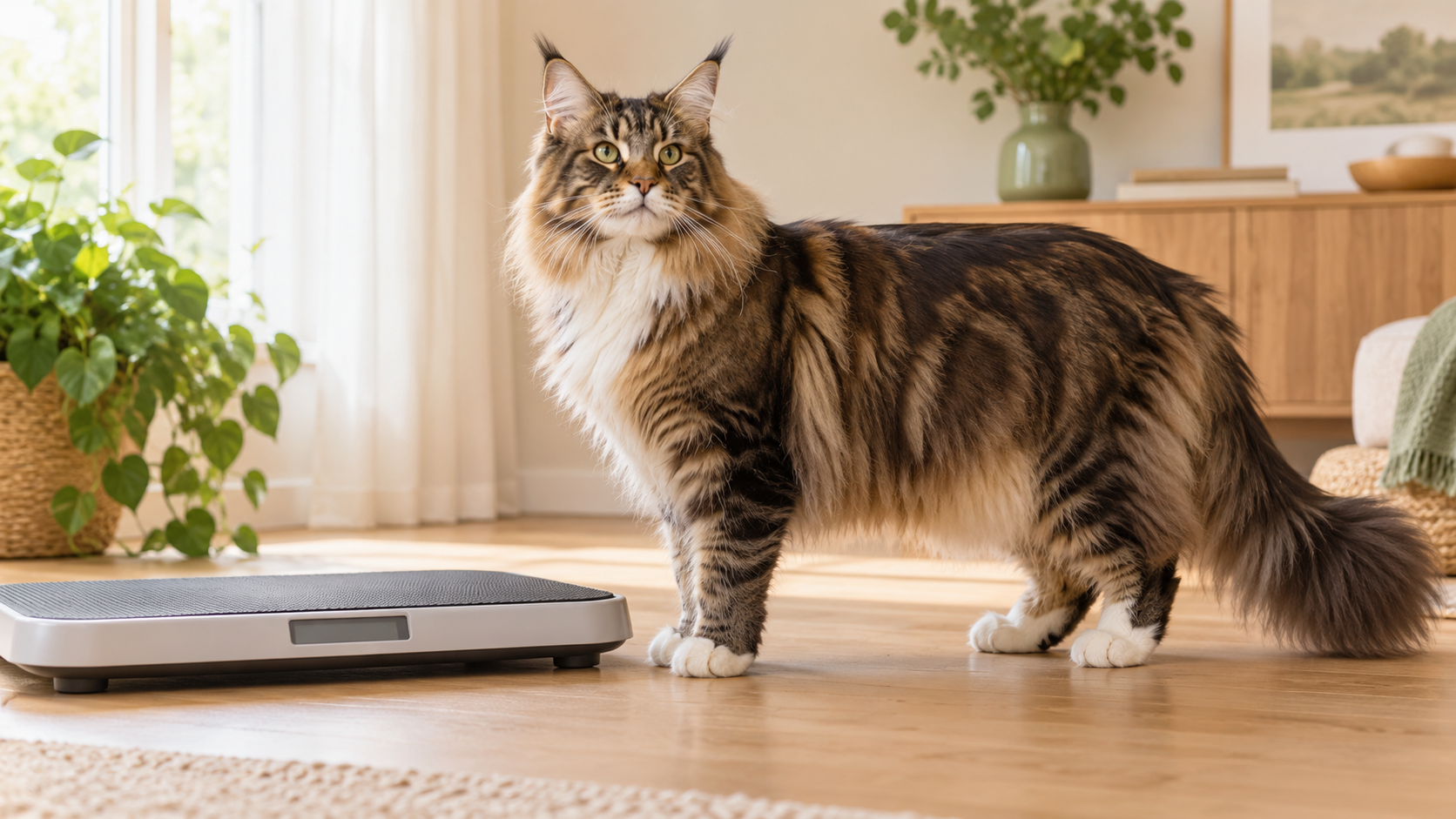
Maine Coon Body Condition Guide
A Maine Coon's size and thick coat can hide both weight loss and weight gain, so hands-on body condition checks matter even more than with a short-haired cat. Feel your cat rather than judging by eye, and remember that the loose belly flap (the primordial pouch) is normal anatomy, not fat.
Underweight
- Ribs, spine, hip bones easily seen
- No fat covering over ribs
- Severe waist tuck
- Muscle wasting along the back
- Dull coat, low energy
Ideal Weight
- Ribs felt with light pressure under the coat
- Thin fat covering over ribs
- Visible waist from above
- Slight belly tuck (pouch is normal)
- Firm, muscular, substantial build
Overweight
- Ribs hard to feel under fat
- No visible waist
- Belly hangs and sways (beyond the pouch)
- Fat deposits near base of tail
- Reluctant to jump or groom fully
Check whether your cat sits in a healthy range with our Cat BMI Calculator, or compare against other breeds in our average cat weight by breed guide.
Maine Coon Size in Context: The Largest Domestic Breed
The Maine Coon is widely recognized as the largest domestic cat breed, and the record holders for longest domestic cat have been Maine Coons. Their weight comes from a long, rectangular body, heavy bone, broad chest, and a dense, water-resistant double coat, not from being overweight. A healthy adult male can measure well over 3 feet from nose to tail tip and stand noticeably taller at the shoulder than an average cat.
Because they are so heavy-boned and thickly coated, a Maine Coon can look and feel dramatically bigger than the scale suggests. That thick coat is also why hands-on checks beat visual ones: a lot of apparent bulk is fur. When you assess weight, part the coat and feel the ribs and spine directly so the coat does not disguise either thinness or excess fat.
Seeing where the Maine Coon falls against other popular breeds puts a healthy weight in context and shows why a single ideal number does not fit every cat.
| Breed | Adult Male | Adult Female | Build |
|---|---|---|---|
| Maine Coon | 15–25 lbs | 10–15 lbs | Very large, heavy-boned, long |
| Ragdoll | 15–20 lbs | 10–15 lbs | Large, muscular |
| Domestic Shorthair | 10–15 lbs | 8–12 lbs | Medium, variable |
| Siamese | 8–12 lbs | 6–10 lbs | Long, lean, athletic |
A 14-pound Maine Coon female and a 14-pound Domestic Shorthair are in very different places on the healthy scale: for the Maine Coon that is a solid adult weight, while for many domestic shorthairs it would be overweight. This is why breed-specific charts matter more than a single ideal number for all cats. Explore more breeds in our Cat Weight Guides.
Keeping Your Maine Coon at a Healthy Weight
Because Maine Coons grow for years, their calorie needs shift with age more than most cats. Kittens and adolescents on a growth curve need generous, frequent meals of a large-breed or kitten formula, while adults need portion control to avoid the slow creep of weight gain that heavy-boned indoor cats are prone to. Weigh your cat on the same scale every few weeks and track the trend, since a gain or loss of a pound is easy to miss under all that coat.
Maine Coons carry breed-linked health risks, notably hypertrophic cardiomyopathy (HCM) and hip dysplasia, and carrying extra weight worsens the strain on the heart and joints. That makes a lean body condition especially valuable in this breed. Sudden weight loss, on the other hand, can be an early sign of illness and deserves a vet visit rather than a wait-and-see approach.
The ranges on this page are general guidance, not a diagnosis. Every Maine Coon has a different frame, and your vet can set the right target weight for your individual cat and confirm they are developing normally. For an amount tailored to your cat, run the numbers through our Cat Weight Calculator. If you want a tool built specifically for the breed, try the Maine Coon Weight Calculator, and for feeding amounts by age and weight see our Maine Coon feeding chart.
Frequently Asked Questions About Maine Coon Weight
Common questions about Maine Coon growth and healthy weight
How much should a Maine Coon weigh?
Adult male Maine Coons typically weigh 15–25 lbs (6.8–11.3 kg) and females weigh 10–15 lbs (4.5–6.8 kg). They are the largest domestic cat breed, so a healthy Maine Coon will genuinely outweigh most other cats. Judge weight by body condition (you should still feel the ribs under a heavy coat) rather than the number alone, and confirm the right target with your vet.
When do Maine Coons stop growing?
Maine Coons are famously slow to mature and keep filling out until 3–5 years of age, far longer than most breeds that finish around 12–18 months. They reach roughly adult length by 1–2 years, then continue adding muscle, bone, and coat until their final size. Do not expect a 1-year-old Maine Coon to be done growing.
How big do Maine Coons get?
Maine Coons are the largest domestic breed. Males commonly reach 15–25 lbs (6.8–11.3 kg) and can measure 3 feet or more from nose to tail tip, while females run 10–15 lbs (4.5–6.8 kg). Their size comes from a long, rectangular body, heavy bone, and dense coat rather than fat, so a big Maine Coon should still feel firm and muscular, not soft.
Is my Maine Coon overweight or just big?
Because Maine Coons are large and heavily coated, real weight gain is easy to miss. Feel for the ribs: you should be able to feel them under a thin fat layer without pressing hard. Look for a waist behind the ribs from above and a slight belly tuck from the side. A hanging belly, buried ribs, and no waist point to excess weight, not just a big frame. A primordial pouch (a loose flap of belly skin) is normal and is not fat.
How many calories does a Maine Coon need?
A healthy adult Maine Coon often needs around 250–360 calories per day, more than an average cat simply because they carry more body mass, with active and still-growing cats at the higher end. Kittens and adolescents on a growth curve need considerably more, spread across frequent meals. Use our Cat Calorie Calculator for an estimate tailored to your cat's weight, age, and activity, and adjust to body condition.
Check Your Cat's Weight & Health
Use our free calculators for personalized recommendations.
Free cat printables
Keep these cat care guides handy
A rotating selection of practical cat guides chosen from our free printable library.Cat Body Condition Chart
A printable body condition reference for cats.
Cat Feeding Guide
Portions by weight, age, and life stage.
Cat Quality of Life Checklist
Track the HHHHHMM quality-of-life measures.