Last updated: October 3, 2026
Dog Health
Dehydration in Dogs
Dehydration in dogs happens when your dog loses more fluid than it takes in, and it is usually a sign of another problem rather than an illness on its own. Here is how to spot it at home, from the skin tent test and dry, tacky gums to sunken eyes and lethargy, what causes it, what to do, and when it becomes an emergency.
This guide is general information, not veterinary advice. Every dog is different. If your dog is unwell or you are worried, contact your veterinarian, who can examine your dog and give advice for their specific situation.
Severe dehydration is an emergency. Get to a vet now.
Do not wait and watch at home if your dog shows any of these. Call the nearest emergency vet to say you are on the way, then go straight there:
- Collapse or extreme weakness, or an inability to stand
- Nonstop vomiting or diarrhea
- Refusing all water
- Very sunken eyes
- Gums that are dry, tacky, pale, or white
- Skin that stays "tented" when you lift it and does not fall back
- A puppy or senior dog going downhill fast, or any suspected heatstroke
Go to a vet now. Do not force water into your dog’s mouth, because it can be inhaled into the lungs and cause choking or aspiration.
How to Tell If Your Dog Is Dehydrated
Simple home checks, from the skin tent test to gums, eyes, and energy
Skin tent / elasticity test
Gently lift the skin between your dog’s shoulder blades and let it go. In a hydrated dog the skin snaps back into place in under 2 seconds. A slow return, or skin that stays tented, suggests dehydration. The test is less reliable in very thin, overweight, or old dogs, so treat it as one clue rather than proof.
Gums and capillary refill
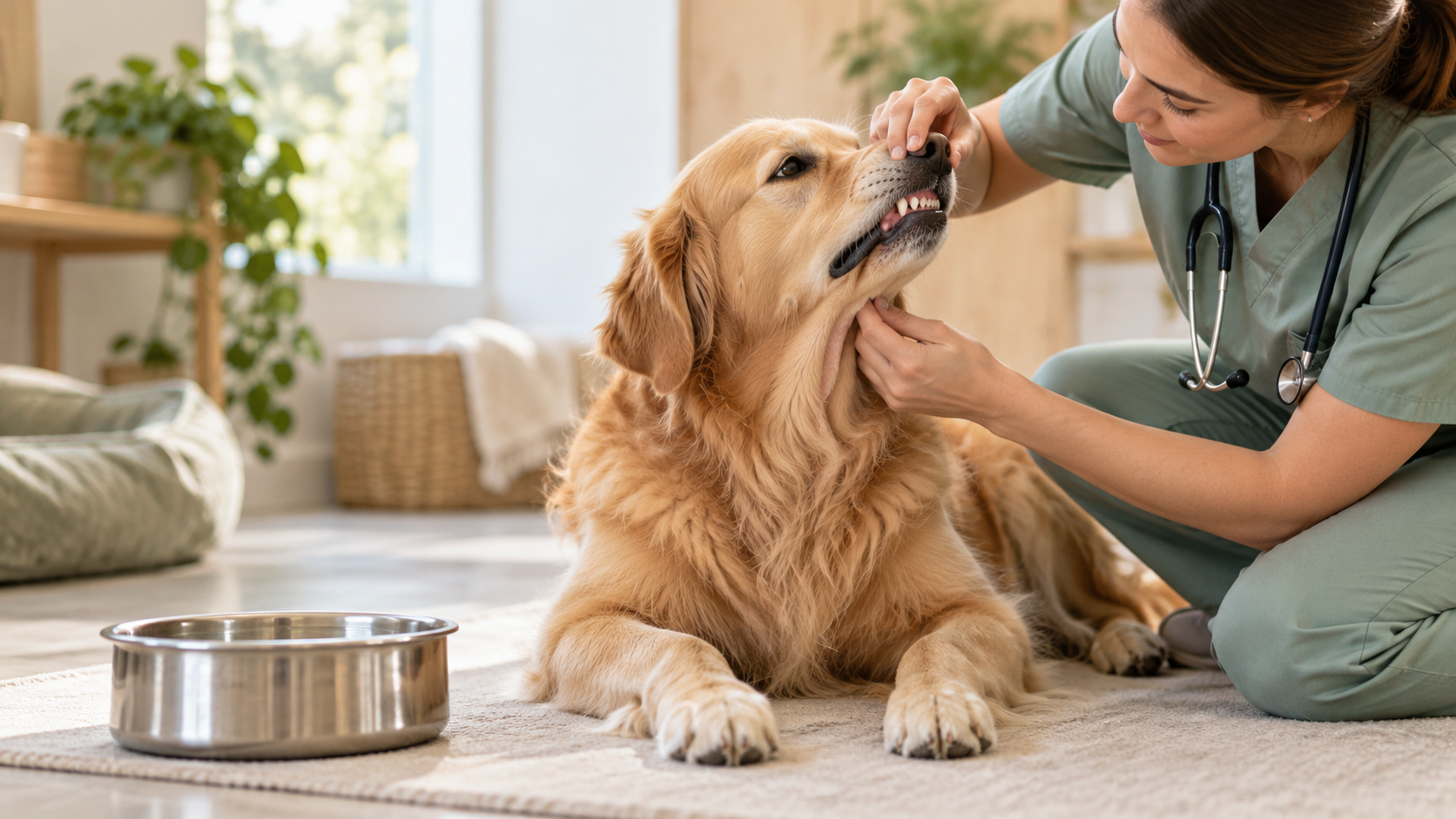
Healthy gums are moist and slick to the touch. Gums that feel dry or tacky are a warning sign. You can also press a fingertip on the gum until it blanches: in a hydrated dog the pink color returns in under 2 seconds, and a capillary refill time longer than that suggests dehydration or poor circulation.
Sunken eyes and low energy
As dehydration builds, the eyes can start to look sunken or dull, and your dog may become tired, weak, or reluctant to move. Lethargy is an important sign that the problem is more than mild and worth a call to your vet.
Appetite, panting, and behavior
A dehydrated dog often eats less, pants heavily, and seems dull or off. Reduced appetite and a flat, low mood frequently travel with the underlying cause, so note them alongside the other signs when you speak to your vet.
Dehydration by Severity
Use this as a starting point, not a diagnosis. When in doubt, call your vet.
| Severity | What you may see | What to do |
|---|---|---|
| Mild | Slightly tacky gums, mild thirst, and normal or near-normal energy. Your dog is still bright, alert, and interested in food. | Offer fresh water, monitor closely for the next few hours, and call your vet for advice if anything gets worse or does not improve. |
| Moderate | Dry gums, a slow skin snap-back on the tent test, lethargy, and eyes that start to look sunken or dull. | Contact your vet promptly. A dog at this stage often needs fluids given by the clinic and should not simply be watched at home. |
| Severe | Skin that stays tented when lifted, very dry or pale gums, collapse or extreme weakness, and rapid breathing. | This is an emergency. Go to a vet immediately for intravenous (IV) fluids. Do not wait for a routine appointment. |
What Causes Dehydration in Dogs
Dehydration is almost always a symptom of something else, so understanding the cause matters as much as spotting the signs. The most common triggers are:
- Vomiting and diarrhea. Fluid lost through repeated vomiting or loose stools adds up fast. If your dog is being sick, our guide to throwing up yellow may help, and a vet-approved bland diet for dogs is sometimes used while the gut settles.
- Heat and heatstroke. Hot weather, exercise, and poor access to water can tip a dog into dehydration quickly, and heatstroke is a life-threatening emergency in its own right.
- Fever and illness. Many infections and illnesses raise fluid needs and reduce drinking at the same time.
- Not drinking enough. Some dogs simply do not take in enough water, especially those fed only dry food or with limited access to a clean bowl.
- Underlying disease. Conditions such as kidney disease and diabetes increase fluid loss and can cause ongoing dehydration that needs veterinary management.
In puppies, dehydration can set in dangerously fast, and one serious cause is parvo in dogs, a viral illness that produces severe vomiting and diarrhea. An unvaccinated puppy that becomes lethargic and dehydrated should be seen urgently.
What to Do If Your Dog Is Dehydrated
For a mild case in a dog that is otherwise bright and alert, you can take a few sensible steps at home while keeping a close eye on how things go:
- Move to a cool place. Get your dog out of the heat and into a shaded, well-ventilated spot to reduce further fluid loss.
- Offer small amounts of fresh water often. Frequent small drinks are easier to keep down than one large bowl gulped at once.
- Never force water. Do not squirt water into your dog’s mouth with a syringe, because it can be inhaled and cause aspiration.
- Use electrolyte solutions only if advised. Plain water is usually best. Only give an electrolyte or rehydration product if your vet recommends it and tells you the amount.
If your dog does not perk up quickly, will not drink, or shows any moderate to severe signs, it needs a vet. At the clinic, a vet may give fluids under the skin (subcutaneous) or into a vein (IV) to rehydrate your dog safely and treat the underlying cause. Home care never replaces veterinary fluids once dehydration is more than mild.
Preventing Dehydration
Most everyday dehydration is easy to prevent with a little planning. Always keep fresh, clean water available, and put out multiple bowls around the home and yard so water is never far away. Take extra care in hot weather and after exercise, offering water breaks and shade, and never leave your dog in a warm car or without water on a hot day.
It also helps to know roughly how much your dog should be drinking so you can notice a sudden drop or spike, both of which are worth a vet visit. Our dog water intake calculator gives you a normal daily range to compare against, and you can browse all of our dog health guides for more on the symptoms that often come with dehydration.
Frequently Asked Questions About Dehydration in Dogs
Common questions about spotting, treating, and preventing dehydration
How can I tell if my dog is dehydrated?
The quickest home checks are the skin tent test and a look at the gums. Gently lift the skin between your dog’s shoulder blades and let go: in a hydrated dog it snaps back in under 2 seconds, while a slow return suggests dehydration. Healthy gums feel moist and slick, so gums that feel dry or tacky are another warning sign. Sunken or dull eyes, tiredness, reduced appetite, and heavy panting can also point to dehydration. These checks are a rough guide, not a diagnosis, so if you are worried, contact your vet, who can assess how dehydrated your dog really is.
How do I do the skin tent test on a dog?
Gently pinch and lift the loose skin between your dog’s shoulder blades, then release it. In a well-hydrated dog the skin springs back into place almost at once, usually in under 2 seconds. If the skin sinks back slowly or stays raised in a tent, that loss of elasticity suggests dehydration. The test is a useful quick check but it is less reliable in very thin, overweight, or older dogs, whose skin behaves differently, so use it alongside the gums, eyes, and energy level rather than on its own.
What can I give a dehydrated dog?
For a mild case in a dog that is otherwise bright and alert, offer small amounts of fresh, clean water frequently rather than letting it gulp a large bowl at once. Plain water is usually best. Do not force water into your dog’s mouth with a syringe, as it can be inhaled into the lungs. Only use electrolyte or rehydration solutions if your vet advises it, since the wrong product or amount can do more harm than good. Because dehydration is usually a symptom of an underlying problem, a dog that stays dehydrated, will not drink, or seems unwell needs a vet, and moderate to severe cases need veterinary fluids.
How long can a dog go without water?
As a general guide, dogs should not go without water for long, and a rough rule is that they can survive perhaps two to three days without any water, though they become unwell and dangerously dehydrated well before that point. A dog that has stopped drinking, or that is losing fluid through vomiting, diarrhea, or heat, can dehydrate much faster, and puppies and small or senior dogs go downhill sooner. Rather than counting hours, treat a dog that refuses water or is showing signs of dehydration as a reason to call your vet.
When is dehydration in a dog an emergency?
Treat dehydration as an emergency if your dog has collapsed or is very weak, has nonstop vomiting or diarrhea, is refusing all water, has very sunken eyes, or has gums that are dry, tacky, pale, or white. Skin that stays tented when you lift it points to significant fluid loss, and any puppy or senior dog going downhill fast, or any suspected heatstroke, needs urgent care. In these cases, go to a vet now rather than trying to manage it at home, and do not force water into the mouth because of the choking and aspiration risk.
Explore More Dog Health Guides
Understand your dog's symptoms and know when to call the vet.
Free dog printables
Keep these dog care guides handy
A rotating selection of practical dog guides chosen from our free printable library.Dog Budget Checklist
Plan monthly, annual, and one-time dog costs.
Dog Feeding Guide
Portion guidance by weight, age, and life stage.
Dog Body Condition Chart
A printable 1–9 body condition reference.