
Last updated: October 3, 2026
How To Use
Enter the date your doe was bred to estimate her kindling (due) date, the day to add the nest box, and what to expect at this stage of the pregnancy.
Quick Steps
- 1 Enter the breeding date (the day the doe was put with the buck).
- 2 Click Calculate to see the kindling date and nest-box day.
- 3 Add the nest box on day 28, the tool highlights the exact date.
Rabbit Gestation Calculator
Fill Out The Fields Below
How to Use the Rabbit Gestation Calculator
Because rabbit pregnancy is short and predictable, a single date gives you everything you need to plan. The calculator counts forward from the breeding date using the 31-day average, then shows both the kindling window and the exact day to put in the nest box.
- Enter the breeding date. Use the day the doe was taken to the buck. Rabbits are induced ovulators, so mating and conception happen on the same day, which makes the date very accurate.
- Calculate. You get the earliest (day 28), expected (day 31), and latest (day 33) kindling dates.
- Note the nest-box date. The tool highlights day 28, the day to add the nest box, and counts down the days until then.
How Long Are Rabbits Pregnant?
The rabbit gestation period is about 31 days, with a normal range of 28 to 33 days. That is roughly one month, one of the shortest gestations of any common pet. Most does kindle on day 31 or 32, almost always overnight or in the early morning.
Litter size has a small effect on timing: a doe carrying a large litter may kindle a day early, while a very small litter can run slightly late. Kits born before day 28 are usually too underdeveloped to survive, and a doe still pregnant on day 34 should be seen by a vet, as a retained or oversized single kit can cause problems.
Rabbit Gestation Chart
Here is the whole pregnancy at a glance, mapped from the breeding date to what is happening and what you should do.
| Day | Stage | What to do |
|---|---|---|
| Days 1–7 | Early gestation, implantation | Keep her calm and well fed. No belly handling. |
| Days 10–14 | Palpation window | Marble-sized embryos can be gently felt by an experienced keeper. |
| Days 15–27 | Rapid growth | Increase food, keep fresh water available, expect a bigger appetite. |
| Day 28 | Add the nest box | Put in a straw-filled nest box. The doe starts pulling fur. |
| Days 31–33 | Kindling | Birth happens, usually fast and overnight. Check kits quietly afterward. |
How to Tell If a Rabbit Is Pregnant
There is no home urine test for rabbits, so keepers rely on behaviour, weight, and gentle palpation. The pregnant-rabbit test most breeders use is careful abdominal palpation.
- Palpation (day 10–14): Support the doe and gently feel low in the belly for a row of marble-sized lumps. Done wrongly this can harm the litter, so learn from an experienced breeder or your vet first.
- Refusing the buck: A doe re-introduced to the buck a week after mating will often grunt, run, or refuse him if she is already pregnant.
- Weight gain and appetite: Steady weight gain and a bigger appetite appear through the second and third weeks.
- Nest-building and fur-pulling: From around day 28, she gathers bedding and pulls fur to line the nest, a strong late sign.
- Behaviour change: Some does become territorial, restless, or moody.
Remember that false pregnancy is common in rabbits and can trigger nest-building and fur-pulling without any kits, typically lasting about 16 to 18 days. If you are unsure, a rabbit-savvy vet can confirm by palpation or ultrasound.
Nest Box Timing and Setup
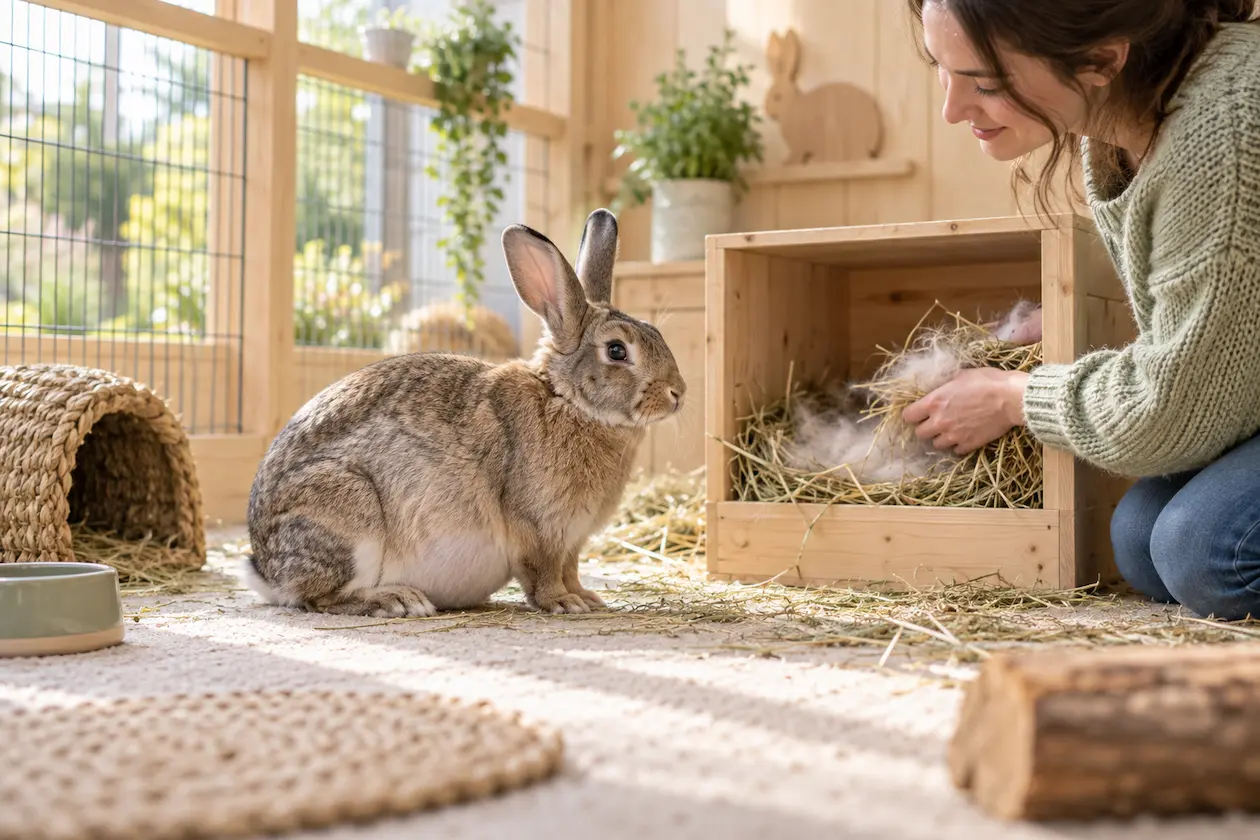
The nest box is the one piece of timing that really matters. Add it on day 28. A box roughly the length of the doe plus a few inches, with sides high enough to keep kits in but low enough for her to hop in, works well.
- Fill it with clean, dry straw or grass hay. Avoid sawdust and cedar shavings.
- Place it in the quietest corner of the hutch, away from the litter area.
- Expect the doe to rearrange the bedding and add a thick layer of her own fur.
- In cold weather, extra hay and a sheltered spot help newborn kits, which are born naked and blind, hold their body heat.
Does normally nurse only once or twice a day, often at dawn, so do not assume the kits are being neglected just because you never see her feeding them.
Litter Size and What to Expect
A typical litter is 4 to 12 kits, averaging around 6 to 8. Breed size is the biggest factor.
| Breed size | Typical litter |
|---|---|
| Dwarf and small breeds | 2–4 kits |
| Medium breeds | 5–8 kits |
| Large and giant breeds | 8–12+ kits |
Kits open their eyes around day 10, start nibbling solids by three weeks, and are usually weaned by six to eight weeks. To check that mum and the growing kits are a healthy weight, use our Rabbit Weight Calculator, and find all our tools on the Homestead Pets hub.
FAQs
Frequently Asked Questions
How long is the rabbit gestation period?
The rabbit gestation period is about 31 days, with a normal range of 28 to 33 days. Most does kindle on day 31 or 32. Litters born before day 28 rarely survive, and if a doe passes day 34 without kindling you should contact a rabbit-savvy vet.
How long are rabbits pregnant?
Rabbits are pregnant for roughly one month, 31 days on average. It is one of the shortest gestations of any common pet, which is why rabbits can produce several litters a year and why they are famous for breeding quickly.
How can I tell if my rabbit is pregnant?
The most reliable home method is gentle palpation from about day 10 to 14, when marble-sized embryos can be felt low in the abdomen. Other signs include a doe who refuses the buck after mating, weight gain, increased appetite, nest-building and fur-pulling near day 28, and territorial or moody behaviour. A rabbit-savvy vet can confirm by palpation or ultrasound.
When should I put in the nest box?
Add the nest box on day 28, three to four days before the due date. Too early and the doe will soil it or use it as a litter tray; too late and kits may be born on the wire and chill. Fill it with clean straw or hay, and expect the doe to line it with fur she pulls from her chest and belly.
How many babies do rabbits have?
A typical litter is 4 to 12 kits, with an average around 6 to 8. Small breeds such as Netherland Dwarf tend to have smaller litters of 2 to 4, while large breeds like New Zealand and Flemish Giant commonly have 8 to 12 or more.
At what age can a rabbit get pregnant?
Small breeds can reach sexual maturity as early as 3.5 to 4 months, medium breeds around 4 to 6 months, and giant breeds 6 to 9 months. Vets generally advise waiting until a doe is closer to full maturity before her first litter to reduce the risk of complications.
Can a rabbit get pregnant right after giving birth?
Yes. A doe can be fertile within hours of kindling, so an intact buck and doe left together will breed again immediately, a pattern that quickly leads to back-to-back litters. Separate them unless you are deliberately, and responsibly, planning another litter.
Do rabbits have any pregnancy warning signs before labour?
In the last day or two you may see intense nest-building, heavy fur-pulling, restlessness, and a drop in appetite. Kindling itself is usually fast, often 15 to 30 minutes, and typically happens in the early morning. Leave the doe in peace and check the kits quietly a few hours later.
More Homestead Pet Calculators
Chicken Coop Size Calculator
Plan indoor space, a laying-hen run, nest boxes and roost length, then check usable measurements in an existing coop.
Plan coop fit →Goat Gestation Calculator
Turn a breeding date into a kidding due date, with a breed toggle for Nigerian Dwarf and standard goats plus a stage-by-stage guide.
Calculate kidding date →Goat Weight Calculator
Estimate your goat's weight from a tape measure, no scale needed, and compare it to typical adult weights by breed.
Estimate goat weight →Rabbit Weight Calculator
Check your rabbit against healthy weight ranges for 15+ breeds, from Netherland Dwarf to Flemish Giant.
Check rabbit weight →Pig Gestation Calculator
Turn a breeding date into a farrowing due date, the classic 3 months, 3 weeks, 3 days, for pet and smallholder pigs alike.
Calculate farrowing date →Mini Pig Weight Guide
How big do mini and potbelly pigs really get? Project adult weight from age and see past the teacup myth.
Estimate adult size →Horse Feed Calculator
Work out how much hay and grain to feed your horse a day by body weight, using the 1.5 to 2.5 percent forage rule, with per-feeding amounts and bales per month.
Calculate horse feed →Bird Egg Incubation Calculator
Turn your egg-set date into hatch, lockdown, and candling dates for chickens, ducks, geese, quail, and more.
Calculate hatch date →